
As an Amazon Associate we earn from qualifying purchases at no extra cost to you.



Top 3 picks at a glance
The Short Answer
For portable video editing, a 15.6-inch screen is the sweet spot for most editors. It gives you enough resolution and physical size to read waveforms, color scopes, and a usable timeline without becoming a burden in your bag. If you prioritize absolute portability above all else, a 13.3- to 14-inch display still works fine for trimming and light color work, especially at 1080p or higher. If your editing sessions happen mostly at a desk and you want a genuine two-screen setup on the road, pair your laptop with a 15.6-inch portable monitor — most weigh 1.5 to 1.8 pounds and slip into the same sleeve as your machine.
Here’s the practical breakdown:
– **12.5–13.3 inches:** Trim, cut, and review footage on the go. Timelines get cramped.
– **14 inches:** Best balance of weight and workspace for solo travel editing.
– **15.6 inches:** The sweet spot. Full HD editing with room for timeline, preview, and panels.
– **16–17.3 inches:** Near-desktop experience, but expect 4 to 6 pounds and a tighter fit in backpacks.
Standard Sizes
Screen size is measured diagonally, corner to corner, in inches. Two screens with the same diagonal can have different widths and heights depending on aspect ratio, so always check the listed dimensions before buying — especially if you plan to use a sleeve, stand, or laptop extender that clamps onto your machine.
| Screen Size | Approx. Width | Approx. Height | Diagonal (cm) | Typical Weight | Best For |
|---|---|---|---|---|---|
| 13.3″ | 11.6″ (29.4 cm) | 7.5″ (19 cm) | 33.8 cm | 1.2–1.5 lb (0.5–0.7 kg) | Ultra-light travel editing |
| 14″ | 12.2″ (31 cm) | 7.7″ (19.5 cm) | 35.6 cm | 1.3–1.6 lb (0.6–0.73 kg) | Balanced travel + timeline work |
| 15.6″ | 13.6″ (34.5 cm) | 8.5″ (21.6 cm) | 39.6 cm | 1.5–1.8 lb (0.7–0.8 kg) | Full portable editing setup |
| 16″ | 13.9″ (35.3 cm) | 8.7″ (22.1 cm) | 40.6 cm | 1.8–2.2 lb (0.8–1 kg) | Color work, larger previews |
| 17.3″ | 15.1″ (38.3 cm) | 9.4″ (24 cm) | 43.9 cm | 2.2–2.9 lb (1–1.3 kg) | Desk-first editors who travel occasionally |
Note that laptop weights in the table assume the display alone or a typical thin-and-light panel; full laptops at these sizes generally run 2.8 to 5.5 pounds. Portable monitors in the 15.6-inch class — like the ASUS ZenScreen MB16ACE or the InnoView 15.6-inch FHD — are the ones you’ll actually carry alongside your editing laptop.
How to Measure Your Space
Whether you’re checking whether a portable monitor fits your desk, backpack, or laptop extender setup, follow these steps:
- Measure diagonally for size class. Screen sizes are listed as diagonal measurements. On a 16:9 display, multiply the diagonal by 0.87 to get the width and by 0.49 to get the height. A 15.6-inch panel, for example, is roughly 13.6 inches wide and 8.5 inches tall.
- Check your laptop’s hinge and lid clearance. If you’re considering a clip-on screen extender, most models fit laptops from 12 to 17.3 inches, but verify the thickness limit — many extenders need a lid between 0.2 and 0.6 inches thick and a flat top edge.
- Measure your bag’s laptop compartment. Add the monitor’s depth to your laptop’s depth. A 15.6-inch portable monitor is typically 0.1 to 0.3 inches thick, so a compartment that fits a 15.6-inch laptop with less than a quarter inch of spare room won’t work.
- Account for the stand or smart case. Magnetic folio covers and kickstands add roughly 0.1 to 0.3 inches of thickness and an ounce or two of weight. Factor this into sleeve sizing.
- Confirm your desk depth. If you’ll run a laptop-plus-monitor side-by-side rig, you’ll want at least 30 inches of horizontal workspace for two 15.6-inch panels. Anything less and you’ll be stacking vertically on a stand.
- Check your power and video outputs. Most portable editing monitors draw 5 to 10 watts over a single USB-C cable. Confirm your laptop’s USB-C port supports DisplayPort Alt Mode, or plan to use the included mini-HDMI input with a separate power source.
By Room or Use Case
The Traveling Documentary or Event Editor
You’re cutting footage in hotel rooms, airports, and cafés. Go with a 14-inch editing laptop paired with a 15.6-inch portable monitor as your preview screen. Total added weight is around 1.5 to 1.8 pounds, and the pair fits a standard 16-inch laptop backpack. Budget $50 to $180 for a quality 1080p IPS portable monitor — entry options like the InnoView sit around $50, while models with better color accuracy and three-year warranties run closer to $180. If your laptop’s processor runs hot during export, choose a monitor powered by a single USB-C cable (5–10W) rather than one needing a separate wall adapter.
The Colorist or Commercial Editor Working Remote
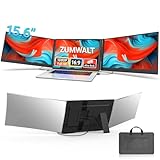
You need bigger panels for scopes and accurate color evaluation. A 15.6- to 16-inch laptop with a high-color-gamut display is your base, and a second 15.6-inch 1080p monitor at $90 to $190 gives you a dedicated fullscreen preview. Keep expectations realistic: a $50–$180 portable panel won’t match a calibrated reference monitor, so use it for composition and timing, then finalize color on a calibrated display. A tri-screen laptop extender ($90–$190) can add two 14- to 15.6-inch panels at once, but verify your laptop has two free USB-C/USB-A ports and supports the extra 10–20W combined power draw.
The Dorm, Studio, or Small-Apartment Editor
Desk space is the constraint here. A 15.6-inch portable monitor on an adjustable arm or fold-out stand takes just 9 inches of depth and frees your desk compared to a 24-inch desktop monitor (which typically needs 18–20 inches plus a stand footprint). Spend $50–$100 on a basic 15.6-inch FHD IPS panel if you edit casually, or $150–$190 if you want an anti-glare coating and a protective smart case for storage under your bed or on a shelf.
The Content Creator on a Budget
You’re editing YouTube videos on a 13- to 14-inch laptop and the timeline feels suffocating. Rather than replacing the laptop, add a 15.6-inch portable monitor for $50–$90. You’ll get 60% more screen area than a 13.3-inch display for less than the cost of a laptop upgrade. Make sure your laptop has USB-C with video output or an HDMI port; nearly every portable monitor in this price range includes both cables or supports plug-and-play over USB-C on Windows, Mac, and Android devices.
Common Sizing Mistakes
- Buying 17.3 inches “just in case.” A 17.3-inch laptop or extender panel can weigh 4 to 6 pounds total and won’t fit most 15.6-inch sleeves. If you fly weekly, you’ll feel every ounce.
- Ignoring resolution-to-size ratio. A 17.3-inch panel at 1080p has a lower pixel density (about 127 PPI) than a 13.3-inch at the same resolution (166 PPI). Text and interface elements look softer on larger low-resolution panels — a real issue when you’re reading scopes and small timeline labels.
- Assuming all 15.6-inch monitors are the same depth. Folio cases, built-in stands, and extender mechanisms vary from 0.1 to 0.5 inches thick. If your sleeve has zero clearance, measure the total stack.
- Overlooking weight of accessories. Cables, hubs, and smart cases add 4 to 10 ounces combined. Your “1.6-pound monitor” is closer to 2 pounds packed.
- Forgetting power draw with extenders. Dual- and tri-screen extenders can pull 10 to 20 watts from your laptop. On battery, expect noticeably shorter runtime — budget for a 65W–100W USB-C power bank if you edit untethered.
- Buying a monitor bigger than your laptop screen for clip-on extenders. Extenders are designed for 13- to 17-inch laptops; mounting a panel far wider than your lid creates balance and stability problems on a narrow desk.
FAQ
Is a 13-inch laptop screen too small for video editing?
It’s workable but cramped. At 13.3 inches, you’ll spend more time hiding and showing panels, and long timelines require frequent zooming. It’s fine for cutting, reviewing, and social-media shorts; it’s frustrating for multicam or color-heavy work. Adding a 15.6-inch portable monitor ($50–$90) solves most of the pain without replacing the laptop.
Is 15.6 inches enough for professional video editing?
Yes, for most professional work — especially if the panel is 1080p or higher and covers decent color gamut. Pairing a 15.6-inch laptop with a second 15.6-inch portable monitor gives you a two-screen workflow for 1.5 to 1.8 pounds of extra carry weight. Final color grading should still happen on a calibrated display.
Do I need 4K on a portable editing monitor?
Not usually. At 15.6 inches, 1080p provides about 141 PPI, which looks sharp at typical viewing distances, and it’s easier on your laptop’s GPU during long sessions. A 4K portable monitor at this size costs noticeably more and draws more power. Choose 4K only if you need pixel-accurate 4K previews or share the screen for client review.
Will a portable monitor drain my laptop battery?
A single 15.6-inch 1080p monitor draws roughly 5 to 10 watts over USB-C, which is modest — expect maybe 10–20% shorter runtime depending on your laptop’s battery. Tri-screen extenders drawing 10 to 20 watts will cut runtime far more. If you edit away from outlets, carry a USB-C power bank rated 65W or higher.
What should I buy first: a bigger laptop or a portable monitor?
For almost everyone, the portable monitor first. A capable 15.6-inch FHD IPS second screen costs $50 to $190, weighs under 2 pounds, and instantly expands your workspace on any laptop from 12 to 17.3 inches. Upgrading your editing laptop costs 5 to 20 times more and only makes sense when your processor or RAM is the bottleneck — not your screen size.
Related guides
- Alienware 16 Aurora RTX 5070 Review: Display, Portability and Configuration Gaps
- Lenovo Legion Pro 7i Gen 10 Review: 64GB RAM and Dual-SSD Configuration
- MSI Katana 15.6-inch RTX 5050 Review: Configuration Strengths and Upgrade Unknowns
- ASUS ROG Strix SCAR 16 G635LX-XS97 Review: Display Ambition, Upgrade Questions


