
Shopping for a cooling solution for a thin gaming laptop is not the same as shopping for a standard 17-inch desktop replacement. Thin gaming laptops, usually 0.65 to 0.85 inches thick and built with shared heat pipes and compact vapor chambers, have less internal airflow by design. The most common mistakes buyers make are assuming any large cooling pad will help, chasing the highest fan count without checking actual airflow direction, and ignoring how a cooler affects your desk height, keyboard angle, and noise level. A poorly matched cooler can block your laptop’s bottom intakes, add uncomfortable wrist strain, or simply push air against a solid panel where there are no vents.
This guide focuses on how to choose a thin gaming laptop cooling system that actually works with your machine’s design, not against it. As of 2026, most thin gaming models from 14 to 16 inches rely heavily on bottom intake vents and side or rear exhaust, which changes what kind of external cooling makes sense.
As an Amazon Associate we earn from qualifying purchases at no extra cost to you.
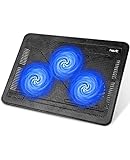


Top 3 picks at a glance
Decide These 3 Things First
Before you compare specs, narrow your options with three decisions. They will filter out most coolers that look impressive but will not help your specific laptop.
1. Where are your vents? Flip your laptop over and check. If you see large mesh intakes on the bottom panel, a pad with upward airflow can help. If the bottom is mostly solid with only narrow side or rear intakes, a flat pad with fans in the center will do little. Lifted stands that increase clearance often work better for that design. Take a photo of your vent layout to compare against fan placement.
2. Where will you use it? A desk setup can handle a 15 to 19-inch cooler that weighs 2 to 3.5 pounds and stays in one place. If you move between rooms, classes, or a couch, you need something under 2 pounds and less than 15 inches wide that fits in a backpack alongside a 14 or 15.6-inch laptop.
3. What bothers you most? Rank noise, surface temperature, and ergonomics. If you game with headphones, a 25 to 35 dB cooler at full speed is fine. If you record or take calls, you will want a model that stays under 24 dB at mid speed. If your keyboard deck gets hot, look for coolers that improve circulation across the entire bottom panel rather than just one hot spot.
Size and Compatibility
Do not buy by laptop screen size alone. A cooler labeled for 17-inch laptops can be 16.5 inches wide and 11.5 inches deep, which will overhang a small desk and push your screen too far back. Measure instead.
For 14-inch thin gaming laptops (typically 12.3 x 8.8 inches), choose a cooler surface of at least 13.5 x 9.5 inches so the rubber stops and bumpers actually contact the chassis and prevent sliding. For 15.6-inch models (about 14.1 x 9.5 inches), look for a pad between 14.5 and 16 inches wide. For 16 to 17.3-inch models, you need 16 to 17.5 inches of width and 11 to 12 inches of depth.
Also check height and lip design. Thin laptops often have front edges as low as 0.6 inches. A cooler with a raised front lip over 0.75 inches will block ports or make typing awkward. Low-profile lips of 0.3 to 0.5 inches and non-slip pads are better for low front edges.
Material and Surface Design
Material affects both airflow and how heat transfers away from the chassis. Most pads use a combination of plastic frame, metal mesh, and rubber.
Metal mesh, usually aluminum, does not actively cool on its own, but it transfers heat more evenly and resists sagging under a 4 to 5.5-pound laptop. It also allows air to pass through with less restriction than solid plastic with drilled holes. Plastic frames are lighter, often 1.4 to 2.2 pounds versus 2.5 to 3.8 pounds for metal-heavy builds, and cost less, but they can flex and trap heat if the perforated area is under 60 percent of the surface.
Look for a flat, open mesh where your laptop’s intakes sit. Avoid pads with a solid plastic center medallion or large logo plate directly under the fan zone. That plate blocks the exact spot where you need unobstructed airflow.
Construction and Fan Layout
Fan count alone tells you very little. What matters is fan size, placement, and how air is directed.
Common configurations include 1 to 2 large fans (140 to 200mm at 800 to 1200 RPM) or 4 to 9 smaller fans (70 to 120mm at 1200 to 2100 RPM). Large fans typically move more air per decibel and create a broad, even column. Small-fan arrays can target multiple zones but often overlap and create turbulence without more total cubic feet per minute (CFM).
Check total CFM and that fans align with your intakes. Budget pads often list 60 to 75 CFM total, mid-range pads 70 to 95 CFM, and premium smart pads 80 to 110 CFM with adaptive speed control. More important than the peak number is whether the fans are positioned over your laptop’s actual vent openings. A pad with five fans where only two line up with vents is less effective than a two-fan pad that lines up perfectly.
Construction details to note: fan power draw of 0.2 to 0.6 amps per fan, USB passthrough that does not steal a port you need, and mesh dust filters you can remove and rinse. Baffles or foam seals that direct air upward help on thin laptops with recessed bottoms.
Comfort and Performance
A good cooling system should improve both thermals and everyday use. For thin gaming laptops, the realistic benefit is steadier intake air and a cooler bottom panel, which helps the internal fans work less hard rather than dramatically lowering CPU or GPU temperatures.
For comfort, focus on adjustable height and noise. Look for 4 to 8 height settings that give you 0.8 to 2.5 inches of rear lift. Even a 1 to 1.5-inch lift increases clearance under the chassis from about 0.2 inches to over an inch, which helps bottom intakes breathe. Angle matters too: a 15 to 25-degree incline reduces wrist extension compared to a steep 35-degree angle.
Noise is measured in decibels at about 20 inches. Under 23 dB is whisper-quiet, 24 to 28 dB is a low hum suitable for shared spaces, and 30 dB and above is clearly audible. Many pads advertise quiet operation at 20 to 24 dB on low, but rise to 28 to 34 dB on high. Variable speed knobs or PWM control let you find a middle setting that balances airflow and noise without running at maximum all the time.
Price Tiers
Prices cluster into three clear tiers. Use them to set expectations for build and features.
Budget, $20 to $35: Plastic frame, metal mesh top, 1 to 5 fans, basic on/off or single dial speed control, 1 to 2 height settings, often powered by a single USB-A cable at 5V. Examples in this bracket include simple 15.6 to 17-inch pads around $27.99 to $34.98. They add useful lift and baseline airflow, typically 60 to 75 CFM total.
Mid-range, $35 to $75: Sturdier frames, 4 to 6 height settings, 5 to 9 fans or 2 larger fans, dual USB ports for passthrough, adjustable speed for different fan zones, and often RGB lighting controls. Weight is usually 1.8 to 3 pounds.
Premium, $90 to $150: Adaptive or smart control that adjusts fan speed based on temperature sensors, larger high-quality fans, better bearings that keep noise at 21 to 26 dB, aluminum construction, and 12 to 24-month warranties. Models around $125.99 typically fall here. They are worth considering if you want automatic adjustment and lower noise during light use.
Warranty and Support
Thin gaming laptops run hot, so your cooler will run for long sessions. Warranty length is a practical indicator of expected fan life.
Budget pads generally carry a 30-day return window and a 12-month limited warranty. Mid-range options often extend to 12 to 18 months. Premium pads frequently offer 18 to 24 months. Check what is covered: fan motor failure is usually covered, but mesh dents and rubber foot wear often are not.
Fan lifespan is often rated at 20,000 to 40,000 hours, which translates to about 2.3 to 4.5 years of 8-hour daily use. Replaceable fans or a seller that stocks spare fan modules is a plus. Keep your receipt and note the support contact before you discard the box.
Delivery and Assembly
Most cooling pads ship ready to use with no assembly beyond unfolding stands or attaching a small baffle. Carton sizes run about 16 x 12 x 2.5 inches to 22 x 15 x 3 inches and weigh 2 to 5 pounds packed, so standard ground shipping applies.
Check the power method. Nearly all pads draw power from a USB-A connection at 5V and 0.3 to 1.2 watts total per fan, with total draw of 2 to 5 watts. Some include a second USB port for passthrough so you do not lose a laptop port. If your thin gaming laptop only has USB-C, you will need a USB-C to USB-A adapter or a hub.
For setup, allow 2 to 3 inches of clearance behind the cooler for rear exhaust, especially if your laptop vents out the back. Avoid placing the pad on soft surfaces like beds or blankets, which block bottom intake even with a cooler underneath.
Spec Checklist
Use this table to compare what you actually get at each tier. Focus on measurements that affect fit, noise, and airflow rather than marketing claims.
| Spec | Budget | Mid | Premium |
|---|---|---|---|
| Surface size | 14.5 to 16 in wide, fits 15.6 to 17 in laptops | 15 to 17 in wide, fits 14 to 17.3 in laptops | 15 to 19 in wide, often adjustable fan positions |
| Weight | 1.4 to 2.2 lbs | 1.8 to 3.0 lbs | 2.5 to 3.8 lbs, often aluminum |
| Fans and speed | 1 to 5 fans, 1200 to 1800 RPM | 5 to 9 fans or 2 x 140mm, 800 to 2100 RPM | Adaptive control, 700 to 1500 RPM large fans |
| Airflow and noise | 60 to 75 CFM, 24 to 34 dB on high | 70 to 95 CFM, 22 to 30 dB on high | 80 to 110 CFM, 21 to 26 dB managed |
| Height adjustment | 1 to 2 levels, 0.8 to 1.4 in lift | 4 to 6 levels, 1.0 to 2.0 in lift | 6 to 8 levels, 1.0 to 2.5 in lift |
| Power and ports | Single USB-A, no passthrough | Dual USB-A with passthrough | Dual USB, PWM or sensor control |
| Price range | $20 to $35 | $35 to $75 | $90 to $150 |
| Warranty | 12 months | 12 to 18 months | 18 to 24 months |
Red Flags
Watch for these issues when reading listings. They often signal a poor match for thin gaming laptops.
1. No perforation map or vent layout photo. If the listing does not show the exact mesh open area or where fans sit relative to common intake zones, you cannot verify alignment.
2. Excessive fan count with low total CFM. Nine small fans that total 55 CFM are less useful than two large fans at 75 CFM. Count does not equal coverage.
3. No noise rating or speed control. A fixed high-speed pad that is loud at 32 dB with no dial will be annoying during browsing or work. Look for stated dB range and adjustable speed.
4. Tall fixed angle with no low setting. Thin laptops need a modest lift. A steep, non-adjustable incline above 30 degrees strains wrists and can cause the laptop to slide if the lip is shallow.
5. Blocked center or decorative plates. A solid plastic badge in the center blocks airflow where many thin laptops have their main intakes.
6. USB power without passthrough on a port-limited laptop. If you only have two USB-A ports and the pad uses one without offering another, you lose connectivity for a mouse or headset.
FAQ
Do thin gaming laptops even need an external cooling system?
They can benefit, but the benefit is indirect. Internal vapor chambers and heat pipes do the heavy lifting for CPU and GPU temperatures. An external pad or stand helps by feeding cooler, unrestricted air to bottom intakes and by cooling the chassis surface. The most noticeable improvement is often lower bottom-panel temperature, less fan ramping at idle to moderate loads, and more consistent performance during long sessions, rather than a large drop in peak core temperatures.
Should I choose a cooling pad or just a simple laptop stand?
If your laptop has large bottom intakes, a mesh pad with fans aligned to those intakes adds value over a passive stand, especially in a warm room above 75 degrees Fahrenheit. If your bottom panel is mostly solid or you are sensitive to noise, a sturdy aluminum stand that lifts the rear by 1.5 to 2 inches gives you most of the airflow benefit with zero noise and less weight, usually 0.7 to 1.5 pounds. Many users start with a stand and add a fan pad later if surface heat remains an issue.
How loud will a cooling pad be in a quiet room?
At low to mid speed, most well-built pads stay between 22 and 28 dB at desk distance, which is similar to a quiet whisper or a low fan. On high, many budget models reach 30 to 34 dB, which is audible over quiet game audio. Premium models with larger fans and adaptive control manage this by keeping speeds at 800 to 1100 RPM during light tasks, typically 21 to 24 dB, and only speeding up when needed.
What maintenance does a laptop cooling system need?
Dust buildup on mesh and fan blades reduces airflow quickly. Clean the mesh with compressed air or a soft brush every 2 to 4 weeks if you use the pad daily. Wipe rubber feet so the laptop does not slide. Check USB cables for fraying where they bend at the hinge. If a fan develops a rattle or grinding sound, stop using that fan zone if possible, as a failing bearing can vibrate and add noise without moving much air. Replacement is usually more cost effective than repair for pads under $40.


