The best freezer refrigerator energy star choice is usually a top-freezer model for the lowest electricity use, a bottom-freezer model for easier daily access, or a French-door model when family capacity and refrigerator space matter more than minimum kWh.
As an Amazon Associate we earn from qualifying purchases at no extra cost to you.


Our Top Picks
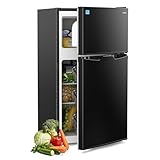
 Upstreman 3.1 Cu.Ft Mini Fridge with Freezer3.1 Cu.Ft20.47 x 17.9 x 33.46 inches48.5 poundsCheck on Amazon
 Midea 3.1 Cu.ft Mini Fridge with Freezer3.1 cubic feet18.5 x 19.37 x 32.95 inches52.24 PoundsCheck on Amazon

Top 3 picks at a glance
Quick comparison: which efficient layout fits you?
| Household and kitchen situation | Best layout | Useful capacity target | Typical annual energy target | Main trade-off |
|---|---|---|---|---|
| One or two people with limited space | Top-freezer | 14–18 cu. ft. | About 350–500 kWh/year | Freezer is at eye level; fresh food is lower |
| Two to four people wanting convenient refrigerator access | Bottom-freezer | 18–22 cu. ft. | About 450–600 kWh/year | More efficient than many large French-door designs, but less wide storage |
| Four or more people, frequent fresh-food shopping | French-door | 22–28 cu. ft. | About 550–750 kWh/year | High capacity and wide shelves, but more doors and features can increase consumption |
| Large frozen-food inventory | French-door with lower freezer or separate freezer | 24–30 cu. ft. refrigerator/freezer | Check the exact EnergyGuide label | Maximum capacity usually costs more to run and buy |
These are practical selection targets rather than guarantees. The yellow EnergyGuide label on the exact model is the deciding source because ice makers, external dispensers, convertible compartments, lighting, and control systems can change annual consumption.
Top efficient refrigerator-freezer picks
Best overall for a family: ENERGY STAR French-door refrigerator
A certified French-door refrigerator in the 22–27 cu. ft. range is the strongest all-around choice for a family that needs broad refrigerator shelves, multiple crisper drawers, and a freezer large enough for routine frozen-food storage. Models such as the LG LRFVS3006S represent this large-capacity class, while the GE Profile PVD28BYNFS represents a feature-rich French-door alternative.
Choose this layout when at least three people use the refrigerator every day or when you regularly store wide dishes, sheet pans, meal-prep containers, and large produce items. Look for an annual-use figure near the lower end of the model’s size category, ideally without paying for features you will not use.
The energy compromise is physical size. A 28–30 cu. ft. refrigerator has more insulated volume to cool than a 20–22 cu. ft. unit. Through-the-door ice and water dispensers can also add hardware, openings, and heat-producing components. If efficiency matters more than convenience, choose an internal water dispenser or an ice maker without an external door cutout.
Best for low energy use and value: ENERGY STAR top-freezer refrigerator
A top-freezer refrigerator is often the best freezer refrigerator energy star option when electricity cost, purchase price, and simplicity come first. The freezer compartment sits in the coldest part of the cabinet, and the design usually has fewer powered features and less complicated door hardware.
Choose a 16–18 cu. ft. model for one or two people, or approximately 18–21 cu. ft. for a small family. A top-freezer is also a good fit for a narrow kitchen because its doors generally need less open floor area than French-door models. The disadvantage is ergonomic: the refrigerator section is lower, so frequently used food may require more bending.
For the lowest running cost, prioritize a certified top-freezer with no external dispenser, a manual or simple automatic ice maker, and an EnergyGuide estimate below comparable models. Do not assume a smaller exterior guarantees low consumption; poor insulation, an old compressor design, or a poorly fitting door seal can erase the advantage.
Best for everyday access: ENERGY STAR bottom-freezer refrigerator
A bottom-freezer refrigerator places fresh food at a comfortable standing height while keeping frozen food in a drawer below. This is a useful middle ground for households that open the refrigerator much more often than the freezer.
Models such as the LG LRDCS2603S illustrate the bottom-freezer format, with a capacity suitable for a larger household than a compact top-freezer. This layout can make sense when you want a single wide refrigerator compartment but do not need the dual-door organization of a French-door model.
Compare the freezer design carefully. A pull-out drawer with wire or plastic baskets is easy to load but can waste vertical space. A two-drawer freezer costs more and may organize food better, yet extra hardware does not automatically improve efficiency. Measure the fully opened drawer, not just the closed cabinet, before buying.
Best for flexible storage: certified four-door or convertible refrigerator
A four-door refrigerator can be useful when one compartment changes between refrigerator and freezer temperatures. Samsung Bespoke four-door models are examples of this category. The value is flexibility: you can create more refrigerator space before a holiday or more freezer space after bulk shopping.
This is not automatically the most efficient choice. A convertible compartment can reduce wasted capacity only if you use it intelligently. Extra control electronics, multiple evaporators, and frequent temperature changes may raise energy use compared with a simpler refrigerator of similar size. Choose this layout for changing storage needs, not merely because it has more doors.
Capacity: calculate what you actually need
A common mistake is buying the largest cabinet available and then paying to cool empty air. Start with about 4–6 cu. ft. of total refrigerator/freezer capacity per person, then adjust for shopping habits. A household that buys fresh food several times a week may need less capacity than a smaller household that shops monthly.
- One or two people: approximately 14–18 cu. ft.
- Three people: approximately 18–22 cu. ft.
- Four people: approximately 22–26 cu. ft.
- Five or more people: approximately 25–30 cu. ft., or a main refrigerator plus a separate freezer.
Allow for usable capacity rather than advertised capacity. Ice bins, fixed shelves, door bins, water filters, and freezer baskets occupy space. A heavily divided 25 cu. ft. refrigerator may hold less practical food than a simpler 23 cu. ft. model.
Annual kWh and operating-cost calculation
Annual kWh is more useful than a vague claim that one refrigerator is “efficient.” To estimate the electricity cost, multiply the EnergyGuide annual kWh by your utility rate:
Annual cost = annual kWh × electricity price per kWh
For example, suppose a 20 cu. ft. certified bottom-freezer uses 520 kWh per year and electricity costs around $0 per kWh:
520 × around $0 = around $93 per year
A larger French-door model using 680 kWh would cost:
680 × around $0 = around $120 per year
The difference is around $28 annually, or about $144 over five years before rate changes. That may be a reasonable price for the larger layout, but it shows why a more expensive ENERGY STAR label alone does not make a large refrigerator cheaper to operate. Compare the actual kWh figures, not just the certification.
Kitchen-fit checks that affect efficiency
- Measure the opening: record width, height, depth, and the path through doorways and hallways.
- Allow ventilation clearance: follow the manufacturer’s required top, side, and rear gaps. A refrigerator squeezed tightly into cabinetry may release heat poorly.
- Check door swing: French-door models still need clearance for drawers, and a bottom-freezer needs space for the drawer to extend.
- Confirm electrical access: use a properly grounded outlet rather than an extension cord or overloaded power strip.
- Compare counter-depth carefully: it projects less into the room but commonly sacrifices interior capacity and may cost more per cubic foot.
Features worth paying for—and features to question
Adjustable shelves, full-width lighting, strong door seals, and clearly arranged freezer baskets can improve real-world usability without requiring excessive power. A dual-compressor or dual-evaporator design may provide better temperature control, but compare its labeled kWh rather than assuming the technology saves energy.
Question external ice and water dispensers, rapid-freeze modes, transparent illuminated doors, Wi-Fi controls, and oversized ice makers. These features are not necessarily inefficient, but they add complexity and can increase purchase price, repair exposure, or energy use. If you rarely use a feature, a simpler certified model is usually the better value.
How to choose in five steps
- Measure the kitchen opening and delivery path.
- Estimate capacity from household size and shopping frequency.
- Choose the layout based on what you access most: refrigerator, freezer, or flexible storage.
- Compare annual kWh among models with similar capacity.
- Check the EnergyGuide label, required clearances, warranty terms, and ice-maker configuration before ordering.
For most shoppers, the best answer is a certified top-freezer when minimum energy use is the priority, a certified bottom-freezer around 18–22 cu. ft. for convenient everyday access, or a carefully selected French-door refrigerator when family capacity justifies its higher annual kWh. The winning model is the one that fits your kitchen and food habits without paying to cool capacity you will not use.
Frequently asked questions
Does an ENERGY STAR label mean every refrigerator of the same layout uses the same amount of electricity?
No, annual energy use can vary between models with the same layout. The article says ice makers, external dispensers, convertible compartments, lighting, and control systems can affect consumption. Compare the annual kWh on each model’s yellow EnergyGuide label rather than relying on the certification alone.
Can a refrigerator that is too large for my household cost more to operate?
Yes, a larger cabinet has more volume to cool and may use more electricity. The article recommends starting with about 4–6 cu. ft. per person and adjusting for shopping habits. It also notes that a main refrigerator plus a separate freezer may suit households with a large frozen-food inventory.
How can I tell whether a refrigerator’s capacity will be useful in practice?
Look beyond the advertised capacity and consider how the interior is arranged. Ice bins, fixed shelves, door bins, water filters, and freezer baskets take up room. The article notes that a heavily divided 25 cu. ft. model may hold less practical food than a simpler 23 cu. ft. model.
What should I measure before choosing a refrigerator?
Measure the opening’s width, height, and depth, as well as the route through doorways and hallways. Check the manufacturer’s ventilation-clearance requirements and allow room for doors, drawers, or a freezer drawer to open. The article also recommends confirming electrical access and comparing counter-depth models’ capacity.
Are convertible compartments always more energy-efficient?
No, a convertible compartment does not automatically make a refrigerator more efficient. It can reduce wasted capacity if you use it to match changing storage needs, but extra control electronics, multiple evaporators, and frequent temperature changes may raise energy use. Compare the exact model’s labeled annual kWh with simpler refrigerators of similar size.