The best infrared patio heaters for outdoor comfort are chosen by heated area, mounting height, available electrical service, weather exposure, and control needs—not by wattage alone.
Our Top Picks
 DR. INFRARED HEATER 1500W Portable Infrared Indoor and39 Inches25 x 11.5 x 39 inches10.7 PoundsCheck on Amazon
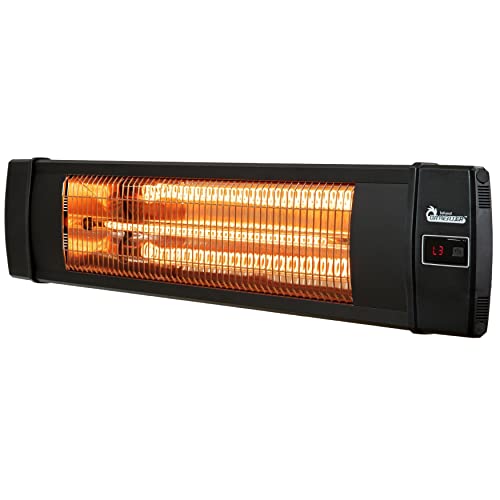 DR. INFRARED HEATER Portable Infrared Indoor and Outdoor35 Inches35 x 8 x 4 inches8 poundsCheck on Amazon


Top 3 picks at a glance
Quick picks by patio size and installation
| Patio situation | Recommended heater class | Typical power | Approximate effective coverage | Best mounting approach |
|---|---|---|---|---|
| Small balcony or 6 × 8 ft seating area | Compact short-wave or medium-wave electric heater | 1,500–2,400 W | 40–70 sq. ft. | Wall or ceiling mount, 6–8 ft above the floor |
| 8 × 10 ft dining patio | Single 2,400–3,000 W electric heater | 2,400–3,000 W | 70–100 sq. ft. | Centered ceiling mount or wall mount aimed across the seating |
| 10 × 12 ft conversation area | One large heater or two smaller heaters | 3,000–6,000 W total | 100–150 sq. ft. | Two ceiling units for even coverage |
| Large, exposed 15 × 20 ft patio | Multiple commercial-grade electric units | 6,000–12,000 W total | 200–300 sq. ft., depending on wind | Several ceiling or wall-mounted zones |
These figures describe a comfort zone rather than a sealed-room temperature rating. Infrared heaters warm people and nearby surfaces directly, so wind, mounting height, clothing, and furniture layout can change the result substantially.
As an Amazon Associate we earn from qualifying purchases at no extra cost to you.


How infrared patio heating works
Infrared elements radiate energy toward people, floors, walls, and furniture instead of trying to heat the entire outdoor air volume. This is why an infrared heater can feel useful in an open patio where a fan heater would mostly warm moving air.
Short-wave infrared produces intense, directional heat and responds almost immediately. It is useful for exposed patios, higher mounting positions, and situations where you want heat to reach people through some moving air. Medium-wave and long-wave designs usually produce a softer, broader sensation and less visible glow, making them attractive for covered dining and lounge areas.
Short-wave units are not automatically better. They can create hot spots if aimed too directly, and their performance depends heavily on line of sight. A broad medium-wave heater may feel more comfortable when several people are seated at different angles.
Choose coverage before choosing wattage
Start by drawing the seating area, not the entire patio. Mark chairs, tables, outdoor kitchens, and the direction of prevailing wind. The heater should radiate toward occupied seats with as few obstructions as possible.
- Small, sheltered areas: use roughly 1,500–2,400 W.
- Average covered patios: plan on approximately 2,400–3,000 W for a concentrated seating zone.
- Large or windy patios: use multiple heaters rather than one very powerful unit. Separate zones reduce cold edges and let you heat only occupied areas.
- High ceilings: increase power or use a heater specifically rated for the mounting height. A unit mounted several feet too high can feel weak even when its electrical rating looks adequate.
A practical target is about 25–35 W per square foot for a sheltered patio and 35–50 W per square foot for a breezy or open location. This is a planning estimate, not a substitute for the manufacturer’s clearance and coverage guidance.
Worked electrical calculation
Suppose an 8 × 10 ft covered patio needs one 3,000 W heater. On a 240-volt circuit, the operating current is:
3,000 W ÷ 240 V = 12.5 A
For a continuous load, electrical planning commonly uses 80% of a circuit’s breaker rating. A 20-amp, 240-volt circuit provides a practical continuous-load limit of about 16 amps, so one 3,000 W heater fits. Two identical heaters would draw 25 amps and require a different circuit arrangement; they should not simply be connected to the same 20-amp circuit.
On 120 volts, the same heater would draw 25 amps, which is beyond a standard 15-amp or 20-amp household circuit. This is why larger patio heaters frequently use 240 volts and may need hardwiring by a qualified electrician.
Mounting options: ceiling, wall, or portable
Ceiling mounting
Ceiling mounting gives the most even coverage when seats are arranged below the heater. It keeps the unit out of the way and can distribute heat over a table or lounge area. Check the minimum and maximum mounting height carefully: too low creates uncomfortable hot spots and clearance problems, while too high reduces intensity.
Wall mounting
Wall mounting is practical under a covered roof or against a solid exterior wall. Aim the heater across the seating rather than directly down at one chair. A swivel bracket is valuable because you can adjust the angle seasonally or redirect heat after rearranging furniture.
Freestanding mounting
Portable pedestal units are useful when seating moves frequently or permanent wiring is unavailable. They are easier to reposition but occupy floor space, can be vulnerable to tipping, and may deliver less consistent coverage in wind. Use the supplied weighted base and never operate one where it can be knocked into furniture, curtains, or vegetation.
Power requirements and running cost
Electric infrared heaters are nearly silent and have no combustion emissions at the point of use, but they can consume substantial power. The operating-cost formula is:
Cost = heater kilowatts × hours used × electricity rate
For example, a 3,000 W heater equals 3 kW. Running it for four hours at around $0 per kWh costs:
3 × 4 × around $0 = around $2
If a thermostat or two-stage control runs the element only half the time after the patio reaches comfort, the average cost could be closer to around $1 for that session. Real savings depend on wind and outdoor temperature; infrared heaters do not retain warmth after they switch off in the way an enclosed room does.
For frequent use, compare a 120-volt compact heater with a 240-volt larger model by total wattage, not voltage. A 240-volt heater is not inherently more efficient, but it allows more heating power with lower current, which can simplify wiring for larger installations.
Weather resistance: what to look for
Outdoor suitability is more than a claim that a heater is “weatherproof.” Look for an explicit IP rating, installation instructions for covered or uncovered locations, corrosion-resistant materials, and a control system rated for outdoor use.
- IP24 or similar protection: generally indicates protection against splashing water, but it does not mean the heater can be exposed to every storm or pressure-washed.
- Higher splash and rain protection: preferable for uncovered installations, provided the manufacturer permits that placement.
- Marine or coastal locations: prioritize stainless steel or finishes specified for salt-air exposure. Salt can corrode brackets, fasteners, and electrical connections even when the heating element still works.
- Covered patios: still need ventilation, drainage, and protection from wind-driven rain. A roof does not eliminate all moisture risk.
Do not cover or store a heater while it is hot. Keep combustible ceilings, fabrics, plants, and plastic furniture outside the specified clearance zones. Installation manuals take priority over generic sizing advice.
Controls and zoning
The simplest heaters use a pull cord or local switch. These are inexpensive and reliable, but inconvenient when the unit is mounted high. Better installations use a wall switch, remote control, timer, dimmer-compatible controller, or smart relay approved for the heater’s load.
Variable power is particularly useful outdoors. A 3,000 W heater at full output may be ideal on a cold, windy evening but excessive during mild weather. Two 1,500 W zones can be more flexible than one 3,000 W unit: turn on the zone nearest occupied seats, then add the second only when needed.
Do not assume a standard household smart plug can control a high-wattage heater. Check its resistive-load rating, voltage, outdoor certification, and compatibility with the heater’s switching method. Hardwired equipment and high-current controllers should be installed by a qualified professional.
Decision matrix for common patio layouts
| Your situation | Most suitable choice | Why | What to avoid |
|---|---|---|---|
| Covered dining table, little wind | Medium-wave 2,400–3,000 W ceiling unit | Broad, comfortable coverage with discreet installation | One narrowly aimed heater at an extreme angle |
| Open balcony with two chairs | 1,500–2,400 W directional wall unit | Directs heat toward occupants without heating unused space | Large high-output unit that overloads the circuit |
| Windy outdoor lounge | Two shorter-range units aimed at the seating zone | Reduces cold spots and allows separate control | One unit mounted too high in the center |
| Rental home or changing furniture | Portable pedestal heater | No permanent mounting and easy repositioning | Unsecured units near children, pets, or walkways |
| Coastal or rainy location | Outdoor-rated heater with documented corrosion protection | Better resistance to moisture and salt exposure | Indoor-rated equipment or an unspecified “weatherproof” claim |
Real product families worth comparing
For premium architectural installations, Bromic’s Platinum Smart-Heat and Tungsten Smart-Heat electric ranges are established options with different appearance and heat-distribution priorities. Infratech’s W Series and Slimline electric heaters are also commonly specified for built-in, wall, and ceiling installations. Heatstrip electric ranges are another established category for low-profile covered-patio installations.
Compare these products by wattage, element type, minimum mounting height, required circuit, IP rating, included brackets, and controller compatibility. Product families often contain several sizes, so the series name alone does not identify the right heater for your patio.
Frequently asked questions
How far above the floor should an infrared patio heater be mounted?
Mount a heater according to its manufacturer-specified minimum and maximum height, with about 6–8 ft above the floor suggested for a small balcony or 6 × 8 ft seating area. Mounting too low can create hot spots and clearance problems, while mounting too high reduces heat intensity. Always prioritize the installation manual over general sizing guidance.
Is short-wave infrared always the best choice for an outdoor patio?
No, short-wave infrared is not always the best choice for an outdoor patio. It responds almost immediately and can work well in exposed or breezy areas, but it may create hot spots when aimed directly. Medium-wave or long-wave heaters can provide a softer, broader sensation and may feel more comfortable when several people sit at different angles.
Can two patio heaters share one 20-amp, 240-volt circuit?
Two 3,000 W patio heaters should not share one 20-amp, 240-volt circuit because together they draw 25 amps. A single 3,000 W heater draws 12.5 A at 240 volts, fitting within the approximately 16-amp continuous-load limit of that circuit. Multiple heaters require an appropriate circuit arrangement, planned and installed by a qualified electrician.
Can I use a regular smart plug with an electric infrared heater?
Do not assume a regular household smart plug can control an electric infrared heater safely. Check the plug’s resistive-load rating, voltage, outdoor certification, and compatibility with the heater’s switching method. High-wattage equipment and high-current controllers should be installed by a qualified professional, particularly when the heater is hardwired or operates at 240 volts.
What should I do if patio furniture is rearranged after installation?
Redirect the heater toward the occupied seats after rearranging patio furniture, provided the new angle remains within the specified clearances. A wall-mounted unit with a swivel bracket makes seasonal or furniture-related adjustments easier. Keep the shortest practical line of sight between the heater and people, and avoid placing furniture, fabrics, plants, or plastic items inside clearance zones.
Bottom line
For a small sheltered seating area, choose a 1,500–2,400 W directional heater on a suitable circuit. For an average 8 × 10 ft patio, a 2,400–3,000 W ceiling or wall-mounted unit is a strong starting point. For larger or windy spaces, use multiple independently controlled heaters, confirm the electrical load before buying, and prioritize mounting height and weather rating over headline wattage. The best infrared patio heaters are the ones that place the right amount of radiant energy on occupied seats while remaining safe, serviceable, and affordable to operate.