The best portable electronic drums for most players in 2026 are compact 5-piece mesh kits like the Roland TD-07DMK and Yamaha DTX402K for balanced practice and gigging, tabletop all-in-one pads like the Yamaha DD-75 and Alesis CompactKit 7 for travel and ultra-small spaces, and multipad samplers like the Roland SPD-SX Pro for hybrid gigs where acoustic drums stay but electronics are added.
Portability is not just weight. The right choice depends on your footprint at home, packed size in a car, how fast you can set up on stage, whether you need battery power, and how you connect to headphones, PA, or a DAW. This guide breaks down those trade-offs with real numbers.
As an Amazon Associate we earn from qualifying purchases at no extra cost to you.


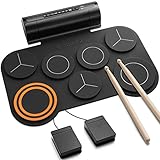
Our Top Picks
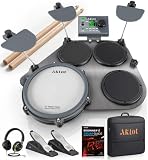
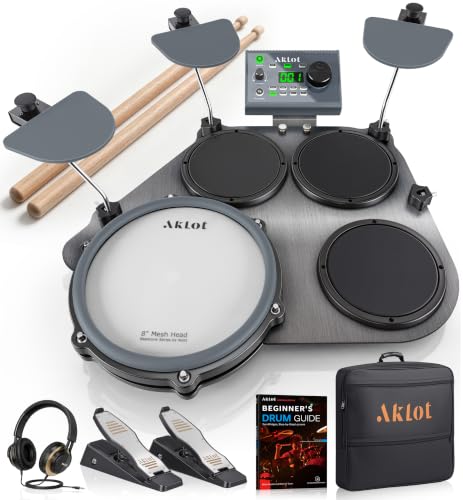 AKLOT Portable Electric Drum Set: Electronic Drum Pad18.1 x 18.7 x 7.6 inches13.8 PoundsCheck on Amazon


Top 3 picks at a glance
How to Choose: Portability Is 5 Different Specs
A kit that weighs 25 lbs but takes 25 minutes to assemble is not portable for a gig. Evaluate these five factors together:
- Footprint: Floor space when fully assembled and seated. Matters for apartments, dorms, and small stages.
- Packed Weight & Size: Whether it fits in a hatchback, closet, or needs to be broken down into multiple bags.
- Setup Time: How long from case to playing, including rack assembly and cabling.
- Power Options: AC adapter only vs. battery power for busking, rehearsals without outlets, or outdoor gigs.
- Connectivity: Headphone quality for silent practice, USB MIDI/audio for recording, and L/R or direct outputs for live sound.
Best Portable Electronic Drums Compared: Footprint, Weight and Setup Time
These are the most common portable classes in 2026 and what to expect in real-world use.
| Model / Class | Assembled Footprint (W x D) | Packed Weight | Typical Setup Time | Power | Best For |
|---|---|---|---|---|---|
| Roland TD-07DMK | 48″ x 32″ (122 x 81 cm) | ~38 lbs (17.2 kg) without stand/throne | 12-15 minutes | AC adapter only | Home practice + small club gigs |
| Yamaha DTX402K | 50″ x 30″ (127 x 76 cm) | ~32 lbs (14.5 kg) | 10-12 minutes | AC adapter only | Beginner practice, lessons, quiet apartments |
| Alesis Nitro Mesh Kit | 48″ x 30″ (122 x 76 cm) | ~35 lbs (15.9 kg) | 15-20 minutes | AC adapter only | Budget mesh-head practice kit |
| Roland SPD-SX Pro (multipad) | 14″ x 13″ (360 x 330 mm) pad only | ~7.7 lbs (3.5 kg) | 2-3 minutes | AC adapter | Hybrid gigs, adding samples to acoustic kit |
| Yamaha DD-75 / Alesis CompactKit 7 (tabletop) | 27″ x 14″ (69 x 35 cm) on table | ~9-11 lbs (4-5 kg) | 1-2 minutes | AC adapter or 6x AA batteries | Travel, ultra-small rooms, kids/secondary kit |
Full foldable kits like the Roland TD-02K or Yamaha DTX452K fall in a similar range to the TD-07DMK and DTX402K but add Bluetooth on the module, which cuts practice cable clutter. All-in-one tabletop kits cut footprint by more than 70% but sacrifice kick pedal and hi-hat realism.
Sound, Pad Feel and Why It Matters for Practice
Sound and feel determine whether your practice transfers to an acoustic kit or a stage.
1. Pad Material
- Mesh heads (Roland TD-07DMK, Alesis Nitro Mesh, Yamaha DTX402K snare): Tunable tension, more acoustic-like rebound, lower stick noise. Best if you practice rudiments, doubles, and ghost notes daily. They also respond better at low velocities.
- Rubber pads (tabletop kits, Yamaha DTX402 toms, entry-level Alesis): Durable and cheap but louder stick attack and less dynamic range. Fatigue is higher on long sessions.
- Multipad surfaces (SPD-SX Pro): Designed for sticks, hands, and click tracks, not full kit technique. Excellent velocity layers and sample playback but not a substitute for hi-hat and snare practice.
2. Module Sounds and Dynamics
Portable modules prioritize portability over massive sound libraries. The Roland TD-07 module offers around 25 preset kits with editable instruments and ambience, while the Yamaha DTX402 module offers 10 kits plus 10 training functions. For practice, the quantity of kits matters less than dynamic response. Look for 3-zone snare (head/rim/cross-stick) and dual-zone cymbals with choke. If you only get single-zone toms, rimshots and rim clicks will not translate when you move to an acoustic kit.
3. Headphone Practice Quality
For apartment practice, the headphone amp matters more than speaker output. Set your module’s master volume to 75-80% and control level with headphones to avoid digital clipping. If your module has a compressor or EQ on the master, leave them flat for practice. Boosting low end to make headphones feel punchier hides inconsistent kick dynamics.
Power Options and a Real Battery Runtime Calculation
Most compact rack kits require AC power. If you need true portability for street performance, rehearsals in a park, or gigs where you cannot rely on an outlet, you need either a tabletop kit that runs on AA batteries or a separate portable power station.
Worked Calculation: How Long Will a Kit Run on a Battery Station?
Modules and power supplies list power consumption in watts. You can estimate runtime with:
Runtime (hours) = Battery Capacity (Wh) x 0.85 / Kit Power Draw (W)
The 0.85 accounts for inverter and conversion losses.
- Roland TD-07DMK module + power supply: ~12W typical draw while playing
- Yamaha DTX402K module: ~10W typical draw
- Alesis Nitro Mesh module: ~9W typical draw
Example: A 256Wh portable power station (a common size usually $200–$350) powering a Roland TD-07DMK:
256Wh x 0.85 / 12W = 18.1 hours of continuous playing time. In practice, expect 14-16 hours after accounting for higher volumes, powering a small monitor, and age of the battery.
If you add a 30W wedge monitor at moderate volume (average draw ~15W), your total draw becomes ~27W. The same battery then lasts: 256 x 0.85 / 27 = 8 hours. This is still enough for a full rehearsal day or a 3-4 hour gig with soundcheck.
Tabletop kits on AA batteries are simpler: 6x AA alkaline (~15Wh total) on a Yamaha DD-75 at 6W draw lasts about 2.1 hours (15 x 0.85 / 6). Use rechargeable NiMH AA (around 2.5Wh per cell, 15Wh) for similar runtime at lower long-term cost, and carry a spare set.
Connectivity for Home Practice, Recording and Gigs
Portability is wasted if you cannot connect quickly where you play.
- Headphones / Aux In: All portable modules have a 1/4″ or 1/8″ headphone jack and an aux input for play-along tracks. Use a wired aux cable, not Bluetooth, for timing-critical practice to avoid 150-300ms Bluetooth latency.
- USB MIDI / USB Audio: The Roland TD-07DMK and Yamaha DTX402K both send MIDI over USB to trigger plugins like Superior Drummer or EZdrummer in a DAW. The TD-07DMK also sends stereo audio over USB, so you can record without an audio interface. The Alesis Nitro Mesh sends MIDI over USB but not audio.
- Audio Outputs: For live use, you need at least stereo L/R 1/4″ outputs to feed a PA or keyboard amp. The SPD-SX Pro adds balanced main outputs and separate headphone cue, which is critical if you run click to the drummer only. Entry tabletop kits often have only headphone and aux, meaning you need a DI box to play live.
- MIDI DIN / Bluetooth: Bluetooth MIDI (on Roland TD-02K, TD-07, and Yamaha DTX402) is useful for wireless play-along from a phone, but use it for music playback, not for triggering. For reliable triggering, stay wired.
Decision Matrix: Match Your Situation to the Right Class
Use this to avoid buying a kit that is portable on paper but wrong for how you play.
| Your Situation | Recommendation | Why |
|---|---|---|
| Apartment practice, need quiet, have 4×4 ft corner | Compact mesh kit: Roland TD-07DMK or Yamaha DTX402K | Mesh snare keeps stick noise low, full kick/hi-hat teaches proper technique, headphones only |
| Need to fit kit in a small car weekly for lessons/gigs | Yamaha DTX402K or Alesis Nitro Mesh | Lighter rack, fewer parts than mid-tier kits, 10-minute teardown |
| Travel, fly, or no space for stands | Tabletop: Yamaha DD-75 or Alesis CompactKit 7 | Under 11 lbs, runs on batteries, plays on a desk or snare stand |
| Drummer with acoustic kit who needs samples/click live | Roland SPD-SX Pro on a snare stand | 2-minute setup, no rack to build, integrates with acoustic hardware |
| Recording at home, want best sounds without micing | Roland TD-07DMK via USB audio/MIDI | USB audio interface built in, best editing depth in this size |
Setup Tips to Cut Footprint and Setup Time in Half
Most time is lost to rack assembly and cable routing. Do this once:
- Leave the rack horizontal bars pre-assembled and fold the legs inward instead of fully disassembling. Wrap the snake cable around the module and leave it plugged in. This saves 5-8 minutes per setup.
- Mark height and angle positions for snare, toms and cymbals with small strips of colored tape on the rack. You will recall your setup instantly on stage.
- For mesh heads, set tension finger-tight plus a quarter turn across all lugs. Too loose feels sluggish and triggers inconsistently; too tight raises acoustic volume and reduces sensitivity for ghost notes. Trigger threshold should be set so a 1-inch drop of the stick from the head registers, but resting the stick does not.
- Set hi-hat pedal sensitivity so closed and half-open are distinct. On Yamaha and Roland modules, calibrate the hi-hat closed position after every setup: press the pedal fully down, then hit calibrate in the module. This prevents the common problem where the hi-hat stays half-open after moving the kit.
- For gigs, carry a small power strip, a 10 ft stereo 1/4″ cable, and a 1/8″ to 1/4″ headphone adapter. Venue power and headphone jacks are unpredictable.
FAQ
Can I gig with a portable electronic kit instead of acoustic drums?
Yes for small venues, worship teams, and corporate events where volume must be controlled. Bring your own monitor or ask the venue for a stereo DI. Compact kits like the TD-07DMK are loud enough through a 200W PA, but have a plan for monitoring because you will not have acoustic stage volume to hear yourself.
Do I need a special amp for electronic drums?
Not for practice – headphones are better. For performance or jamming with a band, use a keyboard amp or PA speaker, not a guitar amp. Guitar amps color the sound and cannot reproduce kick low end cleanly at volume.
What is the quietest option for an apartment?
A mesh-head kit on a rug with a tennis-ball riser or drum isolation platform. Mesh is quieter than rubber by 8-12 dB at the pad, but the kick pedal thump through the floor is the main complaint. A platform decouples the kit from the floor far more than mesh alone.