Our Top Picks
 Lippert Radius 24" Double Manual RV Step Assembly24 Inch30.5 x 15 x 10 inches30.5 poundsCheck on Amazon

Top 3 picks at a glance
Best RV Steps: Stable, Easy-to-Store Picks
The best RV steps for most owners are a fold-down entry step such as the MORryde StepAbove or Lippert Solid Step when it fits the door frame; for a low doorway, a wide portable platform step is easier to store and often more practical.
Choosing between them is less about the number of steps than the distance from the campsite surface to the RV floor. A step that is strong enough on paper can still feel unsafe if its top tread is too high, its feet sit on a narrow footprint, or it cannot be stowed without blocking the door.
As an Amazon Associate we earn from qualifying purchases at no extra cost to you.


Quick comparison of the main RV step types
| Step type | Typical top-step height | Typical capacity | Approximate footprint | Storage requirement | Best use |
|---|---|---|---|---|---|
| Built-in two- or three-step entry | 16–24 in. to the RV floor | 300–500 lb | 20–28 in. wide by 10–16 in. deep | Folds inside the doorway or under the RV | Frequent travel and fast setup |
| Fold-down step, such as MORryde StepAbove or Lippert Solid Step | 20–36 in., depending on the model | 400–500 lb | 22–26 in. wide by 20–28 in. deep when deployed | Stores inside the door; verify clearance | Travel trailers and fifth wheels needing a rigid entry |
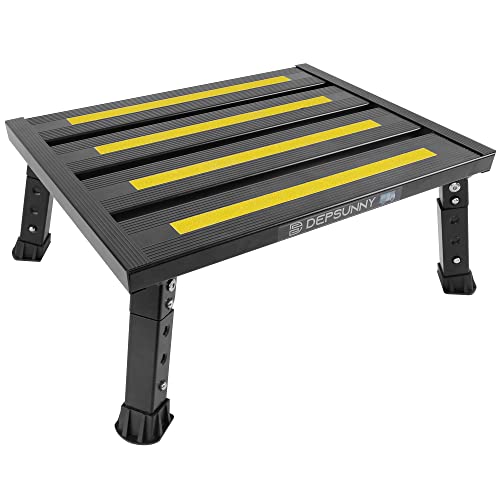
| Portable platform step | 7–10 in. per step | 250–500 lb | 20–24 in. wide by 14–20 in. deep | Outside storage compartment or vehicle cargo area | Low doorways, uneven sites, and flexible setups |
| Telescoping or folding aluminum step | 8–24 in., depending on configuration | 250–330 lb | Usually 20–24 in. wide | Compact; often fits in a narrow compartment | Owners prioritizing low weight and portability |
These are useful comparison ranges rather than a substitute for the specifications of a particular model. Door-mounted steps vary by frame size, and portable steps vary by height and leg design.
Best choices by RV situation
| Your situation | Most suitable choice | Why |
|---|---|---|
| Door sill is 18–24 inches above firm ground | Two-step fold-down or sturdy platform step | Provides manageable risers without a large deployed footprint |
| Door sill is 25–36 inches high | Three- or four-step fold-down system | Splits the climb into safer, more consistent steps |
| Doorway is narrow or interior storage is limited | Portable folding aluminum step | Avoids a large assembly stored across the entry |
| Ground is soft, sandy, or frequently uneven | Wide portable step with adjustable legs or large feet | Spreads the load and allows leveling at the campsite |
| Children, older adults, or pets use the entrance | Wide, deep treads with a handrail-compatible design | Provides more foot room and reduces the consequence of a missed step |
| Every pound matters for a small trailer | Aluminum folding or telescoping step | Usually lighter than steel or permanently mounted systems |
How to choose the correct step height
Measure from the ground where the steps will stand to the RV floor or door threshold, not to the bottom of the exterior door. Then divide that height into roughly equal risers. A comfortable target is about 7–9 inches per rise; taller risers can feel awkward, while very short risers require more tread space.
For example, suppose your threshold is 30 inches above the ground. A three-rise arrangement would average 10 inches per rise, which may feel steep. A four-rise arrangement averages 7.5 inches:
30 inches ÷ 4 rises = 7.5 inches per rise.
The exact geometry depends on whether the RV’s built-in threshold counts as the final step, but the calculation explains why a four-step unit can be more comfortable even when both options have the same advertised weight capacity.
Measure at the campsite as well as at home. A sloped campsite can increase the effective entry height, and leveling the trailer changes the distance between the doorway and the ground.
Fold-down steps: best for a permanent, rigid entry
MORryde StepAbove
The MORryde StepAbove is a popular choice for travel trailers and fifth wheels with compatible door frames. Its main advantage is rigidity: the steps typically brace against the ground rather than hanging entirely from the door threshold. Many versions use wide aluminum treads, adjustable legs, and a high stated load rating.
Choose it when you want a stable entry that deploys as one assembly and you have enough interior doorway clearance to store it folded. Check the number of steps, door width, threshold height, and whether the folded unit interferes with the screen door. A StepAbove model designed for a tall fifth-wheel entry is not automatically correct for a shorter travel trailer.
Lippert Solid Step
The Lippert Solid Step serves a similar role: a door-mounted folding staircase with broad treads and ground-supporting legs. It is appealing when the RV already uses compatible Lippert hardware or when replacement parts and brand-specific fit are important.
Its storage advantage is that the assembly folds into the doorway, but that is also the principal limitation. Measure the available interior space before buying. If the folded steps contact a cabinet, screen door, or opposing wall, a lighter portable unit may be the better solution.
Portable steps: best when storage and campsite flexibility matter
A portable platform step is often the most versatile option for a low or medium-height entrance. Aluminum versions are light and resist corrosion; steel versions tend to feel heavier and can tolerate rough handling, but they add more cargo weight. A wide top tread, rubber feet, and an open underside are useful features.
Portable steps are particularly effective when the ground is not level. Some models have independently adjustable legs, while basic platform steps do not. Without adjustment, do not compensate for an uneven site by placing loose boards or rocks under one corner. Use a manufacturer-approved leveling method, or reposition the step on firmer ground.
For a single-step platform, look for a top surface around 20 inches wide and at least 14 inches deep. A small 10-by-12-inch step may meet its load rating but leave little room for a boot, mobility aid, or a dog stepping beside you.
Materials, traction, and stability
- Aluminum: lightweight, corrosion-resistant, and convenient for frequent setup. It can transmit more vibration underfoot than a heavier steel frame.
- Steel: generally heavier and more resistant to flex, but inspect painted or powder-coated surfaces for rust, especially around joints and welds.
- Textured tread: useful in rain and mud, but deep patterns can collect grit and become slippery when packed with dirt.
- Rubber feet: improve grip on concrete, asphalt, and hard-packed soil. They are less effective when the entire foot sinks into soft sand.
- Adjustable legs: valuable on uneven campsites, provided each leg locks securely and cannot retract under load.
Do not select capacity by matching only the heaviest person using the step. Include clothing, luggage, groceries, and any force created when someone steps down quickly. A sensible margin is to choose a rated capacity at least 1.5 times the heaviest expected combined load. For a 220-pound person carrying a 30-pound box:
250 pounds × 1.5 = 375 pounds.
That points toward a step rated for at least 400 pounds, assuming the rating applies to the complete assembly and the surface is properly supported.
Storage and fit checks before buying
- Measure the door opening width at its narrowest point.
- Measure the distance from the threshold to the floor or ground when the RV is level.
- Record the available folded depth inside the doorway or storage compartment.
- Check whether a screen door closes with the steps installed.
- Compare the step’s packed weight with your cargo and tongue-weight limits.
- Confirm that the deployed legs do not contact slide-outs, stabilizers, awnings, or sewer equipment.
- Look for a complete weight rating, not just a rating for an individual tread or leg.
Which RV steps should you buy?
Choose a MORryde StepAbove or Lippert Solid Step when your RV has a compatible doorway, you want a rigid multi-step entry, and there is room to store the folded assembly inside. Choose a wide portable platform when your entrance is low, your campsite surfaces vary, or interior storage is tight. Choose a lightweight folding or telescoping aluminum step when portability is more important than maximum rigidity.
The most stable option is the one that matches your actual entry height, gives each foot a full tread, sits on a broad supported footprint, and can be stored without being left loose in the campsite. Verify those four points before comparing cosmetic features or brand names.
Frequently asked questions
Can RV steps be used safely on uneven ground?
Yes, but the step should have adjustable legs or large feet that can level and spread the load. Measure the entry at the campsite because sloped ground can increase the effective height. Do not use loose boards or rocks under one corner; reposition the step on firmer ground or use a manufacturer-approved leveling method.
Will fold-down RV steps fit behind the screen door?
They may, but fit must be verified for the specific RV and model. Measure the doorway, available interior storage depth, and clearance around the screen door. A folded MORryde StepAbove or Lippert Solid Step can contact a cabinet, screen door, or opposing wall, making a portable step the better choice.
How much weight capacity should an RV step have?
Choose a rated capacity at least 1.5 times the heaviest expected combined load, including clothing, luggage, groceries, and force from stepping down quickly. For example, a 220-pound person carrying a 30-pound box creates a 250-pound load; multiplying by 1.5 points to a step rated for at least 400 pounds.
Should I measure the RV door height at home or at the campsite?
Measure it in both places. Measure from the ground where the steps will stand to the RV floor or door threshold, rather than to the bottom of the exterior door. A sloped campsite can increase the effective entry height, and leveling the trailer can change the distance between the doorway and the ground.
What should I check before storing a portable RV step?
Check the step’s packed weight, folded or compact dimensions, and the space available in the storage compartment or vehicle cargo area. Also confirm that the deployed step will not contact slide-outs, stabilizers, awnings, or sewer equipment. Storage should not block the door, and the step should not be left loose in the campsite.