
Shopping for a laser cutting machine has never been more confusing or more dangerous when done carelessly. Diode-powered desktop engravers now span from under $90 to nearly $550, and manufacturers throw wattage numbers, milliwatt figures, and “equivalent” ratings at buyers with little standardization. The concrete problem you are solving is simple: you want a machine that cuts through the materials you actually work with, at a level of precision and reliability that justifies the price, without putting your eyes or your lungs at risk.
What separates a worthwhile purchase from a regrettable one comes down to beam consistency, enclosure and safety class, material versatility, and real-world cutting speed. A machine rated at 10W can still produce ragged cuts if the optics are cheap or the focus mechanism drifts. Conversely, a well-built unit with air assist and a rigid frame punches above its nominal power rating. Owner feedback across these eight models highlights recurring themes in exactly these areas, which is the lens we used to sort this roundup for 2026.
As an Amazon Associate we earn from qualifying purchases at no extra cost to you.

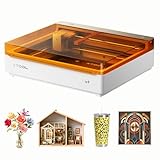


Top 3 picks at a glance
Quick Picks
| Product | Best for | Price |
|---|---|---|
| ACMER S2 | Raw cutting power on a budget | $218.68 |
| xTool M2 | Safe enclosed crafting for beginners | $548.99 |
| LONGER Ray5 | Speed and offline workflow | $219.99 |
| Twotrees TTS-55 Pro | Lowest-cost diode entry point | $125.88 |
| BlazeX M3 | Precision cutting with full safety | $339 |
| ACMER S1 | Wood and acrylic engraving for under $100 | $86.62 |
| CREALITY FALCON | Cylindrical objects and tumblers | $434.99 |
| Carverall K15 Pro | Class 1 safety with a near-A4 workspace | $199.99 |
How We Picked
We narrowed this list using four criteria drawn from published specs and recurring owner feedback. First, real cutting capability relative to price: a machine that claims high wattage but fails on thin plywood or acrylic is a spec-sheet fantasy. Second, safety design: Class 1 enclosures, integrated air assist, and eye-protection requirements matter more than most buyers expect before their first session. Third, material breadth: the best machines handle wood, acrylic, leather, and coated metal without constant re-tuning. Fourth, workflow friction: offline operation, touchscreen control, and software compatibility determine whether you actually finish projects or fight the machine.
The 8 Best Laser Cutting Machines in 2026
ACMER S2 Laser Engraver
The ACMER S2 earns its spot because 12000mW of optical output at $218.68 is a genuine value proposition for anyone whose primary need is cutting speed on wood and acrylic. Owners consistently praise how cleanly it slices through birch plywood and thin acrylic without multiple passes, which is rare at this price tier. The trade-off is an open-frame design with no enclosure, meaning you must supply your own eye protection and fume extraction. Build quality on the X/Y rails also receives mixed comments regarding long-term alignment. Skip this if you work indoors without a garage or workshop, or if children or pets share the room — the lack of a Class 1 housing makes it the wrong choice for a casual home setup.
xTool M2 10W Laser Engraver
The xTool M2 is the machine for people who want to walk away from their desk while it works. Its fully enclosed Class 1 housing, dual built-in cameras for placement and preview, and a workflow tuned toward wood, leather, felt, fabric, and paper make it the most beginner-friendly option here. Owner feedback highlights the software polish and the convenience of camera-assisted alignment that eliminates guesswork on small craft pieces. The clear downside is price: at $548.99 it costs more than twice some competitors, and its 10W beam is not suited for thick acrylic or metal cutting. Skip this if your projects involve structural cuts through plywood or acrylic, where you are paying a premium for safety features you do not strictly need.
LONGER Ray5 10W Laser Engraver
The Ray5 sits in the same price bracket as the ACMER S2 but differentiates itself through speed and workflow independence. A 0.06mm spot size and 10000mm/min maximum speed mean it moves quickly across large engraving jobs, and the built-in 3.5-inch touchscreen allows fully offline operation without a laptop tether. Owners report solid results on wood, acrylic, glass, and thin coated metal. The open-frame design demands the same safety precautions as other diode machines at this tier, and the included software, while functional, draws criticism for occasional import errors. Skip this if you want a plug-and-play experience with no assembly — the Ray5 expects a user comfortable with mechanical calibration.
Twotrees TTS-55 Pro Laser Engraver
At $125.88, the TTS-55 Pro is the cheapest way into a functional diode engraver with a 5500mW beam. For wood and acrylic at modest thicknesses, owners describe it as a capable starter that teaches you whether laser work is worth a larger investment. The frame is compact and the included focus tool is simple. The limitations are clear: at this power level, cutting anything beyond thin plywood requires patience and multiple passes, and the open frame offers zero containment of fumes or stray light. Skip this if your projects involve anything harder than 3mm basswood or if you need consistent one-pass cuts — you will outgrow it quickly.
BlazeX M3 10W Laser Engraver
The BlazeX M3 occupies a deliberate middle ground: Class 1 enclosed safety at $339, an 0.01mm precision claim that owners back up with fine-line engraving on metal and glass, and a bundled honeycomb bed plus enclosure. It is explicitly marketed as beginner-friendly, and the enclosed design means you can run it on a kitchen counter with confidence. The trade-off is workspace size, which feels tight on projects larger than a postcard, and the included software ecosystem is less polished than xTool’s. Skip this if you need a wide cutting area or plan to engrave tumblers and cylindrical objects, since the enclosure limits what you can fit inside.
ACMER S1 Laser Engraver Machine
The ACMER S1 is the absolute floor of this list at $86.62, and its 2500mW beam reflects that. It exists for one purpose: engraving names and patterns onto wood and thin acrylic for people who want to try laser work before committing more money. Owners on forums consistently describe it as “surprisingly functional” for its price, with decent edge quality on soft woods. The beam lacks the power to cut anything meaningful, so calling it a “cutter” in the product title stretches the definition. Skip this if your primary goal is cutting rather than surface engraving — you will be frustrated within an afternoon.
CREALITY FALCON 10W Laser Engraver
What sets the CREALITY FALCON apart at $434.99 is the included rotary roller and air assist system, which together make it the only machine here purpose-built for cylindrical objects like tumblers, bottles, and curved surfaces. The 10W beam with air assist produces noticeably cleaner cuts on wood and acrylic compared to enclosed units at similar power, because airflow suppresses flame spread. Owners praise the tumbler workflow but note the rotary setup adds a learning curve. The open frame again requires external safety measures. Skip this if you have no interest in cylindrical work — the bundled accessories inflate the price relative to what you would use.
Carverall K15 Pro Laser Engraver
The K15 Pro delivers 10000mW of output inside a Class 1 enclosed housing at $199.99, which is a genuinely aggressive value proposition. Its near-A4 workspace handles standard craft sheets without cropping, and owner feedback confirms it cuts coated metal, stone, acrylic, and wood without constant reconfiguration. Offline CNC operation via SD card means no computer dependency during a session. The enclosure, while safe, limits the physical height of materials you can place inside, and the software has fewer integrations than market leaders. Skip this if your projects regularly involve items taller than a couple of centimeters or if you require advanced vector import features.
Buying Guide
Power Ratings Are Not Interchangeable
A 10W diode laser and a 12000mW (also 12W) unit are the same thing, but “60W” or “72W” claims often refer to total system draw or peak electrical input, not optical output. When comparing machines across this list, focus on the optical power figure and the spot size. A smaller spot concentrates energy more effectively, so a 10W beam at 0.06mm can outperform a nominal 12W beam at a looser focus. Ignore any number that does not specify “optical” or “laser output.”
Enclosure and Air Assist Change What You Can Cut
Open-frame machines let you feed oversized sheets through the cutting area but expose you to concentrated light and unfiltered fumes. Enclosed Class 1 units protect users but cap the physical dimensions of your workpiece. Air assist, present on the CREALITY FALCON and absent on enclosed models, suppresses flame spread and produces cleaner edges on wood and acrylic at the cost of noise. Decide which constraint you can tolerate before comparing prices.
Software and Workflow Determine Daily Usability
Specifications look similar on paper, but the machine you actually use is the one whose software does not fight you. Look for offline operation via touchscreen or SD card if you dislike laptop tethering. Dual-camera placement systems reduce alignment time dramatically on repeat jobs. LightBurn compatibility, even if not listed in a product title, expands your design options well beyond proprietary software.
Our Verdict
The top pick is the Carverall K15 Pro, which combines Class 1 safety, a near-A4 workspace, and 10000mW of cutting power under $200 — the best ratio of protection to performance on this list. The budget pick is the Twotrees TTS-55 Pro at $125.88, a no-nonsense engraver that teaches you the craft before you spend real money. The xTool M2 wins outright if your priority is a fully enclosed, software-polished experience for soft materials and you will not need to cut anything structural.
FAQ
Can a diode laser cut metal?
Diode lasers cannot cut raw or solid metal. They can mark and engrave anodized aluminum, coated steel, and other pre-treated metals where the laser removes the surface layer. The machines on this list that advertise metal capability do so only in that engraving or coating-removal sense.
Do I need an enclosure for safety?
If you are uncertain, yes. Class 1 enclosures eliminate the risk of accidental eye exposure and contain fumes. Open-frame diode machines are legal to operate but demand dedicated eye protection, proper ventilation, and a controlled environment with no bystanders.
What is the difference between 10W and 12000mW?
They are the same power. 12000mW equals 12W, and a nominal 10W beam refers to optical output. Manufacturers use whichever unit sounds more impressive. Always convert to the same unit before comparing two machines.
Can these machines cut acrylic cleanly?
Cast acrylic in thicknesses up to roughly the beam’s effective range will cut with a flame-polished edge under diode lasers. Extruded acrylic tends to melt and produce a rougher edge. Results depend on speed, passes, and whether air assist is used, but all machines above 2500mW on this list can handle thin acrylic cutting.
Related guides
- Alienware 16 Aurora RTX 5070 Review: Display, Portability and Configuration Gaps
- Lenovo Legion Pro 7i Gen 10 Review: 64GB RAM and Dual-SSD Configuration
- MSI Katana 15.6-inch RTX 5050 Review: Configuration Strengths and Upgrade Unknowns
- ASUS ROG Strix SCAR 16 G635LX-XS97 Review: Display Ambition, Upgrade Questions


