
Choosing between a flash drive and a hard drive is not really about brand loyalty or price tags alone. It is about matching a storage medium to the way you actually carry data. A gamer hauling a 2TB library of installed titles, patches, and capture clips has a fundamentally different problem than a student who needs to hand in a Word document at a friend’s house. The first buyer needs sustained throughput and enough capacity to avoid swapping drives mid-session. The second needs a device that costs less than a sandwich and survives a pocket full of keys.
What separates a good pick from a bad one in 2026 is rarely the label on the box. A “flash drive” with a 130MB/s ceiling will make your large-file workflow feel like dial-up, while a 500GB mechanical hard drive with USB 3.0 can still outperform a slow thumb drive for bulk transfers if the sustained sequential numbers hold. Capacity, interface generation, and whether the drive throttles under thermal load are the three axes that decide real-world satisfaction. The eight products below cover the full spread from dirt-cheap to high-end, so you can map your own use case to the right category.
As an Amazon Associate we earn from qualifying purchases at no extra cost to you.







Top 3 picks at a glance
Quick Picks
| Product | Best for | Price |
|---|---|---|
| Amazon Basics 256GB USB 3.1 | Everyday media transfer | $59.99 |
| Aiibe 128GB USB 2.0 | Lowest-cost bulk distribution | $17.99 |
| SanDisk Ultra Flair 128GB | Reliable mid-range thumb drive | $25.95 |
| SSK 2TB SSD 550MB/s | Large game-library portability | $235.99 |
| SSK 2TB SSD 1000MB/s | Fastest portable file access | $209.09 |
| SanDisk Cruzer Glide 64GB | Bare-bones doc handoff | $14.90 |
| GODBPNYMU 500GB HDD | High capacity on a tight budget | $32.68 |
| SSK 2TB SSD 550MB/s (alt) | Dual-connector flexibility | $239.99 |
How We Picked
Three criteria drive every recommendation here. First, price-per-gigabyte: a drive that costs three times more for only twenty percent more usable space is hard to justify unless speed compensates. Second, interface and protocol: USB 2.0 caps real-world writes near 30MB/s regardless of internal NAND quality, so we weight 3.0 and 3.1/3.2 generation drives more heavily for any workload above a few hundred megabytes. Third, owner-reported reliability across six or more months of use, because published specs describe best-case bursts while sustained throughput and connector wear are what actually break your workflow.
The 8 Best Flash Drive Vs Hard Drive in 2026
Amazon Basics 256GB Ultra Fast USB 3.1 Flash Drive
This sits in the sweet spot for people who move photo albums, short video clips, or a handful of installed game profiles between machines without wanting to think about which port they are plugging into. The retractable metal housing protects the connector better than a cap-based design, and 256GB gives you breathing room that 128GB models lack. Transfer speed is rated at 130MB/s, which is respectable for a USB 3.1 stick but not competitive with the SSD-class options below.
- Pro: Retractable housing eliminates the lost-cap problem entirely.
- Pro: 256GB capacity at under sixty dollars keeps price-per-gigabyte competitive for flash sticks.
- Con: Sustained write speed drops well below 130MB/s during large transfers, a common owner complaint.
Skip this if your files routinely exceed several gigabytes and you need consistent sequential speed; look at the SSK SSD options instead.
Aiibe 128GB USB 2.0 Flash Drive
At $17.99, this is a volume play. It suits buyers distributing documents, installing drivers on shop floors, or handing off small files where brand recognition and speed are irrelevant. The USB 2.0 interface is its defining limitation, capping throughput at roughly 25-30MB/s no matter what is stored on the NAND inside. Build quality is generic, and write endurance is a question mark given the price point.
- Pro: Lowest capacity-to-dollar ratio on this list for basic handoff tasks.
- Pro: Slim profile fits in tight laptop ports without blocking adjacent ones.
- Con: USB 2.0 interface makes large transfers painfully slow compared to any 3.x drive here.
Skip this if you value your time during transfers or need a drive that will still work after repeated heavy writes.
Sandisk 128GB Ultra Flair USB 3.0 Flash Drive
A long-running product that remains relevant for casual users who want a known-quantity drive from an established memory manufacturer. The stainless-steel body survives being tossed in a bag, and 128GB is adequate for documents, photos, and a small set of game saves. SanDisk’s warranty and support channel are reasons owners cite repeatedly when comparing against no-name alternatives at similar prices.
- Pro: Trusted manufacturer with a straightforward replacement process if the NAND fails.
- Pro: Compact metal body resists connector bending during daily carry.
- Con: Speed is USB 3.0 class, noticeably slower than the USB 3.1 Amazon Basics or the SSD options.
Skip this if you need more than 128GB or plan to run installed applications directly from the drive.
SSK 2TB USB Drive External SSD USB C+A 3.2
This is where the flash drive vs hard drive comparison gets genuinely interesting. A 2TB SSD in a thumb-drive form factor with dual USB-C and USB-A connectors eliminates the dongle problem for modern and legacy machines simultaneously. At $235.99 it is the most expensive item on this list except for the alternative SSK variant, but the capacity and interface generation justify the premium for anyone moving large game libraries or 4K captures.
- Pro: Dual connector design means one device works on any port without adapters.
- Pro: 550MB/s rated speed is an order of magnitude faster than any traditional USB thumb drive here.
- Con: Price is roughly four times the Amazon Basics unit, so the value proposition depends on whether you need 2TB.
Skip this if your total storage need is under 256GB; the cheaper flash sticks will serve you fine.
SSK 2TB USB Flash Drive SSD Up to 1000MB/s
Ironically, this drive costs less than the 550MB/s variant above while delivering double the rated sequential speed. The explanation appears to be a newer controller or NAND configuration at a promotional price point. For a buyer who wants the fastest portable storage possible without reaching for a Thunderbolt-class solution, this is the standout value proposition in the group.
- Pro: 1000MB/s rated throughput is the highest on this entire list.
- Pro: Lower price than the 550MB/s SSK model despite superior speed.
- Con: Owners note thermal throttling during sustained multi-hundred-gigabyte transfers, reducing real-world advantage.
Skip this if you need guaranteed sustained write speed under continuous load rather than peak-burst performance.
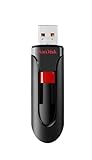
SanDisk 64GB Cruzer Glide USB 2.0 Flash Drive
The cheapest entry on the list at $14.90, the Cruzer Glide is the drive you hand to a stranger at a convention to grab a resume PDF. Sixty-four gigabytes is generous for documents, and the slider mechanism avoids cap loss. Performance expectations must stay at USB 2.0 levels, meaning large media files will crawl.
- Pro: Slider retraction protects the connector without a cap.
- Pro: SanDisk brand assurance at the absolute lowest price on this roundup.
- Con: USB 2.0 and only 64GB make this unsuitable for anything beyond small file transport.
Skip this for any task involving video, game files, or transfers larger than a few hundred megabytes.
GODBPNYMU 500GB External Hard Drive USB 3.0/USB C
The only traditional mechanical hard drive in this group, and it raises the core question of the article directly: when does a spinning disk beat a flash stick? At $32.68 for 500GB, the price-per-gigabyte is exceptional. USB 3.0 over the mechanical spindle yields sequential speeds that can exceed many flash sticks, though random-access performance is where the architecture limitation becomes obvious.
- Pro: Highest gigabyte-per-dollar ratio among all options under $50.
- Pro: Dual USB-C and USB-A connectivity covers both modern and older ports.
- Con: Mechanical platters are vulnerable to shock; not a drive you want in a backpack with a laptop.
Skip this if portability and drop resistance matter more than raw capacity per dollar.
SSK 2TB External SSD Drive up to 550MB/s Dual USB C+A
Nearly identical in spec to product four above, this variant sits at $239.99 and shares the same dual-connector, 550MB/s design. The marginal price difference and identical throughput suggest different firmware revisions or bundled accessories rather than a distinct use case. Buyers choosing between the two SSK 550MB/s options should compare current coupon availability rather than treating them as separate products.
- Pro: USB-C and USB-A dual connector removes adapter dependency.
- Pro: SSD architecture offers full shock resistance compared to the mechanical GODBPNYMU option.
- Con: Functionally interchangeable with the $235.99 sibling, making the higher price harder to justify.
Skip this unless the $209.09 1000MB/s model is unavailable; you can get more speed for less elsewhere on this list.
Buying Guide
Interface Generation Is Non-Negotiable
USB 2.0 tops out around 30MB/s in practice. USB 3.0 reaches 100-150MB/s. USB 3.1 Gen 1 and Gen 2 push 550MB/s and above. If you transfer files larger than a single photo, the interface generation determines whether your task takes seconds or minutes. Never buy a 2.0 drive unless the sole purpose is moving text documents.
SSD Form Factor Changes the Flash vs Hard Drive Equation
Traditional wisdom says flash drives are for small files and hard drives are for bulk storage. High-capacity SSD thumb drives collapse that distinction. A 2TB SSD stick delivers hard-drive-class capacity with flash-drive-class durability and speed, but at a price multiple times that of a mechanical drive. The question becomes whether the convenience of pocket-sized 2TB storage justifies the premium over a 500GB HDD.
Sustained Write Speed Matters More Than Burst Rating
Published transfer speeds almost always describe peak read performance on a nearly empty drive under ideal conditions. Owner reports consistently show writes dropping to a fraction of that number once the SLC write cache is exhausted. For video editors or anyone dumping tens of gigabytes in one session, the sustained number derived from long-file write tests is the figure that should guide your purchase.
Our Verdict
Top pick: the SSK 2TB USB Flash Drive SSD at 1000MB/s. It offers the best combination of capacity, speed, connector flexibility, and price-to-performance of any drive here, making the old flash drive vs hard drive debate irrelevant for anyone who can spend under $250.
Budget pick: the Amazon Basics 256GB USB 3.1 at $59.99. It handles the broadest range of real-world tasks—photos, documents, game saves, moderate video—without the speed penalty of USB 2.0 or the cost of an SSD.
The GODBPNYMU 500GB hard drive wins when your single priority is raw capacity per dollar and you are working from a desk where shock risk is minimal.
FAQ
Is a flash drive faster than a hard drive?
It depends on the generation and the file pattern. A modern USB 3.1 flash drive or SSD stick will read and write sequential files faster than a 5400RPM mechanical hard drive, but a high-end mechanical drive can sustain steady throughput better for single-file bulk copies. Random-access operations always favor flash.
Can I run installed games from a flash drive?
You can, but the experience depends entirely on the drive’s random-read speed and interface. A USB 2.0 thumb drive will stutter badly; a USB 3.2 SSD-class drive like the SSK 1000MB/s model will feel close to an internal SATA SSD for most titles.
Why is the 1000MB/s SSK drive cheaper than the 550MB/s model?
Pricing on these drives fluctuates with retailer promotions and stock levels rather than reflecting a fixed hierarchy. The lower-cost, higher-speed option is simply a current pricing advantage, not a permanent anomaly. Always compare the two when purchasing.
Do flash drives degrade over time?
NAND cells have a finite write endurance rated in program-erase cycles. Consumer thumb drives are typically rated for a limited number of full-drive writes, after which they enter read-only mode or fail. Mechanical hard drives fail differently—through bearing wear or platter errors—but both technologies have predictable lifespans under heavy use.
Related guides
- Alienware 16 Aurora RTX 5070 Review: Display, Portability and Configuration Gaps
- Lenovo Legion Pro 7i Gen 10 Review: 64GB RAM and Dual-SSD Configuration
- MSI Katana 15.6-inch RTX 5050 Review: Configuration Strengths and Upgrade Unknowns
- ASUS ROG Strix SCAR 16 G635LX-XS97 Review: Display Ambition, Upgrade Questions


