
Top 3 picks at a glance

The Short Answer
For most laptops, you need about 20 to 40 CFM of cooling airflow from a laptop cooling pad. That range is usually enough to move warm air away from the underside without creating excessive noise. Thin office laptops and Chromebooks can often use 10 to 25 CFM, while large gaming laptops with powerful processors and dedicated graphics may benefit from 30 to 60 CFM.
CFM means cubic feet per minute, or the volume of air a fan can move. However, laptop cooling-pad manufacturers do not use a consistent testing standard. Some list the airflow of one fan, some list a combined figure, and many do not publish CFM at all. Treat the number as a useful guide rather than a precise performance rating.
As an Amazon Associate we earn from qualifying purchases at no extra cost to you.
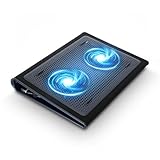

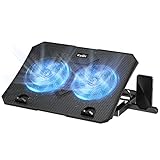
Fan placement, the size of the ventilation openings, laptop clearance, noise level, and the pad’s fit can matter as much as the advertised CFM. A well-fitting pad with modest airflow can cool better than a powerful fan blocked by the laptop’s base.
As a practical buying guide for 2026, choose a pad that supports your laptop’s screen size, lifts the rear by at least 1 to 2 inches, and offers adjustable fan speed. A typical purchase price is about $15 to $25 for a basic pad, $25 to $40 for a larger or quieter model, and $40 to $80 or more for premium gaming designs.
Standard Sizes
Cooling pads are generally sold by the laptop screen size they can hold, not by their exact exterior dimensions. Measure your computer and compare the pad’s platform dimensions before buying. The measurements below are practical size ranges for common laptop and cooling-pad categories; individual models will vary.
| Category | Typical laptop size | Recommended cooling-pad platform | Suggested airflow | Typical weight |
|---|---|---|---|---|
| Compact | 10 to 13.3 in 25.4 to 33.8 cm |
10.2–13.8 in wide x 8.0–10.5 in deep 25.9–35.1 x 20.3–26.7 cm |
10–25 CFM | 1.0–1.8 lb 0.45–0.82 kg |
| Standard | 14 to 15.6 in 35.6 to 39.6 cm |
13.0–15.8 in wide x 9.5–12.0 in deep 33.0–40.1 x 24.1–30.5 cm |
20–40 CFM | 1.3–2.5 lb 0.59–1.13 kg |
| Large | 16 to 17.3 in 40.6 to 43.9 cm |
14.5–17.5 in wide x 10.5–13.5 in deep 36.8–44.5 x 26.7–34.3 cm |
30–60 CFM | 1.8–3.5 lb 0.82–1.59 kg |
| Extra-large gaming | 17 to 18 in 43.2 to 45.7 cm |
16.0–18.5 in wide x 11.5–14.5 in deep 40.6–47.0 x 29.2–36.8 cm |
40–70 CFM | 2.5–5.0 lb 1.13–2.27 kg |
These airflow targets are not mandatory minimums. A 15.6-inch laptop used for email and streaming may be comfortable with 20 CFM, while a similarly sized gaming laptop can need closer to 40 CFM during long sessions. Consider cooling capacity together with your laptop’s processor, graphics card, workload, and room temperature.
How to Measure Your Space
- Measure the laptop’s width and depth. Close the screen and measure the body from left to right, then from the front edge to the back edge. Do not measure the diagonal screen size alone. Record both measurements in inches or centimeters.
- Check the bottom vents. Look for intake grilles, rubber feet, and any large solid sections. A cooling pad works best when its fans line up with the laptop’s intake vents. If vents are concentrated near the center, choose a pad with a central fan or broad airflow coverage.
- Allow a small border. The platform should be at least 0.5 inch wider and deeper than the laptop on each side when possible. A 15-inch laptop measuring 14.1 by 9.6 inches should fit a platform of roughly 15.1 by 10.6 inches or larger.
- Measure your desk or lap area. Add the pad’s full exterior dimensions, including front controls and rear supports. Leave at least 2 inches behind the pad for cables and airflow, and keep the front edge stable rather than hanging over a desk.
- Check the height. A raised rear edge of 1 to 2 inches improves air access and can make typing more comfortable. Adjustable stands may rise 3 inches or more, but confirm that the viewing angle remains suitable.
- Count your ports. Many pads use one USB-A connection and provide a pass-through USB port. If your laptop has only USB-C, budget for an adapter or choose a model with USB-C input.
By Room or Use Case
Home office and study
For word processing, video calls, browsing, and spreadsheets, choose a quiet pad in the 10 to 25 CFM range. A single large fan or two low-speed fans is usually sufficient. Prioritize a stable platform, a front lip that holds the laptop securely, and a height adjustment of about 1 to 2 inches. Many users will prefer a pad below roughly 35 decibels, although noise ratings are not always measured consistently.
Bedroom or shared living area
Noise is often more noticeable in these spaces. Look for adjustable speed rather than simply the highest CFM rating. A 15.6-inch laptop can generally use a 20 to 35 CFM pad at a reduced setting. Avoid an oversized gaming pad if the laptop does not need it; larger fans and brighter lighting can add bulk without a meaningful benefit for light workloads.
Gaming and creative work
Gaming, 3D rendering, video editing, and other sustained workloads produce more heat. A 15.6- to 17.3-inch laptop typically suits a pad rated around 30 to 60 CFM, provided the platform aligns with the intake vents. Select a rigid base, a strong front stop, and multiple height positions. Cooling pads in this category commonly weigh 2 to 5 pounds and may cost $25 to $80 or more.
Travel and occasional use
For commuting, choose a slim pad weighing about 1 to 2 pounds and measuring no more than 14 to 16 inches wide. Airflow around 15 to 30 CFM is a sensible target for a portable 13- to 15.6-inch laptop. Compact models such as the TECKNET or KeiBn-style designs are useful when portability and USB convenience matter more than maximum cooling capacity. Check the folded thickness before putting one in a laptop sleeve.
Large laptops and lap use
A 17-inch computer needs a broad, well-supported platform. Look for at least 16 inches of usable width and 30 to 60 CFM for a warm gaming system. A soft neoprene lap mat, such as the Targus-style design, can improve comfort and protect your legs, but it may provide less rigid elevation than a desktop stand. Never cover the pad’s underside or place it on bedding, where airflow can be restricted.
Common Sizing Mistakes
- Buying by screen size alone: Two 15.6-inch laptops can have very different body widths and depths. Always compare chassis measurements.
- Choosing the highest CFM: More airflow can mean more noise, vibration, and dust. Match CFM to the workload instead of automatically selecting the most powerful model.
- Ignoring vent placement: Fans cannot cool effectively if the laptop’s feet, solid base, or a poorly positioned grille blocks the air path.
- Forgetting the front lip: A platform that is too shallow can let the laptop slide, especially when the stand is tilted.
- Overlooking desk depth: A 17-inch pad can extend 13 to 15 inches front to back. Confirm that it fits without hitting a monitor stand or desk edge.
- Confusing fan count with airflow: Two fans do not automatically deliver twice the CFM. Motor speed, blade design, and the open area beneath the laptop also matter.
FAQ
Is 70 CFM too much for a laptop?
Not necessarily, but it is more than most everyday laptops require. High airflow can be useful for a large gaming computer during sustained loads, but the extra noise may outweigh the benefit. Adjustable speed is more valuable than a high maximum rating alone.
Does a cooling pad lower laptop temperature?
It can, especially when the laptop’s underside vents need more clearance. The result depends on the laptop design, room temperature, dust buildup, workload, and fan alignment. A pad is not a substitute for cleaning blocked vents or repairing a failing internal fan.
What CFM should I choose for a 15.6-inch laptop?
Choose about 20 to 40 CFM for general use. Move toward 30 to 50 CFM if the laptop is a gaming or creator model that runs demanding software for long periods. Confirm that the platform is at least about 15 inches wide and 10 inches deep, or compare it with your measured chassis.
Are inexpensive cooling pads effective?
They can be effective when sized correctly and used on a hard, flat surface. Basic models from about $15 to $30 may offer adequate airflow for office laptops. Spend more when you need quieter operation, a stronger hinge, larger fans, RGB controls, or support for a heavy 17-inch gaming laptop.
Related guides
- Alienware 16 Aurora RTX 5070 Review: Display, Portability and Configuration Gaps
- Lenovo Legion Pro 7i Gen 10 Review: 64GB RAM and Dual-SSD Configuration
- MSI Katana 15.6-inch RTX 5050 Review: Configuration Strengths and Upgrade Unknowns
- ASUS ROG Strix SCAR 16 G635LX-XS97 Review: Display Ambition, Upgrade Questions


