
Most people shopping for a dock start with the wrong question. They ask “which dock is best?” instead of “which dock works with my laptop and my monitors?” That single mistake leads to returns, dead pixels on one screen, and docks that charge a laptop at a trickle while running two 4K displays. The other common error is buying a $30 hub when the job demands a $200 dock, or paying $250 for ports you’ll never touch. This guide walks through what actually matters: bandwidth, display output modes, power delivery, build quality, and where your money genuinely buys performance.
Top 3 picks at a glance
Decide These 3 Things First
Before comparing any products, answer these questions. Everything else follows from them.
As an Amazon Associate we earn from qualifying purchases at no extra cost to you.


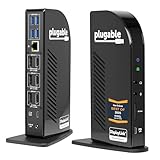
1. What ports does your laptop have, and what display protocol does it support? A USB-C port is not automatically a Thunderbolt port. If your laptop has Thunderbolt 3 or 4, nearly any dock works at full capability. If it has plain USB-C with DisplayPort Alt Mode, you can still drive two monitors, but only through docks that explicitly support it. If your laptop only does USB-C data (some budget machines), you need a DisplayLink dock, which uses software compression — fine for office work, not ideal for fast motion.
2. How do you want your two 4K monitors connected? There are two paths. DisplayPort Alt Mode splits native video bandwidth across outputs and gives the best image quality and lowest latency. DisplayLink uses a chip and driver to squeeze video through a data connection — it works on almost anything, including Macs with closed displays, but adds a small amount of CPU load. Check which one a dock uses before buying; it is usually buried in the spec sheet.
3. How much charging do you need? A 13-inch ultrabook might need 45W. A 16-inch creative laptop often wants 100W or more. Gaming laptops frequently demand 180W to 240W and can’t be charged by most docks at all — you’ll keep the proprietary charger plugged in alongside. Match the dock’s power delivery to your laptop’s actual adapter rating, not a smaller “works with most laptops” figure.
Display Output: The Spec That Decides Everything
Two 4K monitors at a usable 60Hz requires serious bandwidth: roughly 25 to 32 Gbps of video data combined. This is where cheap docks fall apart. Many $30 to $60 USB-C hubs use HDMI 1.4 ports, which cap a single 4K display at 30Hz. The cursor visibly lags and scrolling stutters — a dealbreaker for daily work.
What to look for:
- HDMI 2.0 or DisplayPort 1.4 minimum on every output. HDMI 2.0 handles 4K at 60Hz; HDMI 2.1 pushes 4K at 120Hz if your monitors support it.
- Dual-output capability, not just dual ports. Some docks advertise two HDMI ports but can only drive one external display from certain laptops. Windows laptops with DisplayPort Alt Mode can typically run two displays directly; older Macs with Apple Silicon historically could not without DisplayLink. Verify the exact laptop-and-dock combination is supported.
- Bandwidth sharing. On many mid-range docks, running both HDMI outputs drops each to 4K at 30Hz, or drops charging speed. Read the fine print: a dock listing “4K@60Hz single, 4K@30Hz dual” is not a dual-4K dock.
Port Selection and Power Delivery
Count your actual needs before paying for a 13-in-1 dock. A realistic desk setup needs: two video outputs, one Ethernet jack (wired beats Wi-Fi for reliability), two or three USB-A ports for peripherals, one USB-C port with power delivery, and an SD/microSD reader if you shoot photos.
Power delivery tiers:
- 60W passthrough — adequate for small laptops and tablets, but many laptops will drain slowly under heavy load.
- 85W to 100W — the sweet spot for most ultrabooks and 14- to 16-inch productivity laptops. Anything above 100W is a bonus, since USB-C Power Delivery tops out around 100W for most implementations, with newer PD 3.1 standards reaching 140W to 240W on premium docks.
- No charging — common on pure USB 3.0 docks using a USB-A connection. Fine if you don’t mind a separate charger, and often the honest, cheap option.
Also check for a dedicated host cable versus a removable one. Fixed captive cables fail at the strain relief; docks with a detachable host cable are easier to replace and travel with.
Size, Weight, and Desk Footprint
Docks range dramatically in size, and the difference matters on a real desk.
- Compact hubs/docks: roughly 4 to 5.5 inches wide, 1.5 to 2.5 inches deep, 2 to 5 ounces. These sit behind a monitor or velcro under a desk. Good for minimal setups, but often passive-cooled and thermally limited under dual-4K load.
- Mid-size aluminum docks: around 6 to 8 inches wide, 3 inches deep, 8 to 14 ounces. Enough mass and surface area to dissipate heat without a fan. The best balance for most permanent desks.
- Full docks with power bricks: 8 to 10 inches wide, weighing 1 to 2 pounds plus a separate 200 to 300 gram adapter. Plan shelf or under-desk space for the brick; its cable is often only 3 to 4 feet long.
Check cable lengths on peripherals too: a 2-foot Ethernet cable and a 3-foot HDMI run forces the dock’s placement more than any spec sheet suggests.
Build Quality: Materials and Construction
A dock runs warm for eight hours a day, every day. Construction quality shows up in longevity more than in any benchmark.
- Aluminum housings (common in the $60 to $150 range) act as heatsinks, running noticeably cooler than plastic at identical loads. Expect CNC-machined shells on premium units and extruded aluminum on mid-range.
- Plastic housings dominate under $50. They work, but ports on lightly-built hubs can flex under heavy cable weight — a real problem when two thick HDMI cables hang off a device weighing 4 ounces. Anchor cables or use strain relief.
- Port mounting matters more than the shell. Look for ports soldered to an internal metal frame rather than floating on the circuit board. On cheap hubs, HDMI ports fail from repeated plug cycles — rated 5,000 to 10,000 insertions on quality hardware.
- Fanless vs. fanned: DisplayLink docks with compression chips often include small fans. Fanless is silent but throttles video quality under sustained load; a well-implemented fan is worth tolerating.
Performance and Everyday Comfort
Dual 4K at 60Hz is the performance baseline; beyond that, “comfort” is about stability and heat.
- Refresh rate: insist on 4K at 60Hz on both displays simultaneously. If you do motion work — video editing, gaming — target HDMI 2.1 and 4K at 120Hz.
- Color depth: docks and cables limited to 8-bit color show banding in gradients. DisplayPort 1.4 with DSC or HDMI 2.1 preserves 10-bit color at 4K/60 if your monitors support it.
- Heat: expect any dock driving two 4K panels to run 95 to 115°F at its hottest point. That’s normal. Sustained surface temps above 130°F on a plastic shell suggest it’s throttling.
- Ethernet: gigabit (1,000 Mbps) is standard; 2.5-gigabit ports appear on premium docks. Wired networking noticeably improves video calls and large file transfers.
- One-cable convenience: a dock with 100W passthrough means connecting a single USB-C cable wakes both monitors, network, and peripherals. That daily convenience is arguably the biggest performance upgrade a dock delivers.
Price Tiers: What Your Money Buys
Budget: $30 to $70. Compact aluminum or plastic hubs with two HDMI ports, 60W to 85W passthrough, and typically HDMI 2.0. Fine for laptops with full DisplayPort Alt Mode support and modest charging needs. Risks: dual-display limitations on some machines and thinner build quality. Examples in this tier include the UGREEN 7-in-1 dual HDMI dock at around $30 and the Anker 8-in-1 dual-monitor hub near $54.
Mid-range: $70 to $130. Better thermal design, verified dual 4K/60 output, 85W to 100W charging, Ethernet, and card readers. USB 3.0 dual-HDMI docks like Plugable’s universal model at roughly $100 live here — a solid pick for older laptops without USB-C.
Premium: $150 to $300. Thunderbolt-class bandwidth, 100W-plus charging, triple-display support, 2.5Gb Ethernet, and durable metal construction. The Plugable 13-in-1 4K dock at about $246 with 100W charging represents this tier’s value: everything a permanent two-monitor desk needs, with headroom.
For most buyers, the honest answer is: spend $100 to $250 once rather than $50 twice.
Warranty and Support
Docks fail more often than monitors — they’re dense electronics running warm. Warranty terms vary widely and tell you a lot about the maker’s confidence.
- 18 to 24 months is typical for Anker and UGREEN-class brands, with responsive replacement service.
- 2 years or more comes standard from specialist brands like Plugable, which built its reputation partly on long support windows — its docks commonly carry 2-year coverage with direct US-based support.
- No-name listings under $25 often offer 30 to 90 days through the marketplace seller only. At dual-4K workloads, that’s a gamble.
Also check driver availability: DisplayLink docks require ongoing driver updates. Brands that maintain drivers for years are worth a premium.
Delivery and Setup Considerations
Docks ship small — usually 8 to 12 ounces boxed, and premium models with power bricks closer to 2 pounds — so shipping damage is rare and there’s nothing to assemble. Setup is where buyers get surprised:
- Budget 15 to 30 minutes for first-time setup; DisplayLink docks add a driver install and possibly a reboot.
- Buy your own certified cables if the included HDMI cables are generic. For 4K/60, use cables certified as “Premium High Speed” (HDMI) or VESA-certified DisplayPort cables; a bad cable causes more “dock problems” than the dock itself.
- Keep the box for 30 days. Compatibility quirks with specific laptops are the number-one reason for returns, and you want the original packaging.
- On by early 2026, expect more docks advertising USB4 and HDMI 2.1 at mid-range prices — if your laptop is Thunderbolt 4-equipped, waiting a shipping cycle can save money, but current-gen docks remain fully capable for dual 4K/60.
Spec Checklist
| Spec | Budget ($30–$70) | Mid ($70–$130) | Premium ($150–$300) |
|---|---|---|---|
| Video outputs | 2x HDMI 2.0 | 2x HDMI 2.0 or DP 1.4 | 2–3x HDMI 2.1/DP 1.4 |
| Dual-display capability | Laptop-dependent, often requires DP Alt Mode | Verified dual 4K/60 on Windows; check Mac | Verified dual/triple 4K/60, incl. Mac via DisplayLink |
| Max resolution per display | 4K@30Hz dual / 4K@60Hz single | 4K@60Hz dual | 4K@60–120Hz dual |
| Charging | 60–85W passthrough or none | 85–100W PD | 100W+ PD / Thunderbolt charging |
| Ethernet | Rare or 1Gb on some | 1Gb standard | 1Gb–2.5Gb |
| USB-A ports | 1–2 (USB 3.0) | 2–3 (USB 3.0) | 3–4 (USB 3.2, some 10Gbps) |
| Card reader | Sometimes | SD + microSD | UHS-II SD |
| Housing | Plastic or thin aluminum | Aluminum | Machined aluminum, internal frame |
| Warranty | 12–18 months | 18–24 months | 2–3 years |
Red Flags
- “Dual 4K support” with 4K@30Hz listed in the fine print. 30Hz per screen is unusable for daily work. Search the listing for “60Hz” attached to the dual-output spec, not the single-output spec.
- HDMI 1.4 ports. Any HDMI port that doesn’t state “2.0” or higher likely caps at 4K/30.
- Vague laptop compatibility. “Works with USB-C laptops” without naming limitations usually means M1/M2 Mac users will get one display. Look for an explicit compatibility table.
- No wattage listed for charging. If the listing omits watts, assume 60W passthrough at best — possibly none.
- Charging claims without a power brick included. Some docks require you to supply your own USB-C charger; a dock that needs an expensive adapter to charge at all should say so upfront.
- No named brand or support site. Driver-dependent docks from anonymous sellers become e-waste the day the driver stops being updated.
- Dozens of glowing reviews posted in a two-week window with identical phrasing — a hallmark of incentivized reviews on marketplace listings.
FAQ
Can any USB-C dock run two 4K monitors?
No. The dock needs enough bandwidth (two HDMI 2.0 or DisplayPort 1.4 outputs), and your laptop must support multi-display output over its USB-C port. Thunderbolt 3/4 laptops handle this easily; plain USB-C laptops vary. Many budget hubs can only drive one 4K display at 60Hz, dropping the second to 30Hz — check the dual-output resolution specifically.
Will a dock slow down my dual 4K setup?
A native DisplayPort Alt Mode dock adds negligible latency — video passes through directly. A DisplayLink dock compresses video through a driver, adding a small CPU load (typically a few percent on modern machines) and occasional stutter in fast-motion content. For office and coding work it’s imperceptible; for gaming or video editing, prefer native output or Thunderbolt.
Can I charge my laptop through the dock while running two monitors?
Only if the dock supports Power Delivery at your laptop’s required wattage. Match the dock’s PD rating to your laptop’s charger: 65W for small ultrabooks, 100W for 14- to 16-inch machines. If the dock’s charging drops under dual-display load, or your laptop needs more than the dock provides, keep the laptop’s own charger connected.
Why is one of my 4K monitors stuck at 30Hz?
Almost always a bandwidth limit: an HDMI 1.4 port on the dock, a non-certified cable, or a dock that halves refresh rates when both outputs are active. First swap in a certified Premium High Speed HDMI cable; if that doesn’t fix it, the dock itself is the limit. Check the spec for “4K@60Hz (dual display)” — if it only promises 60Hz single-display, no setting will change it.
Related guides
- Alienware 16 Aurora RTX 5070 Review: Display, Portability and Configuration Gaps
- Lenovo Legion Pro 7i Gen 10 Review: 64GB RAM and Dual-SSD Configuration
- MSI Katana 15.6-inch RTX 5050 Review: Configuration Strengths and Upgrade Unknowns
- ASUS ROG Strix SCAR 16 G635LX-XS97 Review: Display Ambition, Upgrade Questions


