
As an Amazon Associate we earn from qualifying purchases at no extra cost to you.


When you’re shopping for a laptop or an external monitor in 2026, the display panel is no longer an afterthought — it’s often the single biggest factor in how much you enjoy the device and how long it stays satisfying to use. The real decision most buyers face isn’t which brand logo sits under the screen, but whether the pixels behind the glass should be self-emissive OLED or backlit Mini LED. Both technologies deliver genuinely premium image quality, but they behave very differently in bright rooms, in dark rooms, on battery power, and over years of daily use. This guide walks through the honest trade-offs — brightness, burn-in risk, power draw, price, and long-term ownership — so you can match the right panel to how your household actually lives and works.
Top 3 picks at a glance
Quick Verdict
If you do creative work in dim light, watch a lot of movies, or want the deepest contrast and thinnest panels money can buy, OLED is the better pick. Typical OLED laptops deliver true blacks, near-instant pixel response (around 0.1–0.5 ms), and wide color coverage covering 100% of the DCI-P3 gamut on most modern panels.
If your laptop lives in a sunroom, doubles as the family’s Netflix machine with the news ticker on all day, or needs to run all-day on battery, a Mini LED display is the safer long-term bet. Mini LED backlights push 1,000+ nits of peak brightness in HDR, resist static-image wear entirely, and are increasingly affordable — as seen in machines like the Dell 16 2-in-1 lineup, which pairs a 16-inch Mini LED WQXGA (2560 x 1600) touchscreen with Intel Core Ultra 9 power starting around $1,249.
For most mixed-use households, Mini LED is the lower-risk purchase. For enthusiasts who prioritize image quality above all else, OLED still wins.
Side by Side
| Factor | OLED Laptop Display | Mini LED Laptop Display |
|---|---|---|
| Contrast | Per-pixel blacks, effectively infinite contrast | Excellent local dimming, but minor blooming around bright objects (contrast typically 100,000:1 or higher with good zoning) |
| Peak brightness | Around 400–600 nits full-screen; 600–1,000+ nits in small HDR highlights | Typically 600–1,000+ nits sustained; many panels sustain high brightness across the whole screen |
| Response time | 0.1–0.5 ms — superb for gaming and fast motion | 2–5 ms depending on panel (IPS-based), still smooth for most users |
| Eye comfort in bright rooms | Can struggle in direct sunlight; some panels use PWM dimming that bothers sensitive eyes | Consistently bright and easy to read in daylight; usually DC-dimming or higher-frequency PWM |
| Longevity/burn-in risk | Static UI elements (taskbars, news tickers) can cause permanent burn-in over years; modern panels mitigate but don’t eliminate it | No burn-in; backlight LEDs gradually dim over many years |
| Power draw | Very efficient with dark content (1–3 W for mostly black screens); can be power-hungry with bright white pages | Fairly consistent draw (roughly 4–8 W for the panel) regardless of content |
| Panel weight/thickness | Thinner and lighter — no backlight layer, often shaving 0.2–0.5 mm and some grams from the lid | Thicker due to the mini LED backlight array (hundreds to thousands of tiny LEDs) |
| Typical laptop price premium | Usually adds $150–$400 over an equivalent LCD model | Usually adds $100–$300 over a standard IPS panel |
| Best for | Movie watchers, photo/video editors, gamers who want contrast and speed | Bright-room users, all-day battery users, households that leave static content on screen |
Where Oled Wins
Contrast and black levels are the headline advantage. Because every OLED pixel produces its own light and can switch off entirely, a night scene in a film shows stars against genuinely black sky rather than the grayish haze you get from even the best local dimming zones. For anyone who watches movies or edits dark footage, this difference is immediately obvious.
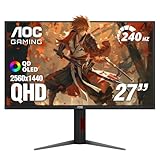
Motion clarity is the second big win. With pixel response times around 0.1–0.5 ms, OLED panels render fast action — sports, scrolling, competitive gaming — with almost no ghosting. That’s why high-refresh OLED monitors like the AOC Q27GAZDV (a 27-inch QHD 240Hz QD-OLED with NVIDIA G-SYNC compatibility, priced at $309.99) have become so popular with gamers; its sibling, the Q27GAZD, offers the same core panel experience at $329.99. If you pair an OLED laptop with an external OLED monitor, the visual consistency is a real pleasure.
Design flexibility matters too. Without a backlight layer, OLED lids can be thinner and lighter, and they enable always-on display features and truly deep blacks at any viewing angle — no backlight bleed in the corners, ever.
Finally, dark-content power efficiency is underrated. If you read at night in dark mode, an OLED panel sips power compared to a backlight that must illuminate the entire screen uniformly.
Where Mini Led Laptop Display Wins
Brightness in real rooms is Mini LED’s superpower. Thousands of tiny LEDs divided into hundreds or thousands of dimming zones let these panels sustain 600–1,000+ nits across the entire screen — bright enough to comfortably work next to a window or outside on a patio, where many OLED laptops become mirror-like and hard to read.
No burn-in anxiety changes how you use the machine. A family laptop that spends its life with a spreadsheet pinned to one side, a video call grid open for hours, or a stock ticker running overnight will wear evenly on Mini LED. OLED owners in the same situation are advised to rotate content, hide taskbars, and enable pixel-shift features — workarounds that are unnecessary with a backlight.
Battery life under mixed use tends to be strong, too. Web pages, documents, and email are mostly white content, which pushes OLED panels to draw more power, while a well-tuned Mini LED backlight stays consistent. For productivity-focused machines — like the Dell 16 2-in-1s with their 16-inch Mini LED WQXGA touchscreen, Intel Core Ultra 9-288V processors, 32GB of LPDDR5X memory, and 1TB SSDs — that predictability is part of the appeal. The Windows 11 Home configuration starts at $1,249, while the Windows 11 Pro version with an M.2 PCIe SSD runs $1,339.99, and both include an active pen, backlit keyboard, fingerprint reader, Thunderbolt 4, and WiFi 7.
Cost is also trending in Mini LED’s favor. The backlight technology has matured quickly, and the price gap between Mini LED and premium OLED machines keeps narrowing.
Cost Over 5 Years
Upfront, an OLED laptop typically runs $100–$400 more than a comparable Mini LED or IPS model in the same spec tier. Between the two Dell configurations above, that $90 difference between the Home and Pro versions shows how small spec-driven price jumps can be within one panel type.
Over five years, factor in:
– Power: OLED saves roughly 1–2 W with dark-content use; Mini LED may save 1–3 W with bright white content. At typical residential electricity rates (~$0.15/kWh), the difference over five years of daily use amounts to only a few dollars either way — negligible.
– Battery replacement: Bright, high-brightness use stresses batteries on both equally; expect a $100–$200 battery replacement around year 3–4 for a heavily used machine of either type.
– Degradation risk: This is where the technologies diverge. A Mini LED panel may lose 10–15% of backlight brightness over five to seven years — an imperceptible slide. An OLED panel used heavily with static content could develop visible burn-in within three to five years, potentially prompting a screen replacement ($250–$500) or an earlier whole-device upgrade. Used carefully (dark themes, auto-hiding taskbars, varied content), most modern OLED panels will look fine at the five-year mark.
– Resale: Mini LED laptops with no burn-in risk tend to command slightly higher resale prices on the used market, since buyers of used machines can’t verify how the previous owner treated an OLED panel.
Realistic five-year cost: roughly equal for careful OLED users; $250–$700 higher for an OLED owner who develops burn-in and repairs or replaces early.
Which One for Your Home
Small Apartment
Space isn’t the differentiator — light is. In a small apartment, your laptop probably moves from a desk near a window to the couch to bed. If it lives near windows most of the day, Mini LED’s high sustained brightness makes it easier to live with. If you mostly compute at night with blackout curtains and stream films on a small screen, OLED’s contrast turns the laptop into a genuine home-theater device. If you’re a gamer in tight quarters, a laptop plus an external OLED like the AOC Q27GAZDV (27 inches, a compact footprint for a 240Hz QD-OLED) covers both needs in one corner of the room.
Family with Kids or Pets
Mini LED, without hesitation. Shared laptops mean unpredictable content: kids leaving YouTube paused on a bright thumbnail for an hour, video calls parked on screen, the same game menu idling all evening. None of that worries a Mini LED panel. OLED burn-in is a slow, cumulative process, but a family machine is exactly the usage pattern that accelerates it. The touchscreen and active pen support on a 16-inch Mini LED 2-in-1 like the Dell also suits kids’ drawing apps and homework better than most OLED clamshells at similar prices.
Rental or Temporary Home
Think resale and portability. If you’ll resell the laptop when you move, Mini LED’s lack of degradation risk protects your resale value — a used OLED with any burn-in takes a steep discount. Portability matters here too: if you’re constantly packing up, OLED’s thinner, slightly lighter lid is a small but real convenience. On balance, choose Mini LED if resale value matters most; choose OLED only if you keep your devices for the long haul.
Long-Term Home
This is the best case for OLED — if you’re the sole user. A personal machine used with dark themes, varied content, and reasonable care will look excellent for five to seven years, and the image quality dividend compounds daily. Pair it with an external OLED monitor for a desk setup with uniform, gorgeous panels. If the machine will serve multiple people or用途 with unpredictable content over a decade, though, stick with Mini LED for peace of mind.
FAQ
Do OLED laptop screens burn in quickly?
No — burn-in is a slow process, not a sudden failure. Modern OLED panels include pixel shift, logo dimming, and screen savers that extend lifespan considerably. Heavy static content (fixed taskbars, dashboards, news tickers) for many hours daily over years is what causes visible wear. Varied, typical use rarely produces noticeable burn-in within three to five years.
Is Mini LED just a marketing name for regular LED?
No. Standard LED-backlit LCDs use a few dozen large LEDs, often in edge-lit arrays with little or no local dimming. Mini LED backlights use hundreds to thousands of much smaller LEDs grouped into many dimming zones (often 500–2,000+), which dramatically improves contrast and lets the screen hit much higher peak brightness.
Which is better for gaming: OLED or Mini LED?
OLED, for most gamers. Response times around 0.1–0.5 ms eliminate ghosting, and high-refresh OLED panels (120–240 Hz in laptops, 240 Hz in monitors like the AOC Q27GAZD) deliver exceptionally fluid motion. Mini LED panels are no slouch, but IPS-based response times of 2–5 ms and backlight blooming in dark scenes give OLED the edge in fast, dark games.
Which display type saves more battery?
It depends on what you’re doing. OLED is dramatically more efficient with dark content — dark-mode reading, video playback with letterboxing — because black pixels use no power. Mini LED is often more efficient with bright white content like documents and web pages, where OLED must light up every pixel. Match the panel to your dominant workload rather than chasing a universal answer.
Related guides
- Alienware 16 Aurora RTX 5070 Review: Display, Portability and Configuration Gaps
- Lenovo Legion Pro 7i Gen 10 Review: 64GB RAM and Dual-SSD Configuration
- MSI Katana 15.6-inch RTX 5050 Review: Configuration Strengths and Upgrade Unknowns
- ASUS ROG Strix SCAR 16 G635LX-XS97 Review: Display Ambition, Upgrade Questions


