The best accent chairs are the ones that fit your room’s usable space, support your body comfortably, and add contrast without turning a walkway into an obstacle. For most homes, start with a chair 28–34 inches wide, a seat height of 17–19 inches, a seat depth of 19–22 inches, and a weight capacity of at least 250 pounds.
As an Amazon Associate we earn from qualifying purchases at no extra cost to you.


Our Top Picks

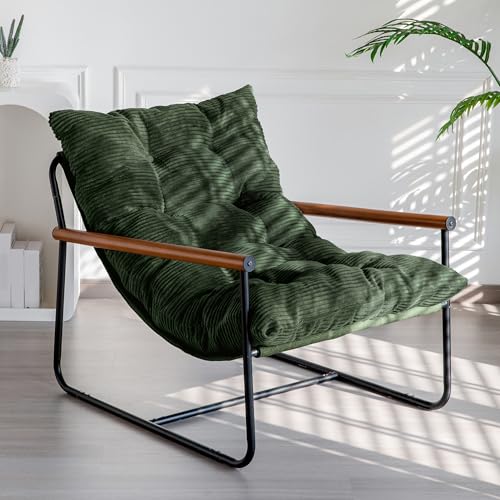


Top 3 picks at a glance
Choose the Chair by Room Size First
Accent chairs look smaller in a product photo than they do beside a sofa, coffee table, or doorway. Measure the open area rather than the whole room. Include the chair’s arms, legs, and any recline or swivel clearance.
| Room or placement | Recommended chair width | Minimum clear space | Best chair format |
|---|---|---|---|
| Small bedroom corner | 24–29 inches | 30 inches in front | Armless, slipper, or compact barrel chair |
| Apartment living room | 28–33 inches | 30–36 inches around traffic paths | Low-profile lounge or narrow club chair |
| Standard living room | 30–36 inches | 36 inches for a comfortable walkway | Barrel, armchair, swivel, or occasional chair |
| Large open-plan room | 32–40 inches | 36–42 inches around the seating group | Wide lounge chair, leather club chair, or matching pair |
| Desk or gaming setup | 26–32 inches | 30 inches to pull out and sit down | Compact upholstered chair with a firm seat |
Use the tape-outline test
Place painter’s tape on the floor around the chair’s maximum dimensions. Add about 2 inches if the chair has broad arms or a swivel base. Walk around the outline while carrying a laundry basket or opening nearby doors. This reveals crowding that a simple width measurement misses.
For a pair of chairs, calculate the combined footprint before buying. Two 30-inch chairs need 60 inches side by side, but the arrangement usually needs another 6–12 inches between them. A 72-inch wall therefore works better with two narrow 28-inch chairs than two 34-inch chairs.
Match Seat Height and Depth to the Way You Sit
Seat height affects how easily you can sit down and stand up. A 17–18-inch seat suits many adults and creates a relaxed lounge posture. A 19–20-inch seat feels more upright and is often easier for taller adults or anyone who dislikes sinking into furniture. If the chair has a thick cushion, check the compressed sitting height rather than the frame height.
- Shorter users: look for a compressed seat height of about 16–18 inches so your feet can rest flat.
- Average-height users: 17–19 inches is a versatile range for reading, conversation, and occasional desk use.
- Taller users: consider 19–21 inches, plus a seat depth of at least 21 inches.
- Older adults or anyone with limited mobility: choose a firmer cushion and a 19–20-inch seat rather than a very low lounge chair.
Seat depth determines whether you sit upright or curl up. A 19–20-inch usable depth supports a more formal posture. Around 21–23 inches works for reading and relaxed conversation. A 24-inch-plus seat is comfortable for lounging but can leave shorter users without back support. Measure usable depth from the front edge of the cushion to the back cushion, not from the front of the frame.
Best Accent Chairs by Use Case
For a small living room: narrow upholstered chairs
Choose a 26–30-inch-wide chair with slim arms or no arms. A tight-back design saves visual space, while tapered legs keep more floor visible. Avoid oversized recliners and deep barrel chairs unless the room has an unusually generous open corner.
For reading: supportive lounge chairs
A reading chair should have a back height of roughly 30–36 inches, a seat depth around 20–22 inches, and enough side support to keep your shoulders relaxed. Pair it with a small table that is approximately level with the chair’s arm or seat so a lamp and book remain reachable without leaning.
For a bedroom: compact slipper or barrel chairs
A slipper chair is useful at a vanity, near a window, or at the end of a bed because it has little or no arm structure. A small barrel chair provides more support but needs additional width. Choose performance upholstery if the chair will be used for dressing, folding laundry, or holding bags rather than serving as decoration.
For a desk or gaming room: firm occasional chairs
An accent chair is not a replacement for an adjustable ergonomic task chair during long computer sessions. For short sessions, streaming, reading, or guest seating, choose a seat with moderate firmness, a back height of at least 28 inches, and a width that leaves room to move your elbows. Keep at least 30 inches behind or beside it if the chair must be pulled away from a desk.
For a large room: wide chairs or a coordinated pair
Large rooms can make small chairs appear lost. A 32–40-inch lounge chair, a substantial leather club chair, or two coordinated 28–32-inch chairs will create a stronger seating zone. Use a rug or side table to connect the chairs visually to the sofa instead of placing them randomly around the perimeter.
Compare Upholstery Before Choosing a Color
| Upholstery type | Best for | Advantages | Watch for |
|---|---|---|---|
| Performance polyester | Busy homes and everyday use | Usually durable, broad color range, easier spot cleaning | Texture and stain resistance vary by fabric |
| Velvet | Bedrooms and statement corners | Rich color and soft hand feel | Shows pressure marks, dust, and directional shading |
| Leather or faux leather | Reading rooms and modern interiors | Wipes clean and develops a defined look | Can feel cold, hot, or slippery; quality differs widely |
| Linen or linen blend | Light, casual interiors | Breathable appearance and natural texture | Wrinkles and may absorb spills quickly |
| Bouclé or looped fabric | Contemporary decorative seating | Soft texture and strong visual interest | Loops can catch on claws, zippers, and rough clothing |
Look for a removable, washable cover if children, pets, or frequent snacking are part of the chair’s job. “Stain resistant” does not mean spill-proof: check the care code and clean marks according to the manufacturer’s instructions. In homes with cats, tightly woven fabrics are generally a safer choice than open loops.
Check Weight Capacity and Frame Construction
Weight capacity is a safety and durability specification, not merely a comfort number. If two people may sit on the chair, add their weights and choose a rating above that total. For example, a 180-pound adult and a 60-pound child total 240 pounds; a chair rated for 250 pounds leaves little margin for movement. A 300- or 350-pound-capacity model is a more sensible choice.
Also inspect the construction details. A kiln-dried hardwood or reinforced engineered-wood frame can be suitable when the joints are well made. Corner blocks, screwed or doweled joints, a stable base, and a cushion that can be rotated usually matter more than decorative trim. For swivel chairs, check that the base does not extend far beyond the seat and that the mechanism returns smoothly without wobbling.
A Practical Decision Matrix
| Your situation | Prioritize | Avoid |
|---|---|---|
| Room under 120 square feet | Under 30 inches wide, exposed legs, shallow depth | Deep club chairs and oversized arms |
| Daily reading | 20–22-inch seat depth, supportive back, firm-medium cushion | Very soft cushions that collapse below the lumbar area |
| Pets or young children | Tight weave, removable cover, dark or patterned upholstery | Delicate linen and looped fabrics |
| Difficulty standing | 19–20-inch seat height, firm cushion, arms for leverage | Low, deep, sink-in lounge chairs |
| Shared seating for adults | At least 300-pound capacity and a 20–22-inch seat width | Decorative chairs with unclear load ratings |
| Need occasional guest seating | Lightweight frame, 17–19-inch seat height, easy-to-move design | Heavy recliners that cannot be repositioned |
How to Coordinate an Accent Chair Without Making the Room Matchy-Matchy
Match one characteristic and contrast another. For example, pair a warm wood-legged chair with a sofa that has wood details, but choose a different upholstery color. In a neutral room, a saturated green, rust, blue, or teal chair can create a focal point. In a colorful room, a textured neutral chair often prevents the arrangement from becoming visually busy.
Keep the chair’s visual weight proportional to the sofa. A low sofa usually pairs well with a low chair, while a tall-backed traditional sofa can make a tiny slipper chair look out of place. Two chairs do not need to be identical, but matching seat heights makes conversation more comfortable.
Frequently asked questions
How can I tell whether an accent chair will fit through my doorway?
Measure the doorway, elevator, and stair turns as well as the chair’s overall dimensions. The article recommends checking all of these before buying, because fitting the room does not guarantee the chair can be carried into it. Include the chair’s arms and legs when comparing its width and depth with the available route.
What’s the difference between outside width and usable seat width?
Outside width includes the chair’s full span, including its arms; usable seat width is the space available to sit between them. The article’s final checklist says to compare usable seat width, not just outside arm-to-arm width. This is especially relevant when choosing a chair for shared seating, where the article lists a seat width of at least 20–22 inches as a priority.
Is a chair with a removable cover a good choice for a home with pets or children?
It can be, particularly if the chair will see frequent use or spills. The article recommends looking for a removable, washable cover when children, pets, or frequent snacking are part of the chair’s job. It also notes that tightly woven fabrics are generally a safer choice in homes with cats than open-loop fabrics.
How do I choose an accent chair for two adults to share?
Choose a chair with a weight capacity above the combined weight of the people who may sit on it. The article’s decision matrix also recommends at least 300 pounds of capacity and a 20–22-inch seat width for shared adult seating. Check the stated load rating rather than relying on decorative appearance.
What should I check if I’m buying a swivel accent chair?
Check that the base does not extend far beyond the seat and that the swivel mechanism returns smoothly without wobbling. Also allow for swivel clearance when measuring the chair’s footprint; the article recommends including any swivel clearance in the usable-space measurement. A tape outline on the floor can help reveal whether the chair will crowd nearby paths.
Final Buying Checklist
- Measure the usable floor area, doorway, elevator, and stair turns.
- Confirm overall width, depth, height, and compressed seat height.
- Compare usable seat width, not just outside arm-to-arm width.
- Choose a weight capacity with a margin above the heaviest expected load.
- Check fabric care instructions and resistance to pets, spills, and sunlight.
- Leave 30–36 inches for normal walkways and door movement.
- Confirm whether a swivel base, recline function, or loose cushion needs extra clearance.
- Use a taped floor outline before ordering any chair wider than 32 inches.
The right choice is rarely the biggest or most decorative option. The best accent chairs combine a seat height that lets you sit naturally, upholstery suited to the room’s workload, a weight rating that provides real margin, and dimensions that preserve the pathways around them.