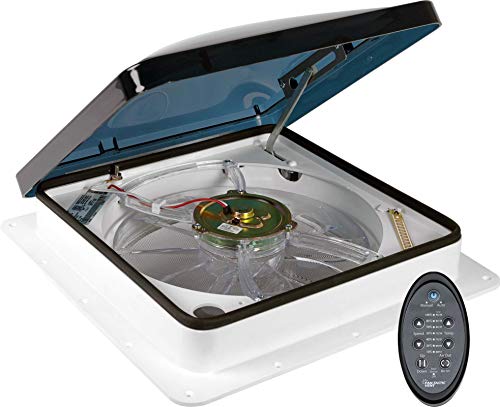
The best campervan roof vent fans with rain sensor and thermostat are the Maxxair MaxxFan Deluxe 7500K for all-weather automation, the Dometic Fan-Tastic Vent 7350 for precise thermostat-led control, and the Maxxair MaxxFan Deluxe 5100K for owners who want most of the 7500K’s ventilation performance at a lower market price.
The right choice depends less on maximum airflow than on how the fan behaves when the weather changes, how accurately it holds a sleeping temperature, how much noise your van’s interior amplifies, and whether its roof opening matches your existing cut-out. The comparison below focuses on those practical differences rather than treating every roof fan as interchangeable.
As an Amazon Associate we earn from qualifying purchases at no extra cost to you.


Our Top Picks


Top 3 picks at a glance
Quick comparison
| Model | Typical airflow class | Thermostat | Rain response | Noise and control strengths | Typical market range |
|---|---|---|---|---|---|
| Maxxair MaxxFan Deluxe 7500K | High; roughly 900–1,000 CFM class | Yes; adjustable automatic operation | Integrated rain sensor closes lid automatically | 10 speeds, reversible airflow, remote control, lid can operate closed | Usually $300–$450 |
| Maxxair MaxxFan Deluxe 5100K | High; roughly 900–1,000 CFM class | Yes | Integrated rain sensor | 10 speeds, reversible airflow, remote control; fewer premium conveniences than 7500K | Usually $250–$380 |
| Dometic Fan-Tastic Vent 7350 | High; approximately 900 CFM class | Yes; multi-speed automatic control | Rain sensor with automatic lid closure | Remote control, reversible fan, strong thermostat-oriented operation | Usually $300–$450 |
| Fiamma Turbo-Vent Premium | Medium to high, depending on version | Varies by regional specification | Rain protection is version-dependent; verify before buying | Useful where Fiamma parts and styling are preferred | Usually $220–$400 |
Airflow figures are approximate product-class comparisons, not a guarantee of delivered airflow in a particular van. A roof fan’s grille, insect screen, voltage, duct resistance, battery voltage, and the size of the opposing air inlet can materially change the result.
Best overall: Maxxair MaxxFan Deluxe 7500K
The MaxxFan Deluxe 7500K is the safest all-round recommendation for a campervan used in mixed weather. Its integrated lid and fan design allows ventilation while the lid is closed, while the rain sensor can close the lid when precipitation reaches the sensor. That combination is more useful than a high airflow number alone: you can leave the system configured for overnight ventilation without relying on a separate cover.
Its thermostat, reversible fan, 10 speed settings, and remote control suit vans that need both exhaust and intake operation. Exhaust mode removes cooking moisture and warm air; intake mode can bring in cooler air from the shaded side of the vehicle if another opening is available.
Where it works best
- Wet or changeable climates: the automatic lid closure reduces the chance of leaving the roof opening exposed during a shower.
- Sleep-focused builds: low speed can maintain airflow with less disturbance than running a small fan at full power.
- Retrofitting: it is designed around the common 14-by-14-inch roof opening, although the roof thickness and mounting flange still need checking.
The main limitation is that a rain sensor is not a perfect weather forecast. Condensation, heavy dew, road spray, tree drips, or dirt on the sensor can trigger closure. Conversely, very fine mist may not activate it immediately. Treat the sensor as a protective response, not permission to leave valuables or bedding directly below the opening during severe weather.
Best for thermostat-led control: Dometic Fan-Tastic Vent 7350
The Dometic Fan-Tastic Vent 7350 is a strong alternative when automatic temperature regulation is the priority. Its thermostat-controlled, multi-speed operation is suited to owners who want the fan to cycle rather than run continuously at one manually selected speed. It also provides reversible airflow and remote control, making it practical for a fixed bed or a high roof where the control panel is inconvenient to reach.
Compared with the MaxxFan approach, the Fan-Tastic Vent range has a different control feel and product ecosystem. Check the exact 7350 revision and regional manual before ordering, because Dometic has sold several Fan-Tastic Vent configurations and replacement parts are not universally interchangeable.
Thermostat accuracy: what matters in a van
Neither a roof fan thermostat nor a household thermostat measures the average temperature of the entire living space. The sensor is near the fan, where rising hot air collects. If the fan is above the kitchen, it may react to cooking heat before the bed area becomes uncomfortable. If the fan is above a rear bed, it may respond to sleeping occupants and warm bedding.
For a more useful comparison, think in terms of stability rather than a laboratory-perfect reading. A fan that holds the roof area within roughly 1–3°C of its set point can still leave the lower sleeping area warmer. Mounting position, insulation, solar load, and inlet placement usually matter more than a small difference in nominal sensor accuracy.
Best lower-cost route: Maxxair MaxxFan Deluxe 5100K
The MaxxFan Deluxe 5100K is attractive when you want integrated rain protection, thermostat control, reversible airflow, and a common roof cut-out without paying for every premium convenience of the 7500K. It remains a high-airflow roof fan with multiple speed settings and remote operation.
Choose it when the essential requirements are automatic weather protection and usable temperature control. Choose the 7500K instead if closed-lid ventilation, a particular remote feature, or the most complete all-weather operating arrangement is important to your build.
Before purchasing either model, compare the included control hardware and lid configuration for your market. A product name can cover small regional or revision differences, and the installation manual is more reliable than a reseller’s abbreviated specification.
How to choose for your climate and layout
| Your situation | Priority | Best fit | Why |
|---|---|---|---|
| Frequent showers and overnight ventilation | Fast rain closure and safe closed-lid operation | MaxxFan Deluxe 7500K | Its integrated lid and rain-sensor design are well suited to unattended ventilation. |
| Hot, dry climate with cooking inside | High airflow and reversible direction | MaxxFan Deluxe 7500K or 5100K | Use exhaust to remove heat and intake when the outside air is cooler and cleaner. |
| Small van with a bed directly under the fan | Low-speed noise and stable cycling | Dometic Fan-Tastic Vent 7350 | Thermostat-led multi-speed control can reduce unnecessary full-speed operation. |
| Existing Fiamma roof hardware | Parts compatibility and matching trim | Fiamma Turbo-Vent Premium, if the exact version fits | Staying within the installed system may simplify replacement, but verify rain and thermostat features. |
| Cold-weather van with limited battery capacity | Low-speed consumption and controlled runtime | Any listed model with a tested low-speed setting | Thermostat cycling matters more than maximum CFM when ventilation demand is modest. |
Battery and airflow calculation before installation
Roof fans are often described by airflow, but the electrical budget determines whether automatic operation is practical. Suppose a 12-volt fan draws 0.2 amps on low speed, 1.0 amp at medium speed, and 3.0 amps at maximum. If it runs on low for eight hours overnight and medium for two hours during cooking, the estimated consumption is:
(0.2 A × 8 hours) + (1.0 A × 2 hours) = 3.6 amp-hours.
Allowing 15% for controller losses and voltage variation gives approximately 4.1 Ah. On a 100 Ah lithium battery, that is a modest load. On a small lead-acid battery where only about 50 Ah is normally treated as usable, it is still manageable, but other loads such as a compressor refrigerator, heater blower, and lighting may dominate the daily budget.
For airflow, a 6-metre-long van with an average usable interior volume of 20 cubic metres contains about 706 cubic feet. A nominal 900 CFM fan could theoretically exchange that air volume more than once per minute, but real-world exchange is lower if the opposing windows are closed. Open an inlet roughly equal to the fan’s effective intake area, ideally low and on the shaded side, to prevent the fan from pulling through gaps and increasing noise.
Roof-cutout and installation checks
- Measure the opening, not just the old fan’s outside frame. Many products target a nominal 14-by-14-inch opening, but the actual required cut-out and corner radius vary.
- Check roof thickness. A thick insulated roof may need an extension garnish or a different mounting kit. Do not compress the roof panel by forcing a short garnish.
- Confirm 12-volt polarity and fuse size. Use the manufacturer’s specified fuse and cable gauge; long runs can cause voltage drop and slower motor operation.
- Seal the flange correctly. Use a compatible non-hardening roof sealant or the sealant specified for the roof material. Avoid blocking drainage paths around the lid.
- Keep the rain sensor clean. Wash it with mild soapy water during roof maintenance. Wax, silicone residue, dust, and leaf debris can alter its response.
Noise: compare the operating mode, not the headline specification
Maximum-speed noise figures are less useful than low-speed behavior because most people run a roof fan slowly at night. Blade balance, roof resonance, insect-screen turbulence, and the path of replacement air can all be audible. A fan may sound louder when an opposite window is barely open because air accelerates through a narrow gap.
For sleeping, begin at the lowest speed that prevents condensation, then increase it one step at a time. If moisture appears on windows, improve the low-level inlet or open a second vent slightly before jumping straight to maximum speed. This often reduces noise while maintaining the same useful air exchange.
Frequently asked questions
Can a rain sensor be relied on during severe weather?
No, a rain sensor should be treated as a protective response rather than a complete weather forecast. Condensation, heavy dew, road spray, or tree drips can trigger closure, while very fine mist may not activate it immediately. The article advises against leaving valuables or bedding directly below the opening during severe weather.
Does a roof fan need an open window or other inlet to work effectively?
Yes, an opposing air inlet helps the fan exchange air effectively and can reduce noise. The article recommends an inlet roughly equal to the fan’s effective intake area, ideally low and on the shaded side of the vehicle. With opposing windows closed, the fan may pull air through gaps instead.
Can these fans be used for both exhaust and fresh-air intake?
Yes, the listed reversible fans can operate in exhaust or intake mode. Exhaust operation removes cooking moisture and warm air, while intake operation can bring in cooler air from the shaded side when another opening is available. The useful direction depends on the outdoor conditions, inlet placement, and the cleanliness of incoming air.
Why might the fan temperature differ from the temperature near the bed?
The fan’s sensor is near the roof, where rising hot air collects, so it does not measure the average temperature of the entire living space. A fan above the kitchen may react to cooking heat, while one above a rear bed may respond to sleeping occupants and warm bedding. Mounting position and insulation affect comfort.
What should I verify before replacing an existing roof fan?
Verify the roof opening, roof thickness, mounting flange, and the exact installation requirements for the replacement. The article notes that the common opening is fourteen by fourteen inches, but the existing cut-out alone is not enough to confirm compatibility. For Dometic models, also check the exact revision and regional manual because parts may differ.
Final recommendation
Choose the Maxxair MaxxFan Deluxe 7500K for the broadest combination of rain protection, thermostat control, reversible airflow, and all-weather convenience. Choose the Dometic Fan-Tastic Vent 7350 when thermostat-led cycling and low-speed comfort are central to the layout. Choose the Maxxair MaxxFan Deluxe 5100K when you want the core automatic features at a generally lower price. For any option, confirm the exact revision, roof cut-out, garnish depth, wiring requirements, and rain-sensor features for your region before cutting the roof.