Our Top Picks


Top 3 picks at a glance

Best Commercial Countertop Rice Cookers: Choose by Batch Size, Holding, and Cleanup
The best commercial countertop rice cookers are sized to your busiest service, hold cooked rice without drying it out, and fit both your counter and cleaning routine—not simply the largest models you can afford. For a compact operation, start with a 10-cup commercial unit; for a busy restaurant, look at 30-cup or larger models, and verify whether the stated capacity means uncooked or cooked rice before comparing.
Commercial models worth comparing
These established models cover different workloads and feature sets. Published cup capacities typically refer to uncooked rice; confirm the exact interpretation and compatible batch sizes in the manufacturer’s manual before ordering.
As an Amazon Associate we earn from qualifying purchases at no extra cost to you.
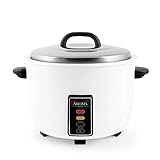

| Model | Stated capacity | Approx. footprint (W × D) | Best fit | What to check |
|---|---|---|---|---|
| Zojirushi NYC-36 | 20 cups uncooked | About 15 × 15 in | Steady service with a moderate counter allowance | Outlet load, minimum batch guidance, and cleaning access |
| Zojirushi NYC-54 | 30 cups uncooked | About 17 × 17 in | Higher-volume kitchens needing a larger batch | Whether one large batch suits your rush pattern |
| Panasonic SR-GA721 | About 40 cups uncooked | About 18 × 18 in | Large batches with simple cook-and-hold operation | Electrical requirements and space for the lid to open |
| Panasonic SR-GA421 | About 23 cups uncooked | About 16 × 16 in | Mid-size batches where a simple commercial design is preferred | Minimum batch size and hold performance for your rice type |
| CookTek 600900 | Model and pan configuration dependent | Check the selected configuration | Kitchens considering induction-based countertop cooking | Compatible cookware, electrical connection, and whether a rice-cooking setup is included |
Dimensions and capacities are useful screening figures, not a substitute for current manufacturer specifications: revisions and regional versions can differ. CookTek’s induction equipment is not a direct like-for-like rice cooker in every configuration, so include it only if the equipment package and workflow actually support rice cooking. For a straightforward comparison, focus first on dedicated rice cookers such as the Zojirushi and Panasonic models above.
Match capacity to the rush, not the menu’s daily total
Cooker capacity is commonly given in rice-cooker cups, which are smaller than a US measuring cup. More importantly, uncooked capacity is not the same as finished-rice output. Rice variety, water ratio, and cooking method affect yield, so use your own recipe’s measured yield for production planning.
Here is a practical sizing calculation. Suppose a restaurant serves 45 rice portions during its busiest 90-minute period. If each portion is 6 ounces of cooked rice, that rush requires 270 ounces, or about 16.9 pounds, of cooked rice. If a test batch yields 2.5 pounds of cooked rice per rice-cooker cup of uncooked rice, the theoretical requirement is about 6.8 cups uncooked. Add a 25% buffer for uneven demand, serving variation, and the time needed to start another batch: about 8.5 cups uncooked. A 10-cup unit may cover that rush if its minimum batch and cook time suit the schedule; a 20-cup model offers more headroom but takes more counter space and may be inefficient for small runs.
To use this method, weigh a real batch after cooking, record how many portions it serves, and calculate the busiest service window—not the whole day. If demand arrives in sharp bursts or the cooker takes longer than your replenishment window, choose enough capacity to cover the surge or use two smaller cookers so a second batch can start independently.
Choose the right setup for your kitchen
| Your situation | Practical direction | Why |
|---|---|---|
| Small café, food stall, or low-volume lunch counter | 10–20 cups uncooked | Less counter occupation and a better chance of running fresh, appropriately sized batches |
| Busy restaurant with a predictable rush | 20–30 cups, or two smaller units | One large batch simplifies production; two units add backup and staggered cooking |
| Catering or high-volume service with a concentrated peak | 30–40 cups or a multi-cooker plan | Greater batch capacity reduces refill frequency, provided the hold period remains acceptable |
| Several rice varieties or frequent small orders | Multiple smaller cookers | Separate batches reduce mixing and make it easier to cook each variety on demand |
Two smaller cookers can be more useful than one large one when service is unpredictable. You can run one batch while the other unit is cleaned or holding a different rice variety. The trade-off is more lids, inner pots, power connections, and surfaces to wipe down.
Evaluate holding quality as carefully as cooking
“Keep warm” is not a complete performance specification. Holding quality depends on the cooker’s design, the rice and recipe, how often the lid is opened, and how long rice stays in the pot. Ask the manufacturer for any stated holding guidance, then establish a kitchen policy based on the texture and food-safety requirements for your operation.
- Check the control style: Simple mechanical cook-and-hold controls are easy to train on; programmable models can help standardize batches if staff follow the same recipe and settings.
- Plan batch turnover: A large batch held too long can lose texture even if the cooker maintains heat. Estimate when it will be used up before choosing capacity.
- Limit lid opening: Repeated opening releases heat and moisture. Use a serving utensil that fits the workflow and keep the lid closed between portions.
- Use a separate food thermometer when required: Do not treat a warm setting as proof that rice meets your local food-safety rules. Follow applicable regulations and your kitchen’s approved time-and-temperature procedures.
Measure the real countertop footprint
Width and depth are only part of the space a cooker needs. Measure the counter, the lid’s full opening arc, clearance to shelves, and room for staff to lift out the inner pot. Leave the clearance specified by the manufacturer, particularly around vents and hot surfaces. Also consider whether the cooker will sit near a sink, where splashes can reach the controls, or at a busy pass where a protruding handle could be bumped.
Before buying, check the appliance’s voltage, wattage, plug, and circuit requirements against the kitchen’s available outlets. A high-capacity model can be a poor choice if it occupies the only usable counter or overloads a shared circuit. Have a qualified electrician assess the circuit when the equipment load is uncertain.
Account for cleaning time and wear
For a busy kitchen, the quickest-to-clean cooker may be more valuable than one with a slightly larger batch. Look for a removable inner pot with a durable nonstick or other food-release surface, a detachable inner lid or steam cap where applicable, and controls that can be wiped without directing water into the appliance. Confirm which pieces are dishwasher-safe in the specific model’s instructions rather than assuming they are.
- After each batch, remove loose rice with a nonabrasive utensil and soak the pot if residue has dried.
- Wash removable parts as directed; abrasive pads and metal utensils can damage coated surfaces.
- Wipe the exterior and heating area only as the manual permits, keeping liquid away from electrical components.
- Inspect the pot coating, lid seal, and steam vent regularly. A damaged surface or blocked vent can complicate cooking and sanitation.
Frequently asked questions
What does a rice cooker cup mean?
A rice-cooker cup is smaller than a US measuring cup. Commercial cooker capacities are commonly listed in rice-cooker cups, and published capacities typically refer to uncooked rice. Because uncooked capacity does not equal finished-rice output, weigh a real cooked batch and record how many portions it serves before planning production.
Should I choose one large cooker or two smaller cookers?
Two smaller cookers can be preferable when service is unpredictable or several rice varieties are needed. They allow separate batches, independent cooking, and continued production while one unit is being cleaned or holding another variety. One large cooker simplifies production for a predictable rush, but it may be less flexible and uses more capacity for small runs.
How can I estimate the cooker capacity my restaurant needs?
Estimate capacity from the busiest service window, not the menu’s daily total. Record the number of portions served during that period, weigh a real batch after cooking, and calculate its yield. Add a buffer for uneven demand, serving variation, and time needed to start another batch, then compare the result with the cooker’s minimum batch and cooking time.
Does the keep-warm setting guarantee that rice is safe?
No, a keep-warm setting does not prove that rice meets local food-safety rules. Holding quality depends on the cooker, rice, recipe, lid openings, and holding time. Follow applicable regulations and your kitchen’s approved time-and-temperature procedures, and use a separate food thermometer when required rather than treating the warm setting as complete verification.
What should I verify before plugging in a commercial rice cooker?
Verify the appliance’s voltage, wattage, plug, and circuit requirements against the outlets available in the kitchen. Also check the counter space, lid-opening arc, shelf clearance, inner-pot access, vents, and hot-surface clearance. If the equipment load is uncertain, have a qualified electrician assess the circuit before purchase or installation.
Bottom line
For a small operation, a 10–20-cup commercial cooker is often the most practical starting point. For a restaurant with a sustained rush, compare 20–30-cup models against a pair of smaller units, and move to 30–40 cups only when your measured peak demand justifies the space and holding volume. The strongest choice is the one that meets the rush with manageable batch turnover, fits the counter with safe clearance, and can be cleaned quickly between services.