Our Top Picks


Top 3 picks at a glance

Best Sear Stations for High-Heat Backyard Cooking
The best sear station for most backyard cooks is a dedicated propane flat-top or infrared gas burner that can deliver roughly 15,000–30,000 BTU per hour, depending on its cooking area and how quickly you need to recover heat. Choose a flat-top for several servings and flexible cooking; choose an infrared burner for fast, concentrated searing in a compact space; choose a charcoal setup if smoke and live-fire flavor matter more than precise temperature control.
There is no single best sear station for every yard. A small balcony, a large family patio, and a cook who wants to finish steaks beside a pellet grill have different limits for footprint, fuel, and setup. The useful comparison is not just advertised heat output: it is how much heat reaches the food, how many portions fit without crowding, and what the station demands from your space.
As an Amazon Associate we earn from qualifying purchases at no extra cost to you.

Compare the main sear-station types
| Station type | Typical heat-output range | Usable cooking area | Fuel and setup | Best fit |
|---|---|---|---|---|
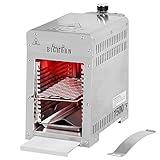
| Infrared gas burner | 12,000–20,000 BTU/hour | About 100–180 sq. in. | Usually propane; may need a compatible grill cart, side-burner cutout, or separate stand | Fast, focused searing for one or two steaks |
| Propane flat-top griddle | 20,000–60,000 BTU/hour total | About 300–700 sq. in. | One or more propane burners; freestanding units need outdoor floor space and a level surface | Multiple portions, smash burgers, vegetables, and mixed menus |
| Charcoal grill or compact charcoal sear setup | Not meaningfully rated in BTU/hour | About 150–400 sq. in. | Charcoal and airflow control; allow time to light, and plan for ash cleanup | Live-fire flavor and cooks who are comfortable managing a coal bed |
| High-output gas side burner | About 12,000–25,000 BTU/hour | Usually 80–150 sq. in. | Often connects to the grill’s gas supply; installation and fuel compatibility matter | A permanent outdoor kitchen with limited counter space |
These are broad comparison ranges, not guarantees of steak temperature. Burner design, wind, cold weather, cookware, and preheat time all change the heat that reaches the cooking surface. A large griddle’s combined burner rating also does not mean every square inch heats evenly.
Choose by your space and cooking style
| Your situation | Good starting choice | Why it fits | Check before buying |
|---|---|---|---|
| You sear one or two steaks at a time | Infrared burner | Concentrated heat and a relatively small cooking zone | Whether the burner is freestanding or requires a compatible grill |
| You cook for four or more, including sides | Propane flat-top griddle | A broad surface lets you sear and move food to a cooler area | Actual cooking dimensions, total burner output, storage, and grease management |
| You already have a built-in outdoor kitchen | Compatible gas side burner | Uses the existing counter and fuel infrastructure | Cutout dimensions, clearance requirements, and natural-gas or propane compatibility |
| You prioritize smoky flavor over quick startup | Charcoal setup | Offers direct live-fire cooking without a separate gas appliance | Safe placement, ash disposal, and local rules for open-flame cooking |
| You have a small patio or need to store the unit | Compact portable gas burner or griddle | Smaller footprint and easier storage than a full-size station | Folded dimensions, stable leg design, and safe storage for the fuel cylinder |
How much heat and cooking area do you actually need?
BTU per hour measures fuel input, not the temperature of the cooking surface. Treat it as a comparison point between similar designs, then consider burner layout and surface area. For example, a 30,000-BTU griddle with three burners may let you run one side hot and another side lower. A single 15,000-BTU infrared burner may reach intense temperatures in a smaller zone but leave little room to stage food.
A practical serving estimate is about 50–75 square inches of active searing area per large steak, plus room to move cooked food away from the hottest zone. For four steaks, that suggests roughly 250–350 square inches of useful surface—not merely the product’s outer dimensions. If you often cook burgers alongside onions or vegetables, add area for those foods rather than counting on a single crowded zone.
Worked example: sizing for four steaks
Suppose each steak needs about 65 square inches during searing. Four steaks need 4 × 65 = 260 square inches. Add roughly 25% for spacing and a cooler resting or staging zone: 260 × 1.25 = 325 square inches. A griddle with around 350 square inches of cooking surface is a more comfortable target than a 200-square-inch unit, even if both advertise high output. If you typically cook only two steaks, a smaller infrared burner can make better use of your space and fuel.
Fuel, installation, and the space around the station
- Propane: Flexible for portable and freestanding units, but you need a cylinder, a secure upright location, and a plan to monitor fuel. A larger multi-burner griddle may consume fuel much faster than a compact burner, especially during long preheats.
- Natural gas: Convenient for a permanent installation if a suitable gas line is already available. Confirm that the model is built or approved for natural gas; propane and natural-gas versions are not automatically interchangeable.
- Charcoal: Does not require a gas connection, but adds lighting time, ash handling, and more hands-on heat management. Keep it well away from buildings and combustible surfaces, and follow local fire restrictions.
- Built-in or side-burner models: Check the manufacturer’s required clearances, enclosure ventilation, counter cutout, and connection type before purchasing. A unit that physically fits an opening may still be unsafe or incompatible.
- Portable stations: Measure where the unit will be used and where it will be stored. Account for lid opening, grease collection, fuel-cylinder placement, and access around the cooking surface—not just the base footprint.
Always use outdoor cooking equipment outdoors and follow the product’s installation instructions and local fire rules. Never operate a propane burner in an enclosed garage, shed, or other enclosed space. If your patio is close to siding, railings, overhead covers, or neighboring property, confirm safe clearances before choosing a high-output flame appliance.
What separates a useful station from a frustrating one?
Heat distribution matters as much as peak heat. Multiple burners and independently adjustable zones help prevent the common problem of a scorching center and a weak edge. For a flat-top, a cooler zone is useful for finishing food without continuing to sear it. For an infrared burner, make sure the grate or cooking surface is sized for the portions you actually cook.
Check the cleanup path. Grease should drain into an accessible, removable tray or cup. A large flat-top can cook a crowd, but scraping and safely disposing of grease are part of the routine. Charcoal removes the grease-tray concern but replaces it with ash cleanup.
Budget for the whole setup. A basic portable burner may cost roughly $100–$300, while larger freestanding griddles commonly range from about $300–$800; built-in appliances and premium configurations can cost more. Allow for a compatible stand or cart, cover, fuel, and any professional gas-line or counter installation. Price alone does not tell you whether a unit’s cooking area and heat zones fit your needs.
Frequently asked questions
Can I use a propane sear station in my garage if the door is open?
No. The article says to use outdoor cooking equipment outdoors and never operate a propane burner in an enclosed garage, shed, or other enclosed space. If you plan to cook near siding, railings, an overhead cover, or neighboring property, confirm the product’s required clearances and local fire rules before setting up.
Can I connect a propane burner to my natural-gas line?
Only if the model is built or approved for natural gas and the connection is compatible. Propane and natural-gas versions are not automatically interchangeable. For a permanent setup, check the appliance’s fuel requirements and installation instructions before buying or connecting it.
Does a higher BTU rating guarantee a hotter cooking surface?
No. BTU per hour measures fuel input, not cooking-surface temperature. Burner design, layout, wind, cold weather, cookware, and preheating all affect heat at the food. A large griddle’s combined rating also does not guarantee even heat across its entire surface.
What should I measure besides the station’s base?
Measure the cooking and storage locations, and account for lid opening, grease collection, fuel-cylinder placement, and access around the cooking surface. For built-in units, also check the counter cutout, enclosure ventilation, clearances, and connection type; fitting the opening alone does not ensure a safe or compatible installation.
Bottom line
For a small, fast steak-searing station, choose an infrared gas burner with a clearly compatible mounting setup. For family meals and a wider menu, a propane flat-top with several burners, at least 300–350 square inches of cooking area, and an accessible grease system is usually more versatile. Pick a side burner when your outdoor kitchen already supports one, and choose charcoal when live-fire flavor is worth the extra time and cleanup. Match the station to the portions you cook, the fuel you can supply, and the clear space you can safely dedicate to it.