The best thermostatic shower valves for steady water are dedicated thermostatic mixers from GROHE, hansgrohe, Kohler, and comparable brands, but the right choice depends on your existing pipework, available flow, and whether you want exposed or concealed installation.
A thermostatic valve controls temperature with a sensing element: when the cold-water supply briefly drops, it reduces hot-water flow to keep the outlet near the selected setting. That is different from a pressure-balancing valve, which limits the hot-water side when pressure changes but does not regulate temperature as precisely. For a consistently comfortable shower, a thermostatic valve is usually the better choice—provided your water heater and supply pipes can deliver enough hot water.
As an Amazon Associate we earn from qualifying purchases at no extra cost to you.


Our Top Picks
 FUGO RV Thermostatic Shower Faucet4.5 x 7.5 x 1.8 inches7.5 x 4.5 x 1.8 inches2.5 poundsCheck on Amazon
 hansgrohe Ecostat Modern Thermostatic Shower Valve Trim withChrome3 x 6.75 x 6.75 Inches4.84 poundsCheck on Amazon
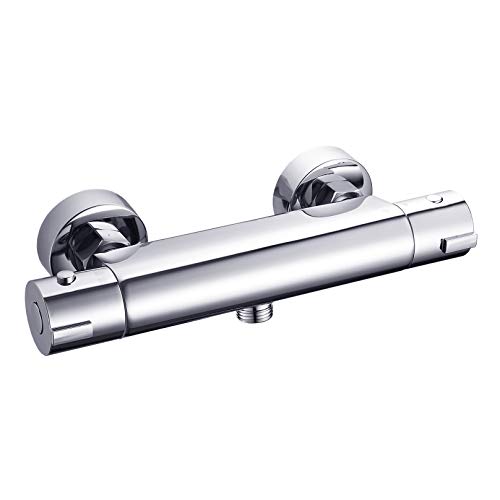
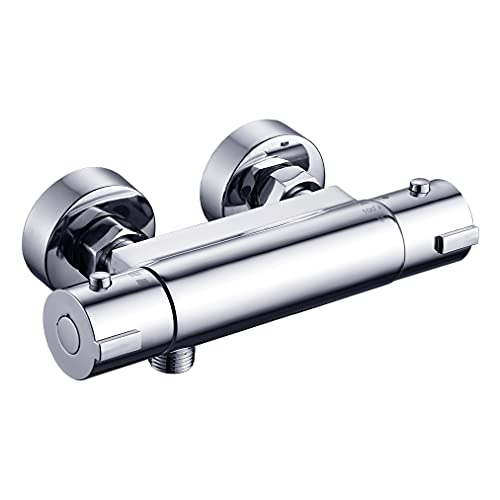
Top 3 picks at a glance
Thermostatic vs. pressure-balancing valves
Pressure-balancing valves remain common because they are relatively simple, affordable, and widely compatible with existing shower plumbing. They are a sensible replacement when the original installation already uses that valve type and the shower has modest flow requirements. However, they can allow temperature drift as the water supply changes, especially when a toilet is flushed or another tap is opened.
Thermostatic valves use a temperature cartridge, commonly with a safety stop around 38°C (100°F). They react to temperature change rather than merely balancing pressure. This makes them better for households with children, older users, multiple bathrooms, or showers supplied by a combi boiler or storage cylinder where demand changes during use.
| Valve type | Typical flow capability | Temperature stability | Best installation situation | Main limitation |
|---|---|---|---|---|
| Pressure-balancing valve | About 5–8 gallons per minute (19–30 L/min), depending on pressure and trim | Good against pressure swings; moderate against temperature changes | Like-for-like replacement with existing valve body | Does not actively maintain a selected temperature |
| Thermostatic mixer | About 6–10 gallons per minute (23–38 L/min) for many shower applications | Very good when hot and cold supplies are correctly sized | New builds, remodels, and higher-comfort showers | Requires correct hot-water temperature and minimum flow |
| High-flow thermostatic valve | Often 8–12 gallons per minute (30–45 L/min) or more with suitable supplies | Very good, but supply-dependent | Rain showers, body sprays, and multiple outlets | Can exceed the capacity of small pipes or water heaters |
Best thermostatic shower valves by installation type
Best for concealed new installations: GROHE Grohtherm or Kohler MasterShower thermostatic systems
GROHE Grohtherm concealed valves and Kohler MasterShower thermostatic valves are strong choices when the wall is open and the pipework can be planned from scratch. They are available in configurations for one, two, or more outlets, such as a fixed head, hand shower, and body sprays.
The key advantage is configuration flexibility. A diverter or volume control can be separated from the temperature control, so each outlet can be managed without forcing every function through one compact control. Choose a model with the required number of outlets before rough-in; adding a second outlet later may require opening the wall.
These systems usually need hot and cold supplies connected to clearly marked inlets, adequate service access, and a finished wall thickness within the manufacturer’s specified range. A concealed valve is attractive and easy to wipe clean, but cartridge access is more important than the smallest possible trim plate.
Best for an exposed retrofit: GROHE Grohtherm 1000 or hansgrohe ShowerTablet thermostatic mixers
Exposed thermostatic mixers such as the GROHE Grohtherm 1000 and hansgrohe ShowerTablet range are often the easiest route when the existing plumbing is accessible and you do not want to remove wall tile. The valve body sits on the finished wall and typically connects to standard hot-and-cold shower outlets using exposed-wall connectors.
This design is practical for replacing an old exposed mixer, although the inlet spacing and connection orientation must match. Many exposed valves use a nominal 150 mm center-to-center connection, but adapters may be required if your existing outlets differ. Measure from the centers of the two threaded outlets—not from the edges of the cover plates.
Exposed mixers also provide useful service access. If the thermostatic cartridge eventually needs cleaning or replacement, the work is normally less disruptive than with a concealed valve. The trade-off is a larger visible body and less freedom to position the controls.
Best when matching an existing concealed rough-in matters: Kohler Rite-Temp or Delta Universal rough-in systems
Delta R10000 Universal rough-in valves are widely used concealed shower bodies, but many Delta trim combinations built around this platform are pressure-balancing rather than thermostatic. Kohler Rite-Temp systems are also generally pressure-balancing products. They can be excellent like-for-like replacements, but do not assume that a thermostatic trim will fit a pressure-balancing body.
Before buying, identify the valve body behind the wall and the exact trim family designed for it. A trim plate that looks similar may use a different cartridge, stop location, or mounting arrangement. If you are remodeling without opening the wall, compatibility with the existing rough-in is often more important than choosing a theoretically superior valve.
Flow rate: calculate before choosing a rain shower
A high-flow valve cannot create water that the plumbing or heater cannot supply. Add the maximum flow rates of outlets that may run at the same time. For example, a 2.5-gpm fixed head plus a 1.75-gpm hand shower requires:
2.5 gpm + 1.75 gpm = 4.25 gpm
That is about 16.1 L/min. If a body spray circuit adds four 0.5-gpm sprays, the total becomes 6.25 gpm, or approximately 23.7 L/min. A valve rated for 10 gpm may handle that demand, but the building supply, stop valves, filters, and water heater still need to maintain it.
Hot-water capacity matters as well. If the shower uses 4.25 gpm with a 50/50 hot-and-cold mix, the heater must deliver roughly 2.125 gpm of hot water continuously. A small tankless heater may not sustain that flow at a large temperature rise, while a storage cylinder may provide strong initial flow but run out of usable hot water. For multiple outlets, select the valve only after checking the heater’s continuous hot-water output.
Finish compatibility is more than color
Manufacturers often sell trims in chrome, brushed nickel, matte black, polished nickel, brushed brass, and other finishes. The visible finish does not determine the valve’s internal performance, but it does affect replacement planning.
- Choose the rough-in body and trim from the same compatible product family.
- Confirm that the selected finish is available for every required component: temperature control, diverter, volume control, escutcheon, shower arm, and hand-shower bracket.
- Do not assume “brushed nickel” from one manufacturer matches “brushed stainless” or “brushed brass” from another.
- For dark or metallic finishes, use a soft cloth and mild soap rather than abrasive cleaner, which can permanently change the surface.
- If a future cartridge replacement may be needed, keep the exact model and finish information with the house records; the cartridge is usually finish-independent, but the trim parts are not.
Decision matrix for common bathroom situations
| Your situation | Most suitable valve class | Why | Check before ordering |
|---|---|---|---|
| Open-wall renovation with one shower head | Concealed thermostatic single-outlet valve | Clean appearance and accurate temperature control | Wall depth, service access, and hot/cold inlet orientation |
| Existing exposed mixer with no desire to retile | Exposed thermostatic mixer | Usually the least disruptive installation | Inlet spacing, thread standard, and pipe centerline height |
| Existing concealed pressure-balancing body | Compatible pressure-balancing trim, or replace the body | Most thermostatic trims will not retrofit directly | Rough-in model and cartridge compatibility |
| Fixed head plus hand shower | Thermostatic valve with two independent outlets or diverter | Prevents unwanted flow through both outlets | Whether the diverter is separate and the combined flow rate |
| Rain head plus body sprays | High-flow thermostatic valve with separate volume controls | Allows simultaneous outlet control and higher demand | Pipe diameter, supply pressure, heater output, and total gpm |
| Child- or accessibility-focused bathroom | Thermostatic valve with temperature limit stop | Reduces scald risk and simplifies repeatable settings | Factory safety setting, accessible controls, and local code |
Installation requirements that affect the result
Install the valve with the hot and cold connections on the correct sides and follow the manufacturer’s orientation markings. Reversed supplies can make a thermostatic cartridge behave incorrectly or fail to regulate temperature. Flush new or modified pipework before fitting the cartridge, because solder, joint compound, scale, and debris can damage its small internal passages.
Use service stops when the valve design provides them. They allow cartridge maintenance without shutting off the entire home. Set the high-temperature limit only after the shower is operating and measure the water at the outlet with a thermometer. Local plumbing rules vary, but many installations use a maximum delivered temperature near 49°C (120°F), with a thermostatic stop around 38°C (100°F) for everyday use.
Minimum pressure and minimum flow are just as important as maximum ratings. Some thermostatic cartridges need a small amount of flow on both hot and cold sides before they regulate properly. If the shower sputters at low flow, check inlet filters, isolation valves, and supply pressure before blaming the cartridge.
How to choose among the best thermostatic shower valves
Choose an exposed GROHE or hansgrohe thermostatic mixer when retrofit simplicity and service access are priorities. Choose a concealed GROHE Grohtherm or Kohler MasterShower system when you are opening the wall and want independent control of multiple outlets. Choose a compatible Delta or Kohler pressure-balancing trim when preserving an existing rough-in is essential and precise thermostatic regulation is not required.
The most reliable purchase is the one that matches the complete system: valve type, rough-in body, pipe size, outlet flow, heater capacity, connection spacing, and finish family. A premium thermostatic cartridge cannot compensate for undersized plumbing or an incompatible concealed body.
Frequently asked questions
What should I check before replacing my shower valve?
Identify whether the existing valve body is thermostatic or pressure-balancing, and confirm which trim is compatible with it. A trim that looks similar may use a different cartridge, stop location, or mounting arrangement. Also check the pipe connections and whether the replacement needs an exposed mixer or a concealed valve.
Can a thermostatic valve prevent a shower from turning cold?
It can reduce temperature swings when the cold-water supply changes, but it cannot compensate for inadequate hot-water capacity. The article notes that the heater and supply pipes must deliver enough hot water, and that a storage cylinder may run out of usable hot water. Check the heater’s continuous output against the outlets you plan to use.
Can two shower outlets run at the same time?
That depends on the valve configuration and the available water supply. Add the maximum flow rates of the outlets that may run together, then check that the pipes and water heater can sustain the total. For example, the article calculates that a 2.5-gpm head and a 1.75-gpm hand shower require 4.25 gpm.
What is a thermostatic safety stop for?
A safety stop helps limit how hot the water can be set, with thermostatic cartridges commonly having a stop around 38°C (100°F). The valve senses temperature and adjusts hot-water flow to keep the outlet near the selected setting. Follow the specific valve’s instructions when setting or adjusting its controls.
How can I make sure an exposed mixer fits my existing connections?
Measure the distance between the centers of the two threaded outlets and check the connection orientation before ordering. Many exposed valves use a nominal 150 mm center-to-center connection, but adapters may be needed if your outlets differ. Measuring from the centers, rather than the edges of the cover plates, gives the relevant spacing.