Our Top Picks
 FEELLE Solar Power Bank 50000mAh Magnetic Portable Charger7.24 x 3.54 x 1.97 inches1.1 poundsCheck on Amazon
 SOARAISE Solar Power Bank 48000mAh Wireless Portable Charger6.38 x 3.43 x 1.57 InchesCheck on Amazon
 Jackery HomePower 3600 Plus & 2x200W Solar Panels15.2 x 12.2 x 19.3 Inches77.16 poundsCheck on Amazon



Top 3 picks at a glance
Quick Comparison
This table covers every model in this roundup so you can see the whole field at a glance. “Price tier” is a general market band, not a fixed figure — solar power bank and portable power station listings move around a lot with promotions and bundle changes, so treat budget as the least expensive band, mid-range as the middle, and premium as the top band.
| Product | Best for | Key specs (per listing) | Price tier |
|---|---|---|---|
| FEELLE Solar Power Bank 50000mAh Magnetic | Maximum capacity in a hand-carry battery, off-grid backup | 50,000mAh class, magnetic wireless attachment, hand crank, solar panel, USB outputs | Premium |
| BLAVOR Solar Power Bank 10,000mAh Wireless | Pocketable everyday carry and short trips | 10,000mAh, wireless charging pad, solar panel, USB-C/USB-A, compact body | Budget |
| SOARAISE Solar Power Bank 48000mAh with 4 Cables | Group trips where nobody brought a cable | 48,000mAh class, wireless charging, four built-in cables, solar panel | Mid-range |
| Jackery Explorer 300 (292Wh) | Powering laptops, fans and small appliances from a wall-style AC outlet | 292Wh Li-ion, pure sine wave AC output, USB-A/USB-C, 12V car port, solar input | Premium |
| BLASOUL Solar Power Bank 49800mAh 22.5W | Fast top-ups of phones and tablets from a big battery | 49,800mAh class, 22.5W fast charging, wireless charging, four built-in cables | Mid-range |
| YELOMIN 38800mAh Solar Power Bank | Budget buyers who want USB-C fast charging and dual outputs | 38,800mAh class, USB-C fast charging, dual outputs, solar panel, iPhone/Samsung compatibility | Budget |
| Nuynix 49800mAh Solar Power Bank | Cheapest route to a very large capacity rating | 49,800mAh class, 15W fast charging, USB charging, solar panel | Budget |
| Jackery HomePower 3600 Plus + 2x200W Panels | Whole-home backup and serious off-grid solar arrays | 3584Wh, 3600W AC output, expandable, paired with two 200W solar panels | Premium |
| Durecopow Solar Charger Power Bank 20,000mAh | Light and cheap emergency top-ups | 20,000mAh, four cables, three ports, fast charging | Budget |
| SOARAISE 50000mAh 22.5W Solar Power Bank | High-capacity phone charging with wireless convenience | 50,000mAh class, 22.5W output, wireless charging, solar panel | Mid-range |
| SolarTred Solar Power Bank 20000mAh, 4 Panels | Faster solar trickle charging from a larger panel area | 20,000mAh, four solar panels, three built-in cables | Mid-range |
| LATIMERIA Solar Power Bank with 3 Panels | Compact foldable panel area with built-in cables | Three solar panels, two built-in cables, portable body | Mid-range |
How We Chose
These picks were selected by comparing published listing specifications and category norms, not by physical testing. The goal was a set that covers the real spread of what buyers want when they search for the best solar power banks: something pocketable, something with maximum capacity, something that can run AC appliances, and something that can back up a house.
Four criteria drove the list. First, capacity honesty — the headline mAh figure on a power bank is measured at the cell’s nominal voltage, and the usable energy that reaches your phone is lower after voltage conversion. We favored models whose numbers are consistent with their physical size rather than spectacular numbers on a tiny body. Second, port fit — built-in cables, USB-C PD, wireless pads and AC outlets solve different problems, so the list deliberately spans all of them. Third, panel area and realism — a solar panel the size of a phone is a trickle charger, and we say so plainly instead of implying otherwise. Fourth, category fit and upgrade path — a 10,000mAh pocket bank and a 3584Wh home battery are not competitors, so each entry is presented as a rung on a ladder, with the next logical step named.
Where a listing does not state an exact figure, this article describes the spec by class (for example, “15W-class fast charging”) rather than inventing a number. Prices appear only as general market bands.
1. FEELLE Solar Power Bank 50000mAh Magnetic — Best for Maximum Capacity in a Hand-Carry Battery
As an Amazon Associate we earn from qualifying purchases at no extra cost to you.

The FEELLE 50000mAh is the top of the hand-carry battery ladder in this roundup. If your question is “what is the biggest battery I can still lift with one hand and keep in a backpack,” this is the category answer. It pairs the two headline features people look for in a premium solar bank — a 50,000mAh-class cell and a hand crank — with a magnetic attachment system that lets a compatible phone snap onto the body for wireless charging without a cable.
Who it suits
This is for campers who run multiple devices across several days, emergency preppers who want a battery that does not depend on a wall outlet or a fuel source to be useful, and households in storm-prone areas where a multi-day outage is a realistic scenario. It is also the pick for anyone who already owns a MagSafe-compatible phone and wants the convenience of snapping it on rather than hunting for a cable in the dark.
Key specs
- 50,000mAh-class lithium cell — the largest capacity rating in the power bank portion of this list
- Magnetic wireless charging surface for compatible phones
- Hand crank generator for manual top-ups when solar is unavailable (night, overcast days, indoor outages)
- Integrated solar panel for trickle charging in daylight
- USB outputs for cabled charging of phones, tablets, earbuds and small accessories
- Ruggedized, larger-than-pocket body that reflects the cell inside
Strengths
The capacity is the point. At roughly 50,000mAh, this bank can carry a typical phone from empty to full several times over on a single charge, which means a weekend trip does not require you to think about power at all. The three-way charging input — wall, solar, hand crank — is what separates it from a plain power bank: the crank in particular gives you a fallback that no panel or outlet can match, and its value shows up exactly when the other two are unavailable.
The magnetic mount is a genuinely useful ergonomic feature rather than a gimmick. It removes one cable from the equation at the moment when you least want to fumble — in a tent, in a car, in a blackout. The magnetic hold also keeps the phone aligned on the charging coil, which is where a lot of inexpensive wireless banks go wrong.
Build quality on this class of product is usually heavier and more sealed than a pocket bank, which matters if it lives in a pack or a glovebox. And because the capacity is so large, even slow solar trickle charging is a meaningful supplement over a multi-day trip rather than a rounding error.
Pros
- Largest capacity in the hand-carry portion of this list
- Three charging inputs: wall, solar and hand crank
- Magnetic wireless charging for compatible phones
- Fewer cables needed for a typical phone
- Doubles as a serious household emergency reserve for phones and small devices
Cons
- Heavy and bulky compared with a 10,000–20,000mAh bank
- Premium tier pricing relative to the mid-range 48,000–50,000mAh options here
- Solar charging is still slow — the panel supplements, it does not refill the whole battery in a day
- Hand cranking is a last-resort method, not a practical way to refill 50,000mAh
- Magnetic wireless charging requires a compatible phone or a magnetic case
How it compares
The nearest alternative is the SOARAISE 50000mAh 22.5W, which matches the capacity class and adds fast wired output, but has no hand crank and no magnetic mount. If you want the largest battery plus a manual fallback, the FEELLE wins. If you mainly want to charge phones quickly and wirelessly, the SOARAISE gets you the same capacity band for less. Against the Jackery Explorer 300, the comparison is about output type: the Jackery gives you true AC power for laptops and small appliances, but at 292Wh its usable energy is a fraction of a 50,000mAh bank’s — the Jackery is about what you can run, the FEELLE is about how long you can run phones.
2. BLAVOR Solar Power Bank 10,000mAh Wireless — Best for Pocketable Everyday Carry
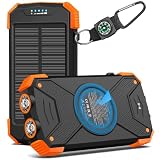
The BLAVOR 10,000mAh is the opposite philosophy from the FEELLE: small, light, and priced in the budget band. It exists for the person who wants a solar power bank that actually fits in a jacket pocket and gets used, rather than a heavy battery that stays in a drawer because carrying it is a chore.
Who it suits
Day hikers, commuters, festival-goers, and anyone building a lightweight emergency kit. It is also the right first solar power bank for a teenager or a casual camper, because the cost of entry is low and the learning curve is short. If your trips are measured in hours rather than days, this is the capacity band you want.
Key specs
- 10,000mAh-class cell — roughly one to two full phone charges in practice
- Wireless charging pad for compatible phones
- Integrated solar panel for trickle top-ups
- USB-A and USB-C ports for cabled charging
- Compact, pocket-friendly chassis
Strengths
The size is the feature. A power bank you carry is worth more than a bigger one you leave behind, and 10,000mAh is the sweet spot where capacity still covers a normal day of phone use. Wireless charging on a bank this small is unusual and convenient — set the phone down and let it top up without a cable.
As an emergency item it is cheap enough to own several. A 10,000mAh bank in the glovebox, one in a desk drawer and one in a hiking pack solves the “where is the power bank” problem better than a single large unit ever will. The integrated solar panel makes it self-sufficient on a sunny day, so it can recover some charge while clipped to the outside of a pack during a lunch stop.
Pros
- Genuinely pocketable — the most portable entry in this roundup
- Budget tier pricing makes multiples affordable
- Wireless charging without a cable
- Simple, reliable feature set with few failure points
- Good first solar power bank for casual users
Cons
- 10,000mAh is not enough for multi-day trips or multiple devices
- Solar panel is small, so solar charging is slow and weather-dependent
- Cannot power laptops or AC appliances
- Will not charge a tablet as many times as a larger bank
- Wireless charging drains the battery faster than a cable
How it compares
Its closest sibling in spirit is the Durecopow 20,000mAh, which doubles the capacity and adds built-in cables and three ports, at the cost of a bulkier body. If you want one bank that covers two phones for a weekend, the Durecopow is the better pick; if you want something you will actually carry every day, the BLAVOR wins. Against the SolarTred 20000mAh with four panels, the BLAVOR trades capacity and panel area for pocketability — a fair trade only if portability is your top priority.
3. SOARAISE Solar Power Bank 48000mAh with 4 Cables — Best for Group Trips With No Cable Sharing

The SOARAISE 48000mAh sits in the mid-range band with a very specific advantage: four built-in cables. That single design choice eliminates the most common failure mode of group camping power — one person brought the bank, nobody brought a Lightning cable, and half the group cannot charge.
Who it suits
Families, car campers, road trippers and anyone who shares a power source with other people. It also suits a household that wants a single big battery on a shelf for outages, since the built-in cables mean no accessories are needed when the power goes out at 2 a.m.
Key specs
- 48,000mAh-class cell — near the top of the hand-carry capacity band
- Four built-in output cables, covering the common phone connectors
- Wireless charging surface for compatible phones
- Integrated solar panel for daytime trickle charging
- Additional USB ports for charging extra devices simultaneously
Strengths
Built-in cables are more valuable than they look. They cannot be forgotten, they cannot be lost, and they cannot be the one cable that does not fit. On a trip with three or four people, having four cables on the bank means four phones can be topped up from a single brick without anybody digging through a bag.
The 48,000mAh capacity is enough to keep a group’s phones alive for several days without a wall outlet, and the wireless pad gives you a fifth charging path for anyone with a compatible phone. Since it is mid-range tier rather than premium, you get most of the capacity of the 50,000mAh flagships for less money, giving up mainly the hand crank and magnetic mount.
Pros
- Four built-in cables — nothing extra to pack
- Very large capacity at a mid-range price
- Wireless charging as an additional output method
- Can charge multiple devices at once
- Excellent value as a shared trip battery
Cons
- Heavy — expect it to stay in a vehicle or basecamp rather than a daypack
- No AC outlet, so no laptops or appliances
- No hand crank fallback
- Built-in cables eventually wear at the flex point with heavy use
- Solar charging still takes many days of good sun to refill the battery
How it compares
Against the SOARAISE 50000mAh 22.5W, this model trades a small amount of capacity and fast-charging speed for the four built-in cables. If speed matters more than convenience, the 22.5W version is the one; if you are managing a group, the four-cable model is more useful. Against the BLASOUL 49800mAh, which also has four built-in cables and adds 22.5W fast charging, the SOARAISE competes on price rather than outright features.
4. Jackery Explorer 300 (292Wh) — Best for Running Laptops and Small Appliances

The Jackery Explorer 300 is not a power bank in the pocket sense — it is a small portable power station, and that changes what it can do. Its 292Wh of stored energy and true AC outlet mean it can run things a USB power bank simply cannot, from a laptop charger to a small fan, a CPAP machine or a mini cooler.
Who it suits
Car campers who work remotely, van lifers, photographers charging camera batteries and drone packs, and households that want a quiet indoor backup for a router, a fan and phone charging during an outage. If your devices run on AC adapters rather than USB, this is the category you need.
Key specs
- 292Wh lithium-ion capacity — roughly equivalent in raw energy to a very large power bank, but delivered differently
- Pure sine wave AC output suitable for sensitive electronics
- Multiple USB-A and USB-C ports for direct device charging
- 12V car port output for accessories
- Solar input for charging from an external solar panel (panel sold separately)
- Internal battery management and cooling for continuous use
Strengths
The AC outlet is the whole point. A 50,000mAh power bank holds comparable energy, but you cannot plug a laptop power brick into it. The Explorer 300 can run a typical laptop for hours, keep a router and a fan alive through an evening outage, and charge camera batteries on location. Pure sine wave output means it will not upset sensitive electronics the way a modified sine wave inverter can.
It also charges fast from a wall outlet, so it can be topped up in a couple of hours before a trip rather than overnight. Combined with a folding solar panel, it becomes a genuinely off-grid power source that can be replenished over a day of good sun, which is a much better ratio than a phone-sized solar panel on a power bank.
Pros
- Real AC output for laptops, fans, lights and small appliances
- Pure sine wave — safe for sensitive electronics
- Charges quickly from a wall outlet
- Scales with an external solar panel far better than a pocket bank
- Quiet, fume-free alternative to a small generator indoors
Cons
- Far heavier and larger than any power bank here
- No built-in solar panel — you need to buy one separately
- Premium tier pricing
- 292Wh will not run high-draw appliances like space heaters or kettles
- Overkill if you only need to charge phones
How it compares
Against the FEELLE 50000mAh, the choice is about output type rather than capacity. The FEELLE carries more phone charges and has a hand crank; the Jackery can run a laptop and an AC device but holds less phone-charging energy in total. Against the Jackery HomePower 3600 Plus, the Explorer 300 is a day-trip companion while the HomePower is a whole-home installation — same brand, completely different scale and purpose.
5. BLASOUL Solar Power Bank 49800mAh 22.5W — Best for Fast Charging a Big Battery

The BLASOUL 49800mAh pairs the mid-range capacity band with 22.5W fast charging and four built-in cables, which makes it one of the most balanced options in this list. It takes the two things people complain about most with big solar banks — slow output and forgotten cables — and addresses both.
Who it suits
Travelers who charge multiple devices quickly, photographers and videographers who need to top up phones and tablets between shoots, and campers who want a single large bank that behaves like a modern fast charger rather than an overnight trickle.
Key specs
- 49,800mAh-class cell
- 22.5W fast charging output — the fastest wired tier in the power bank portion of this list
- Wireless charging pad for compatible phones
- Four built-in cables covering common connectors
- Integrated solar panel for trickle charging
Strengths
22.5W output means a modern phone can recover a large percentage of its battery in well under an hour rather than over a couple of hours. Combined with a 49,800mAh cell, that changes how the bank feels in use: it is not just a reservoir, it is a fast one. The four built-in cables mean you rarely need to unpack anything, and the wireless pad covers the cable-free case.
Because capacity and output are both high, this works as a single do-everything bank for a small group or a couple. It is mid-range tier, so it undercuts the 50,000mAh premium flagships while matching them closely on the specs most people actually use.
Pros
- 22.5W fast charging for quick top-ups
- Very large capacity at a mid-range price
- Four built-in cables plus wireless charging
- Good all-rounder for couples and small groups
- Covers phones, tablets and small USB accessories
Cons
- Heavy — not a pocket bank
- No AC outlet or hand crank
- Fast charging draws down capacity faster than slow charging
- Solar panel is a supplement, not a practical full recharge method
- Some devices will not negotiate the full 22.5W, so real speed varies by phone
How it compares
Its direct rival is the SOARAISE 48000mAh with 4 Cables, which offers the same convenience package with slightly less capacity and no fast-charging headline. Between the two, the BLASOUL is the faster bank. The other close match is the SOARAISE 50000mAh 22.5W, which matches capacity and speed but relies on wireless rather than four built-in cables — so the deciding question is whether you prefer cables attached to the bank or a cable-free pad.
6. YELOMIN 38800mAh Solar Power Bank — Best Budget USB-C Fast Charging Bank

The YELOMIN 38800mAh is the budget-tier option that still offers USB-C fast charging and dual outputs. It sits in a useful middle capacity band — noticeably bigger than a 20,000mAh bank, noticeably cheaper than a 50,000mAh one — and covers iPhone and Samsung users with its port selection.
Who it suits
Budget-conscious campers who want multi-day capacity without the premium price, Android and iPhone users who want USB-C fast charging, and households that want one large bank for emergency use without spending flagship money.
Key specs
- 38,800mAh-class cell
- USB-C fast charging support
- Dual outputs for charging two devices at once
- Integrated solar panel for trickle charging
- Listed compatibility with iPhone and Samsung devices
Strengths
The capacity-to-price ratio is the strongest argument here. 38,800mAh is enough for several phone charges and a couple of tablet top-ups, which covers a long weekend for one or two people. Adding USB-C fast charging at a budget tier is the feature that keeps it relevant — it means the bank does not feel like a slow, outdated brick when you plug a modern phone in.
Dual outputs let you charge a phone and earbuds or a second phone at the same time, which matters more than it sounds when two people are sharing one bank. Solar input means it can pick up a little charge on a sunny day, and the size sits in a comfortable middle ground between pocket banks and the big 48,000–50,000mAh units.
Pros
- Budget pricing for a nearly 40,000mAh capacity rating
- USB-C fast charging support
- Dual outputs for two devices at once
- Lighter and easier to pack than a 50,000mAh bank
- Works with both iPhone and Samsung phones
Cons
- No built-in cables, so you must pack your own
- No wireless charging
- Slower output than the 22.5W models in this list
- No AC outlet and no hand crank
- Solar charging remains a slow supplement
How it compares
Against the Nuynix 49800mAh, the YELOMIN gives up about 11,000mAh of rated capacity but adds USB-C fast charging and dual outputs at the same budget tier — for most phone users, the faster port is worth more than the extra capacity. Against the Durecopow 20,000mAh, the YELOMIN roughly doubles the capacity for a modest step up in size, making it the better choice for weekend trips rather than day trips.
7. Nuynix 49800mAh Solar Power Bank — Best Budget Route to Huge Capacity

The Nuynix 49800mAh is the cheapest way in this list to get a capacity rating near 50,000mAh. It uses 15W-class fast charging and standard USB charging rather than premium fast-charge protocols, so the trade-off is clear: you get the biggest battery number in the budget tier, and you accept slower refills of your phone.
Who it suits
Buyers whose priority is maximum stored energy per dollar — someone stocking an emergency kit, a cabin owner, or a camper who charges devices overnight rather than needing a quick top-up in 30 minutes.
Key specs
- 49,800mAh-class cell
- 15W-class fast charging
- USB charging output
- Integrated solar panel for trickle charging
- Larger chassis consistent with the big cell inside
Strengths
Capacity per dollar is the entire pitch. If you compare the Nuynix to the premium 50,000mAh banks, you are getting the same capacity band without paying for a hand crank, a magnetic mount or top-tier fast charging. For an emergency kit that sits in a cupboard for months and then gets used during a storm, that is a sensible allocation of money.
15W charging is not slow in absolute terms — it will still refill a modern phone in a couple of hours — it is simply a step below the 22.5W models here. For overnight charging, where speed does not matter, that difference disappears entirely.
Pros
- Near-50,000mAh capacity at budget pricing
- 15W charging is adequate for overnight top-ups
- Simple, easy-to-understand feature set
- Large reserve for multi-day trips and outages
- Good value as a second, stay-at-home emergency bank
Cons
- No built-in cables
- No wireless charging
- Slower output than the 22.5W mid-range models
- Heavy for the price you pay in portability
- No AC outlet or hand crank
How it compares
Against the YELOMIN 38800mAh, the Nuynix wins on raw capacity and loses on port speed and dual-output flexibility. If you charge overnight, take the Nuynix; if you want faster top-ups in the field, take the YELOMIN. Against the BLASOUL 49800mAh, the Nuynix is essentially the same capacity class with slower charging and no built-in cables or wireless pad, at a lower tier — a straightforward trade of features for price.
8. Jackery HomePower 3600 Plus + 2x200W Solar Panels — Best for Whole-Home Backup
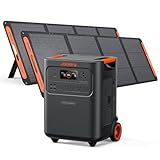
The Jackery HomePower 3600 Plus is in a different category from everything else here. With 3584Wh of capacity, 3600W of AC output and a bundle that includes two 200W solar panels, it is a home battery system designed to keep a house running through an outage or to power an off-grid setup.
Who it suits
Homeowners in areas with unreliable grids, people building a cabin or tiny home, and anyone who wants a solar-charged backup that can run a refrigerator, lights, internet and a few appliances for an extended period. This is also the right tier for someone who wants to expand capacity over time rather than replace hardware.
Key specs
- 3584Wh total capacity — roughly twelve times the stored energy of the Jackery Explorer 300
- 3600W AC output, enough to run high-draw household appliances
- Bundled with two 200W solar panels for a 400W nominal solar input
- Expandable capacity design for adding battery modules
- Multiple AC, USB and DC outputs for household devices
- Designed for indoor and covered-outdoor installation
Strengths
The scale changes what is possible. At 3584Wh with 3600W output, this system can run a refrigerator, a router, lights, a TV and phone charging through a multi-day outage — the exact scenario where a phone-sized solar bank is useless. The bundled 200W panels mean it can be recharged from sunlight without any additional purchases, and 400W of combined solar input is enough to meaningfully replenish a battery this size over a sunny day.
The expandable architecture is the real long-term advantage. You are not buying a sealed appliance; you are buying into a platform you can grow as your needs change. For off-grid cabins, this is often the deciding factor.
Pros
- Whole-home scale capacity and output
- Includes two 200W solar panels — usable off-grid out of the box
- Runs refrigerators and other high-draw appliances
- Expandable for future capacity needs
- Quiet and emission-free compared with a generator
Cons
- Heaviest and most expensive option in this roundup by a wide margin
- Not portable in any everyday sense — this is an installation, not a pack item
- Solar recharge depends heavily on weather and panel placement
- Requires planning around household circuits and placement
- Massive overkill for camping or phone charging
How it compares
Against the Jackery Explorer 300, the HomePower is the same idea scaled up by roughly twelve times in capacity and far more in output. The Explorer 300 covers a weekend and a laptop; the HomePower covers a house. Against every power bank in this list, it is not a competitor at all — those are personal devices, this is infrastructure. If you are choosing between them, the answer is that most people eventually want both: a big battery at home and a small one in the bag.
9. Durecopow Solar Charger Power Bank 20,000mAh — Best Cheap Bank With Cables and Ports
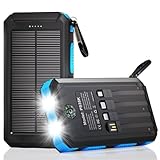
The Durecopow 20,000mAh sits between the pocketable 10,000mAh banks and the heavy 38,000–50,000mAh units. It brings four cables and three ports to the budget tier, which makes it a strong value pick for light camping and glovebox duty.
Who it suits
Weekend campers, day-trippers, and anyone who wants a cheap, self-contained bank that needs no accessories. The 20,000mAh band is the classic sweet spot for a two-day trip with one phone.
Key specs
- 20,000mAh-class cell
- Four built-in cables covering common connectors
- Three ports for charging multiple devices
- Fast charging support
- Portable body suited to a daypack
Strengths
Four built-in cables on a bank this size and price is the standout feature. It means the whole charging solution lives in one object — no cable bag, no adapters, no “I forgot the right one.” Three ports add flexibility for charging a phone and accessories simultaneously.
At 20,000mAh, the capacity covers roughly two to four phone charges depending on the phone, which is enough for a weekend. It is also light enough to carry on a day hike without noticing it, unlike the 50,000mAh units. For the price tier, it is one of the more complete packages in this list.
Pros
- Budget pricing with a genuinely useful feature set
- Four built-in cables — nothing extra to pack
- Three ports for multiple devices
- Balanced 20,000mAh capacity for weekend trips
- Portable enough for a daypack
Cons
- 20,000mAh will not cover a long trip or a group
- No wireless charging
- No AC outlet and no hand crank
- Built-in cables add bulk and are a wear point
- Solar panel is small and slow
How it compares
Against the BLAVOR 10,000mAh, the Durecopow doubles the capacity and adds built-in cables while giving up pocketability and wireless charging — a good trade if you carry a bag. Against the SolarTred 20000mAh, the Durecopow has more built-in cables while the SolarTred has more solar panel area; pick based on whether you value cable convenience or faster solar trickle charging.
10. SOARAISE 50000mAh 22.5W Solar Power Bank — Best High-Capacity Wireless Charger

The SOARAISE 50000mAh 22.5W combines the largest capacity band in this list with fast wired output and wireless charging. It is the model to pick if you want maximum stored energy and maximum charging speed in one hand-carry battery, without the premium-tier extras like a hand crank.
Who it suits
Campers and travelers who charge several devices, want fast top-ups, and prefer wireless charging for their phone. It also suits emergency kits where the priority is a long reserve of energy and quick recovery of phone charge.
Key specs
- 50,000mAh-class cell — the top capacity band in the power bank portion of this list
- 22.5W fast charging output
- Wireless charging surface for compatible phones
- Integrated solar panel for trickle charging
- Larger chassis sized to the cell
Strengths
This is the “most of everything” option in the mid-range tier: the biggest capacity band, the fastest wired charging tier, and a wireless pad for cable-free use. For a couple or a small family, one of these can carry the phone-charging workload for a long weekend without any accessories beyond the phones themselves.
The combination of fast charging and huge capacity is what makes it practical rather than merely large. A big battery with slow output feels like a chore to use; a big battery that refills a phone quickly feels like a convenience. Wireless charging adds a fifth way to use it and removes cable wear from the equation for compatible phones.
Pros
- Top capacity band in the hand-carry segment
- 22.5W fast charging
- Wireless charging for compatible phones
- Excellent capacity-to-price ratio at mid-range tier
- Simple, well-understood feature set
Cons
- Heavy and bulky
- No built-in cables — you supply your own
- No AC outlet and no hand crank
- Solar charging cannot realistically refill the whole battery
- Wireless charging is slower and less efficient than a cable
How it compares
Against the FEELLE 50000mAh, the SOARAISE matches the capacity class and adds fast charging but lacks the hand crank and magnetic mount — choose the SOARAISE for speed and price, the FEELLE for manual fallback and magnetic convenience. Against the BLASOUL 49800mAh 22.5W, both offer similar capacity and speed; the BLASOUL adds four built-in cables, while the SOARAISE pairs high capacity with wireless charging instead.
11. SolarTred Solar Power Bank 20000mAh, 4 Panels — Best for Faster Solar Trickle Charging

The SolarTred 20,000mAh stands out for one reason: it has four solar panels rather than the single small panel most power banks carry. More panel area means more watts under the same sun, so this is the model to consider if you actually intend to let the sun do some of the work.
Who it suits
Multi-day hikers and campers who spend daylight hours outdoors with the bank clipped to a pack, and anyone who wants a solar bank whose panel does more than look decorative. The 20,000mAh capacity keeps it packable.
Key specs
- 20,000mAh-class cell
- Four solar panels — significantly more panel area than typical single-panel banks
- Three built-in cables covering common connectors
- Portable folding form factor
Strengths
Panel area is the single biggest determinant of solar charging speed on a power bank. Four panels give this model a real advantage over the single-panel competition in this roundup when conditions are good. Combined with 20,000mAh of storage and three built-in cables, it forms a genuinely self-contained kit: bank, cables and charger in one object.
The 20,000mAh capacity is the practical middle ground — enough for a multi-day trip with one phone, light enough to carry, and small enough to strap to the outside of a pack where the panels can face the sun while you walk.
Pros
- Four solar panels — more panel area than most competitors
- Three built-in cables, no accessories needed
- Balanced 20,000mAh capacity
- Foldable, pack-mountable form factor
- Best solar-recovery potential in the pocketable segment
Cons
- Still far slower than a wall outlet — solar recharging a 20,000mAh cell takes days of good sun
- No wireless charging
- No AC outlet and no hand crank
- Folding panels add bulk versus a plain bank
- Solar output collapses in shade, cloud or low sun angles
How it compares
Against the LATIMERIA 3-Panel, the SolarTred has one more panel and one more built-in cable, which makes it the stronger solar performer of the two. Against the Durecopow 20,000mAh, the SolarTred trades one built-in cable for substantially more panel area — the right call if you hike in the sun, the wrong call if you mostly charge from a wall.
12. LATIMERIA Solar Power Bank with 3 Panels — Best Compact Foldable Panel Bank

The LATIMERIA solar power bank uses a three-panel folding design with two built-in cables. It is the more compact of the two multi-panel banks here, aimed at buyers who want better-than-average solar area without a bulky body.
Who it suits
Day hikers, festival-goers, and travelers who want a folding solar bank that packs flat. It suits anyone whose priority is a small, self-contained kit with more panel area than a single-panel design.
Key specs
- Three folding solar panels
- Two built-in cables covering common phone connectors
- Portable, compact body designed to fold flat
- Integrated battery for storing collected solar energy
Strengths
The three-panel fold-out design gives this bank more solar collection area than a standard single-panel unit while keeping the folded footprint small. Two built-in cables mean phone charging works without any extra gear. For a compact package, it covers the essentials well.
Its main advantage over the SolarTred is size: three panels fold smaller than four, so it slides into a daypack more easily. If you split the difference between solar area and portability, this is where that middle ground sits.
Pros
- Three fold-out panels for better solar area than single-panel banks
- Two built-in cables — no accessories required
- Compact folded footprint
- Simple, low-friction design
- Good middle ground between packability and panel size
Cons
- No capacity figure stated as a headline — expect a mid-size cell suited to phone charging, not multi-device trips
- Fewer built-in cables than the four-cable models here
- No wireless charging
- No AC outlet and no hand crank
- Solar charging remains weather-dependent and slow
How it compares
Against the SolarTred 4-Panel 20000mAh, the LATIMERIA is smaller and more packable but collects less sun and has fewer built-in cables. If you hike long days in open sun, the SolarTred does more; if you want a compact folding bank for occasional solar top-ups, the LATIMERIA is easier to live with. Against the BLAVOR 10,000mAh, the LATIMERIA offers more solar area and built-in cables in a slightly larger package.
How to Choose
Choosing a solar power bank comes down to four numbers and one honest question about how you will actually use it. This section walks through the decision criteria with concrete figures so you can match a model to your situation.
Start with a power budget, not a capacity number
Work out what you need to charge before you look at mAh figures. A modern phone battery is typically in the 4,000–5,000mAh range. Because a power bank’s headline capacity is measured at the cell’s nominal voltage and then converted to the 5V USB output your phone wants, you lose roughly 30–40% of the rated energy in conversion and heat. That means a 20,000mAh bank realistically delivers somewhere around 12,000–14,000mAh at the port — or about two and a half to three phone charges. A 50,000mAh bank delivers roughly 30,000–35,000mAh, or about six to eight phone charges.
Use this table to translate your devices into required capacity:
| Device | Typical battery size | Charges from a 20,000mAh bank (usable ~12,000–14,000mAh) | Charges from a 50,000mAh bank (usable ~30,000–35,000mAh) |
|---|---|---|---|
| Smartphone | 4,000–5,000mAh | ~2.5–3 full charges | ~6–8 full charges |
| Large phone / small tablet | 7,000–8,000mAh | ~1.5–2 full charges | ~4–5 full charges |
| Full-size tablet | 10,000–12,000mAh | ~1 full charge | ~3 full charges |
| Wireless earbuds case | 400–600mAh | ~20+ charges | ~50+ charges |
| Smartwatch | 300–500mAh | ~25+ charges | ~60+ charges |
A concrete example: a two-person, three-day camping trip where each person charges a phone once a day needs six phone charges total. Add a tablet for evening use at one charge per day and you need three more. That is roughly nine phone-equivalent charges, which means a single 50,000mAh bank (about six to eight charges) is marginal and a 50,000mAh plus a 20,000mAh bank is comfortable. Buying two mid-range banks is often smarter than one premium bank, because you gain redundancy and you can leave one in the car.
Match the output type to your devices
This is the criterion that eliminates the most wrong purchases. Power banks output USB — 5V, with fast-charging variants. Power stations like the Jackery Explorer 300 and HomePower 3600 output AC as well. If everything you carry charges over USB, a power bank is correct and a power station is wasted money and weight. If you carry a laptop with a barrel or AC power brick, a camera battery charger, a CPAP machine or a small appliance, you need AC output and therefore a power station, not a power bank.
Compatibility matrix for common situations:
| Your situation | Output type needed | Capacity band | Suggested pick |
|---|---|---|---|
| Day hikes, commuting, one phone | USB-C / USB-A | 10,000mAh | BLAVOR 10,000mAh |
| Weekend camping, one or two phones | USB + built-in cables | 20,000mAh | Durecopow 20,000mAh or SolarTred 20,000mAh |
| Group trip, multiple phones, shared bank | USB with 4 built-in cables | 48,000–50,000mAh | SOARAISE 48000mAh with 4 cables |
| Multi-day trip, want fast top-ups | USB 22.5W fast + wireless | 49,800–50,000mAh | BLASOUL 49800mAh or SOARAISE 50000mAh 22.5W |
| Vehicle camping with a laptop | AC + USB + 12V | ~292Wh | Jackery Explorer 300 |
| Home outage: refrigerator, router, lights | AC 3600W + expandable | 3584Wh | Jackery HomePower 3600 Plus with 2x200W panels |
| Emergency kit: no wall power for days | USB + crank or solar fallback | 50,000mAh | FEELLE 50000mAh (hand crank) |
Understand what a solar panel on a power bank can and cannot do
This is where most buyers are misled, so it is worth being blunt. A solar panel built into a power bank is small — typically a few square inches. Under full, direct midday sun, panels of that size produce on the order of a few watts at best, and real-world output is well below that because of angle, cloud, shade and heat. Charging a 10,000mAh battery from a panel that size is a multi-day proposition in perfect conditions, and effectively impossible in typical camping conditions with trees and moving shade.
Treat the built-in panel as a maintenance trickle charger, not a recharge method. Its realistic job is offsetting self-discharge and adding a small amount of charge during long, sunny, stationary days. The models in this list with more panel area — the SolarTred with four panels and the LATIMERIA with three — do more of this work than single-panel designs, but none of them will refill a large battery in a day.
If genuinely solar-powered charging is your goal, the correct approach is a larger folding panel paired with a power station. The Jackery HomePower 3600 Plus bundle includes two 200W panels for 400W of nominal input, which is a completely different order of magnitude from a power bank panel. The Jackery Explorer 300 accepts an external solar panel for the same reason. Choose a power bank for portability, and choose a power station plus a big folding panel when solar is the actual power source.
Weight, size and where the bank will actually live
Capacity costs weight and volume, and this is the most common source of buyer regret. A 10,000mAh bank is genuinely pocketable; a 20,000mAh bank fits a jacket pocket or a small pouch; a 38,000–50,000mAh bank is a brick that lives in a bag or a vehicle; a 292Wh power station is a lunchbox-sized unit with a handle; a 3584Wh home battery is furniture.
Be honest about the carrying case. If the bank will be carried on foot for hours, cap it at 20,000mAh and accept more frequent recharging, or carry two smaller banks. If it will live in a vehicle, a basecamp tent or a home cupboard, buy the largest capacity you can afford, because weight stops mattering the moment the bank has a permanent home.
Port selection and cable strategy
Built-in cables solve the forgotten-cable problem and are worth real money on group trips. USB-C with fast charging matters if you want quick top-ups in the field. Wireless charging is convenient but slower and less efficient than a cable, so treat it as a bonus rather than a primary method. Multiple ports matter when two people share one bank.
A practical rule: count how many devices will be charging at once, then require at least that many outputs. If you travel with an iPhone, an Android phone and earbuds, you want three outputs or two outputs plus a wireless pad. Banks with four built-in cables cover this without any accessories, which is why they tend to be the best group-trip picks.
Safety, battery chemistry and how to store it
Lithium cells in reputable power banks and stations include protection circuits against overcharge, over-discharge, short circuit and overheating. Buy from brands with an established product line rather than unknown sellers, and avoid banks whose capacity claims are wildly out of proportion to their physical size.
For storage, keep any lithium battery at roughly 50–70% charge if it will sit unused for months, and store it in a cool, dry place rather than a hot car in summer. Fully discharging a bank to zero and leaving it there is the fastest way to shorten its life. If you keep a bank in an emergency kit, check and top it up every few months.
Upgrade path: buy in the right order
Most people end up wanting both a personal bank and a home backup, so buying in a sensible order saves money. Start with a 10,000–20,000mAh bank for daily carry. Add a 48,000–50,000mAh bank if your trips get longer or you start sharing power with others. Move to a 292Wh-class power station when you need to run a laptop or small appliance. Only step up to a 3584Wh home system when you are protecting a household through multi-day outages — and at that point, pair it with large folding panels rather than relying on built-in bank panels.
One more consideration: redundancy beats a single huge unit for anything safety-related. Two 20,000mAh banks cost less than one 50,000mAh flagship in many cases and give you a spare if one fails, is lost, or is left charging in the car.
Frequently Asked Questions
Can a solar power bank really charge from the sun?
Yes, but far more slowly than marketing implies. The built-in panels on power banks are small and typically deliver only a few watts under ideal direct sun, so charging a large battery from them is a multi-day process, not an afternoon one. Treat the panel as a trickle charger that offsets self-discharge and adds a little charge on long sunny days. If solar is your primary power source, pair a folding panel with a power station instead.
How many phone charges should I expect from a 20,000mAh power bank?
Expect roughly two and a half to three full charges of a modern phone. The headline 20,000mAh rating is measured at the cell’s nominal voltage, and voltage conversion to the 5V USB output loses roughly 30–40% of that energy, leaving about 12,000–14,000mAh usable. Divide that by a typical 4,000–5,000mAh phone battery and you land in that range. Larger phones and wireless charging will reduce it further.
Do I need a power station instead of a power bank?
You need a power station if any of your devices charge from an AC adapter rather than USB — laptops with power bricks, camera battery chargers, CPAP machines, small fans or mini coolers. Power banks only output USB, so they cannot run those devices no matter how large their capacity is. If everything you carry charges over USB-C or USB-A, a power bank is lighter, cheaper and the right choice.
What does 22.5W fast charging actually mean in practice?
22.5W is a fast-charging tier that lets compatible phones recover a large share of their battery in well under an hour, rather than the couple of hours a 10–15W output takes. The exact speed depends on whether your phone supports that protocol — many do, some cap lower — and on the cable you use. It is genuinely useful for quick top-ups but it does drain the bank’s own capacity faster than slow charging, so it is a trade rather than a free upgrade.
Are built-in cables worth choosing over separate ones?
For group trips and emergency kits, yes. Built-in cables cannot be forgotten, lost or misplaced, which is the single most common reason a power bank fails to help when it is needed. The trade-offs are a slightly bulkier body, fewer free ports, and the fact that a built-in cable is a wear point that cannot be replaced. If you travel alone and always carry a cable anyway, separate cables give you more flexibility.
How should I store a solar power bank between trips?
Keep it at roughly 50–70% charge and store it somewhere cool and dry. Leaving a lithium battery at zero for months causes it to lose capacity permanently, and leaving it fully charged in a hot car accelerates aging. If the bank lives in an emergency kit, check it every few months and top it back up to the middle of its range.
How much capacity do I need for a three-day camping trip?
Work it out from your devices rather than guessing. Two people charging a phone once a day for three days needs six phone charges, which is roughly a 50,000mAh bank at the edge of its range. Add a tablet and you should either bring a second bank or step up to a power station. Carrying two mid-range banks is often more practical than one premium bank, because you gain a spare and can split the weight.
Is a hand crank on a power bank actually useful?
It is useful as a last-resort fallback rather than a routine charging method. Hand cranking produces very little power per minute of effort, so it will not meaningfully refill a 50,000mAh cell. Its real value is the scenario where both wall power and sunlight are unavailable — a multi-day outage, a long night, heavy overcast — and you need enough charge for one emergency call or a few minutes of map use. In that narrow case, it is worth having.
Closing Recommendation by Situation
If you want one bank for daily carry and short trips, take the BLAVOR 10,000mAh — its size is why it will actually come with you. For weekend camping with one or two phones, the Durecopow 20,000mAh or the SolarTred 20,000mAh both work, with the SolarTred preferred if you spend your days in the sun and the Durecopow preferred if you value built-in cables. For group trips where several people share one battery, the SOARAISE 48000mAh with 4 Cables is the most practical option. If you want maximum capacity and fast charging without the top price tier, the BLASOUL 49800mAh 22.5W or the SOARAISE 50000mAh 22.5W is the pick. For a no-compromise emergency reserve with a manual fallback, the FEELLE 50000mAh is the one. If you need to run a laptop or small appliance, step up to the Jackery Explorer 300, and if you are protecting a whole household through multi-day outages, the Jackery HomePower 3600 Plus with its two 200W panels is the only entry here built for that job.