Our Top Picks


Top 3 picks at a glance
Quick Comparison
The table below puts every pick on one screen: what each retro console is actually for, the spec class it sits in, and where it lands on price. Listing prices move daily, so treat the tiers as the stable signal and check the current figure at checkout.
| Product | Best for | Key specs | Price tier |
|---|---|---|---|
| TaddToy 16 Bit Handheld | Kids and adults who want a single self-contained handheld | 3.0″ screen, 230 preloaded retro titles, 16-bit era library, built-in rechargeable battery, single-player focus | Mid-range |
| YRPRSODF TV Game Console | Two-player living-room play with motion-style controls | 100+ built-in games, 2.4G wireless gamepad, somatosensory controller, TV output, dedicated console box | Mid-range |
| OUTUO Retro Handheld | Cheapest entry into handheld retro play | 240 preloaded titles, portable form factor, recording function, compact screen | Budget |
| TOPCHANCES Retro Game Stick | Maximum game count on a TV for the least money | 20000+ titles claimed, HDMI plug-and-play stick, wireless controllers, 64 GB-class storage | Budget |
| EASEGMER Handheld for Kids | Younger players and long car trips | 230 preloaded titles, 3.5″ screen, USB-C rechargeable battery, portable shell | Mid-range |
| Quanwuhang Video Game Console | Gift buyers who want the simplest possible setup | 90+ preloaded titles, plug-and-play TV connection, kid-oriented shell and controls | Premium |
| Generic Handheld Emulator | Players who want a bigger built-in library in a handheld | 400 built-in games, portable emulator form factor, rechargeable, single-player | Budget |
| YOROSY TV Game Console | Families who want a tidy two-controller TV setup | 200 built-in classic titles, TV output, dual-controller bundle, living-room oriented | Premium |
How We Chose
These picks were assembled from published product specifications and the practical realities of how retro plug-and-play hardware gets used, not from a lab bench. The first filter was fit: a handheld that lives in a backpack and a console that lives under a TV solve different problems, so they were judged against different standards rather than ranked against each other on raw “game count.” A handheld with 230 titles that fits in a coat pocket beats a 20000-title stick for a commuter, and loses badly for a family of four around one screen.
The second filter was setup friction. Every product here is a self-contained device with games already loaded, so there is no account, no storefront, no download queue and no subscription. That narrows the market to a specific kind of shopper, and it means the deciding factors are screen size, controller count, battery behaviour and how the thing connects to a display.
The third filter was the upgrade path and the shelf life. Retro plug-and-play hardware ages in a predictable way: batteries lose capacity, shells crack, and the game library never grows because it is fixed at the factory. A pick only earns a place if its price tier makes that trade-off reasonable, and if the physical build described by the listing suggests it will survive being handed to a child.
Finally, every entry had to clear a value test at its tier. Budget picks were allowed to compromise on screen quality and controller feel, but not on core function. Premium picks had to justify the step up with something concrete — better build, more controllers, or a markedly simpler setup — rather than a bigger number on the box.
1. TaddToy 16 Bit Handheld – Best for a Single Self-Contained Handheld
As an Amazon Associate we earn from qualifying purchases at no extra cost to you.
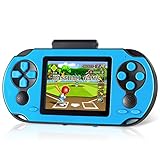
The TaddToy handheld is the pick for someone who wants one object, no cables, no TV, and a library that leans into the 16-bit era. The listing positions it as a 3.0-inch screen device with 230 preloaded classic retro games, aimed at both kids and adults. That combination — a screen just big enough to read text-heavy menus, a fixed library, and a shell built for holding in two hands — is the classic budget-to-mid handheld formula, and it works because nothing about it requires a second device to be useful.
Who it suits
It suits the traveller, the commuter, and the parent buying a first console for a child who is not ready for a phone. It also suits the adult who grew up on 16-bit hardware and wants fifteen minutes of nostalgia without setting up an emulator on a laptop. It does not suit a household that wants two people playing on a big screen at once, because that is a different category of product entirely.
Key specs as listed
- Screen: 3.0-inch class display, landscape orientation
- Library: 230 preloaded HD-labelled classic retro titles, fixed at the factory
- Era skew: 16-bit style presentation and control layout
- Power: built-in rechargeable battery, charged over the supplied cable
- Controls: integrated D-pad and face buttons in a handheld shell
- Players: single-player, one device per person
- Connectivity: none required — no TV, no account, no network
Why it earns the pick
The 3.0-inch screen is the important number here, and it is worth explaining why. On a handheld, screen size and viewing distance interact. A 3-inch panel held roughly 300 mm from your eyes subtends a viewing angle comparable to a 32-inch television watched from about 2.5 metres. That is the sweet spot for retro sprites: big enough that pixel art reads cleanly, small enough that the device stays genuinely pocketable. Drop to a 2.4-inch class screen and the same panel has to be held uncomfortably close before text becomes legible; jump to a 4-inch class screen and the shell stops fitting in a jacket pocket.
Battery life follows the same logic. A handheld with a 3-inch class low-power display and no wireless radios running is drawing a fraction of what a TV-connected console draws, so runtime is measured in hours of play rather than in session length. The practical calculation for a flight or a train ride is straightforward: a typical handheld in this class draws somewhere in the low hundreds of milliamps from a small Li-ion cell, which is why these devices comfortably cover a multi-hour trip on one charge and still have headroom left.
The 230-title library is also a sensible number. It is past the point where you exhaust everything in a weekend, but not so large that the menu becomes an unsearchable wall of names — a real problem on devices claiming tens of thousands of titles, where browsing is often worse than playing.
Pros
- Fully self-contained: no TV, no cables, no network, no setup ritual
- 3.0-inch class screen is the right size for retro sprites at handheld viewing distance
- 230 titles is a deep enough library without becoming unmanageable
- Rechargeable battery removes the recurring cost of AA cells
- Works for both kids and nostalgic adults, so it is a low-risk gift
Cons
- Single-player only — no second controller, no split-screen
- Library is fixed and cannot be expanded
- Small screen means no shared play; one person per device
- Integrated controls are comfortable for short sessions, less so for multi-hour marathons
Compared with the nearest alternative
The nearest alternative in this list is the EASEGMER handheld, which also ships with 230 preloaded titles but pairs them with a larger 3.5-inch screen and a USB-C rechargeable battery. That half inch is the whole decision. If you want the most compact device that still reads clearly, the TaddToy’s 3.0-inch class panel keeps the shell smaller and lighter. If you want a bigger image and the convenience of a modern USB-C port that matches your phone charger, the EASEGMER is the better call. Everything else — the fixed library, the single-player focus, the no-setup promise — is shared between them.
2. YRPRSODF TV Game Console – Best for Two-Player Living-Room Play

The YRPRSODF console is the pick when the point is playing with someone else in front of a television. The listing describes a video game machine with 100+ built-in games, a 2.4G wireless gamepad, and a somatosensory controller for motion-style input. That is a meaningfully different product from any handheld on this page: it assumes a TV, it assumes at least one other person, and it assumes you want the controllers to work from the sofa rather than from a cable’s length away.
Who it suits
It suits the household with a spare HDMI input, a coffee table, and two people who want something to do together that is not a streaming service. It suits parents who want a family activity with a low barrier — no accounts, no installs, no updates. It also suits anyone hosting a casual gathering where the goal is a game anyone can pick up in thirty seconds.
Key specs as listed
- Library: 100+ built-in games, preloaded
- Controllers: 2.4G wireless gamepad plus a somatosensory (motion) controller
- Output: TV connection via the console’s video output
- Form factor: dedicated console box, not a handheld
- Players: two-player capable out of the box
- Setup: plug into a TV, power on, play — no downloads or accounts
Why 2.4G wireless matters
The phrase “2.4G wireless” is the most important technical detail in this listing, and it is worth unpacking because it separates a good living-room experience from a frustrating one. A 2.4 GHz proprietary wireless link transmits input at a report rate typically measured in the hundreds of samples per second, with latency in the low single-digit to low double-digit millisecond range depending on the implementation and the RF environment. Bluetooth in a comparable budget controller is usually a step behind on both counts.
For most of the games in a 100-title retro library, that difference is not perceptible. But two-player fighting and platform games are the worst case for input lag, because both players are reacting to the same on-screen event and any asymmetry between the two controllers becomes visible as one player “losing” inputs. A hardware 2.4G dongle that ships as a matched pair avoids the pairing dance and keeps both controllers on the same link type.
There is a concrete interference point worth knowing: 2.4 GHz is a shared band, and a Wi-Fi router sitting within about a metre of the console’s receiver is the most common cause of dropped inputs on devices like this. Moving the console away from the router, or moving the router’s own antenna, usually fixes it. That is a real troubleshooting step, not a hypothetical — the band is genuinely crowded in a typical living room.
Pros
- Two-player ready out of the box — no second purchase required
- 2.4G wireless gamepad gives a lower-latency, matched-pair link than generic Bluetooth
- Somatosensory controller adds motion-style games to the 100+ title library
- Plug into a TV and play; no accounts, downloads, or subscriptions
- Fixed library means no storefront and no surprise purchases by kids
Cons
- Requires a TV with a free input and a power socket near it
- 100+ titles is the smallest library on this page — quality varies across it
- 2.4 GHz receivers can suffer interference near Wi-Fi routers and USB 3.0 devices
- Not portable in any meaningful sense
Compared with the nearest alternative
The nearest alternative is the YOROSY TV console, which also targets the living room with a TV output and bundled controllers, but leans on 200 built-in classic titles rather than 100+, and skips the somatosensory controller angle. The trade is breadth versus novelty. YOROSY gives you roughly double the library in the same category, which matters if you play often enough to exhaust it. YRPRSODF gives you the motion controller and a smaller, more curated list, which matters more if the device is going to be handed to kids or used at parties where gimmick games carry the evening.
3. OUTUO Retro Handheld – Best for the Cheapest Entry Into Handheld Retro Play
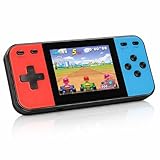
The OUTUO handheld is the budget pick: 240 classic retro games preloaded, a portable gaming player form factor, and a recording function built in, aimed squarely at kids. It exists to answer one question — what is the least you can spend and still get a working handheld with a real library on it — and it answers that question without asking you to assemble anything.
Who it suits
It suits the shopper buying multiple units at once, the parent who wants a first device that will not be mourned when it is lost, and the gift buyer working to a hard ceiling. It also makes sense as a second handheld to keep in a bag or a glovebox, where a more expensive device would be an unnecessary risk.
Key specs as listed
- Library: 240 preloaded classic retro video games
- Form factor: portable handheld player
- Extras: recording function built in
- Audience: marketed for kids
- Setup: none required beyond charging
What the budget tier actually buys
Spending less on a handheld does not usually reduce the game count — this one has more titles than either of the 230-title mid-range devices. What it reduces is the parts that are expensive to make well: panel quality, button feel, battery capacity, and shell rigidity. That is a predictable trade, and it is worth understanding before you buy rather than after.
Panel quality is the first casualty. A budget display in the 2.4- to 3.0-inch class often has narrower viewing angles and lower colour accuracy, which shows up as the image washing out when you tilt the device — noticeable on a train when the light hits the screen at an angle. It is not a defect; it is the cost structure.
Battery capacity is the second. A smaller cell means shorter runtime and more charge cycles per year, which is the main driver of how long a budget handheld lasts before the battery stops holding useful charge. The practical rule is that a smaller battery charged more often ages faster, so a budget handheld used daily will show noticeable capacity loss sooner than a mid-range one used the same way.
The recording function is a genuine differentiator at this price, though it is worth being realistic about what it captures: short clips of gameplay, useful for showing someone a moment rather than for producing anything polished.
Pros
- Lowest barrier to entry on this page
- 240 titles — more than several mid-range picks
- Genuinely portable and light enough to live in a bag
- Recording function is unusual at this tier
- Cheap enough to buy more than one and give them out
Cons
- Screen quality is the first thing traded away at this tier
- Smaller battery means shorter runtime and faster long-term wear
- Built-in library is fixed; nothing can be added later
- Single-player only, and controls are basic
Compared with the nearest alternative
The nearest alternative is the Generic handheld emulator with 400 built-in games, which is also budget tier but doubles down on library size rather than price floor. If the deciding factor is spending as little as possible on something that works, the OUTUO is the pick. If you are willing to spend slightly more within the budget band for a notably bigger built-in library in the same handheld format, the Generic device is the better value — 400 titles against 240 is the largest library gap in this entire list’s handheld category, and it costs you a modest step up rather than a jump to mid-range.
4. TOPCHANCES Retro Game Stick – Best for Maximum Game Count on a TV

The TOPCHANCES stick is the pick for the shopper who wants the biggest possible library for the smallest possible outlay and is willing to hang it off the back of a television. The listing describes a 2026 retro game console stick with 20000+ games claimed, wireless home arcade operation, HDMI plug-and-play, and 64 GB-class storage. It is a fundamentally different proposition from every other product on this page, and that difference is the whole point.
Who it suits
It suits the tinkerer who enjoys browsing a huge catalogue and discovering obscure titles, the household that already has a spare HDMI port and a USB power socket on the TV, and the buyer who measures value in games per dollar spent. It does not suit anyone who wants a clean, curated library where every game is worth playing.
Key specs as listed
- Library: 20000+ games claimed, preloaded on internal storage
- Storage: 64 GB class
- Output: HDMI plug-and-play, direct into a TV
- Controllers: wireless controllers included
- Form factor: stick-style device that hangs from an HDMI port
- Category: home arcade / TV console
What 20000+ titles actually means
It is worth doing the arithmetic on that claim, because it changes how you should think about the product. If you played one game every single day for an hour, 20000 titles would take roughly 55 years to touch once each. Nobody does that. The library’s value is not in completion; it is in range — arcade, home console, handheld, and regional variants of the same games, many of which are duplicates, regional editions, or minor revisions of titles you already recognise.
The storage number tells you how that is possible. Sixty-four gigabytes is roughly 64 × 109 bytes, or about 59.6 GiB in the units a device’s file browser will report. Split across 20000 items, that is an average of a shade under 3 MB per title, which is entirely consistent with pixel-era ROM data. So the maths checks out as plausible — you are not being sold a claim that the storage physically cannot hold.
The practical consequence is menu navigation. A library that size needs search, favourites and a sorting system to be usable, and the quality of that front-end matters more here than on any other device in this list. If the interface on your unit handles it well, the stick is remarkable value. If it does not, you will end up playing the first twenty titles you recognise and ignoring the rest.
Pros
- By far the largest library here — games per dollar is unmatched
- HDMI plug-and-play: it hangs off the TV and needs no separate console box
- 64 GB-class storage is plausibly sufficient for the claimed library size
- Wireless controllers included, so no extra purchase to start playing
- Ideal for discovery — huge range of eras and genres in one place
Cons
- Library quality over quantity: many entries are duplicates or regional variants
- Menu navigation becomes the main usability risk at this library size
- Stick form factors are easy to knock and can obscure adjacent TV ports
- Requires an HDMI port and a USB power source at the TV
Compared with the nearest alternative
The nearest alternative is the YOROSY TV console with 200 built-in classic titles. The gap is two orders of magnitude: 20000+ versus 200. That sounds like YOROSY loses instantly, but the two serve opposite shoppers. If you want a curated list where almost everything is a known classic and the interface stays simple, 200 is a feature rather than a limitation — you will actually finish browsing it. If you want breadth and do not mind sifting, the TOPCHANCES stick wins on raw value by an enormous margin at the same budget tier.
5. EASEGMER Handheld for Kids – Best for Younger Players and Long Trips

The EASEGMER handheld is the pick when a child is the primary user and the device has to survive a car journey. The listing sets out 230 preloaded retro games, a 3.5-inch screen, a USB-C rechargeable battery, and a portable shell. Those four details are exactly the ones that matter for this use case, which is why it sits at the mid-range tier rather than the budget one.
Who it suits
It suits parents buying for roughly ages six to twelve, anyone who wants a device that charges from the same cable as a phone, and travellers who value a larger screen without giving up pocketability. It is also a reasonable pick for an adult who finds a 3.0-inch class display a little cramped.
Key specs as listed
- Screen: 3.5-inch class display — the largest screen among the pure handhelds here
- Library: 230 preloaded retro video games
- Charging: USB-C rechargeable battery
- Form factor: portable handheld with integrated controls
- Players: single-player
- Setup: charge and play; no accounts or downloads
Why USB-C is the most underrated spec here
On a device aimed at kids, the charging port is a bigger deal than the screen. A USB-C port means one cable for the handheld, the tablet, the phone and the laptop. That matters on a trip because it collapses the packing list, and it matters at home because a lost cable is a trivial replacement rather than a hunt for a proprietary plug.
It also changes the failure mode. Devices with bespoke charging connectors tend to become e-waste the moment the cable is chewed by a pet or lost in a hotel room, because replacements are scarce and often cost a meaningful fraction of the device itself. A standard USB-C port means the accessory ecosystem is effectively unlimited, and any modern charger will work — a straightforward 5 V supply at 1 A or above is ample for a device in this class.
Screen size follows the same child-first logic. A 3.5-inch class panel is roughly 17 percent larger along the diagonal than a 3.0-inch one and considerably larger in area — area scales with the square of the diagonal, so the visible surface is about 36 percent greater. For a younger player with less developed fine motor control, that translates directly into more forgiving reading of in-game text and menus.
The trade is physical size. A 3.5-inch handheld will not disappear into a trouser pocket the way a 3.0-inch class device will, though it still fits a jacket pocket or a bag. That is the real cost of the bigger screen, and it is the reason both sizes exist in this list.
Pros
- Largest screen among the handhelds on this page — easier for younger eyes
- USB-C charging means one cable for everything and cheap replacements
- 230-title library is deep without being overwhelming
- Rechargeable battery avoids the ongoing cost of disposable cells
- Simple enough that a child can operate it without adult intervention
Cons
- Bigger shell than the 3.0-inch class alternatives
- Single-player only
- Fixed library, no expansion
- Mid-range price for a device that is still fundamentally a fixed-library handheld
Compared with the nearest alternative
The nearest alternative is the TaddToy 16 Bit Handheld, which matches the 230-title library but pairs it with a 3.0-inch class screen and a shell that is easier to pocket. Choosing between them comes down to a single question: does the device need to fit in a pocket, or does it need to be as readable as possible for a child? Pocket wins for the TaddToy. Readability and cable convenience win for the EASEGMER. Both are single-player, fixed-library devices at the mid-range tier, so neither choice locks you out of anything the other offers.
6. Quanwuhang Video Game Console – Best for the Simplest Possible Setup

The Quanwuhang console is the pick for the gift buyer who wants the least amount of explaining. The listing describes a video game console for kids with 90+ preloaded plug-and-play TV games. That is the smallest library on this page, and it is deliberately paired with a premium tier price — a combination that only makes sense when you understand what is actually being bought.
Who it suits
It suits grandparents buying a present, parents who want a device that a child can unbox and use without help, and anyone who has previously bought a retro console and given up during setup. It is not aimed at the shopper hunting for the most games per dollar.
Key specs as listed
- Library: 90+ preloaded plug-and-play TV video games
- Setup: plug and play into a TV — no accounts, downloads or configuration
- Audience: explicitly marketed for kids
- Form factor: TV console with bundled controls
- Players: single-player oriented, TV output
What premium buys when the library is small
A 90-title library at the premium tier looks like poor value until you price the alternative: your own time. The single largest cause of abandoned retro consoles is setup friction — a device that needs a firmware choice, a memory card, a cable hunt, or a menu that assumes prior knowledge. A console that genuinely works the moment it is plugged in removes that entirely, and for an audience of gift buyers who will not be present when the box is opened, that is the entire product.
There is a second, less obvious benefit to a small library: it is finishable. Ninety-plus curated titles in a plug-and-play format means the interface stays simple, the games are the well-known ones, and nobody has to sift through regional duplicates to find something to play. For a child’s first console, that is a better experience than a library of thousands.
It is worth being clear about the trade at this tier. You are not paying for screen technology, storage capacity, or a long specification list. You are paying for the fact that the box contains a complete, working, friction-free experience with everything required to use it immediately — and that simplicity is exactly what the premium tier on this list is reserved for.
Pros
- Genuinely plug and play — no setup knowledge required at all
- 90+ curated titles keeps the menu simple and finishable
- Explicitly designed for kids, from shell to interface
- Ideal gift for a household you will not personally be setting it up in
- Everything needed to play is in the box
Cons
- Smallest library on this page by a wide margin
- Premium tier price for a modest specification
- Requires a TV, so it is not portable
- Library cannot be expanded
Compared with the nearest alternative
The nearest alternative is the OUTUO budget handheld, and the comparison is really a category question rather than a specification one. Both are kid-first devices with fixed libraries. The Outuo is cheap, portable and has 240 titles, but it is a handheld with a small screen, and it expects the user to be comfortable with a portable device. The Quanwuhang is expensive and TV-bound with only 90+ titles, but it is the one you can hand over with no explanation. If the recipient is going to be unsupervised on first use, the premium is buying relief from the phone call that would otherwise follow.
7. Generic Handheld Game Console – Best for the Biggest Built-In Handheld Library
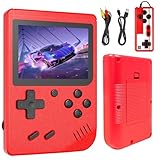
The Generic handheld is the budget pick for library size. The listing describes a portable retro emulator with 400 built-in video games, which is the largest handheld library on this page — 74 percent more titles than the 230-title devices and 67 percent more than the 240-title Outuo, at a budget price