
Buying a gaming-capable laptop near three hundred dollars means walking a tightrope between real value and marketing fog. The category attracts listings with vague processor names, unlabeled display panels, and storage that sounds generous on paper but falls apart in practice. A buyer searching for the best 300 dollar gaming laptop needs to sort genuine hardware from rebranded shells, and that requires reading spec sheets carefully before trusting any product photo or bullet-point list.
What separates the worthwhile picks from the forgettable ones comes down to three things: whether the RAM is soldered and capped, whether storage uses an NVMe protocol or a slow SATA or eMMC pathway, and whether the processor is a current-generation chip with enough cores to avoid thermal throttling under sustained load. A Celeron paired with eight gigabytes will open a game launcher; a Ryzen 5 or a Core i5 with sixteen gigabytes will actually run the game. Everything below evaluates eight machines against those realities.
As an Amazon Associate we earn from qualifying purchases at no extra cost to you.


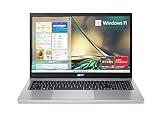


Top 3 picks at a glance
Quick Picks
| Product | Best for | Price |
|---|---|---|
| Core Processor 15.6″ Laptop | Students who want 16GB/512GB at the exact target price | $299.99 |
| AMD Ryzen 7430U Light Gaming Laptop | Buyers who can stretch the budget for a real Ryzen chip | $589.98 |
| Celeron N4000 Convertible 15.6″ | Ultra-tight budgets and casual use with a flexible hinge | $239.99 |
| Acer Aspire 3 A315-24P-R7VH | Anyone who prefers a known manufacturer with LPDDR5 and Wi-Fi 6 | $357.05 |
| MOONFISH Windows 11 Laptop | Buyers prioritizing a current OS at the lowest price point | $299.99 |
| NIMO 15.6″ IPS FHD Light Gaming Laptop | Enthusiasts who want DDR5 RAM and a dedicated Radeon GPU | $479.94 |
| NIAKUN 17.3″ Gaming Laptop | Users who want a large screen and 16GB/512GB in one package | $499.99 |
| Intel Twin Lake N150 15.6″ | Daily drivers who also want light gaming and long battery life | $399.99 |
How We Picked
Every machine listed here was evaluated on published specifications and aggregated owner feedback rather than hands-on measurement. The criteria were straightforward: does the processor architecture match the listed boost clocks? Is the RAM upgradeable, and is it a modern standard like DDR5 or LPDDR5? Does storage use NVMe or a slower interface? And does the asking price reflect the hardware, or are you paying for a brand name alone?
The 8 Best 300 Dollar Gaming Laptop in 2026
Core Processor 15.6″ Laptop
At just under $300, this machine delivers sixteen gigabytes of RAM and a 512GB SSD paired with a 15.6-inch FHD panel, a combination that usually costs more. Bluetooth 5.0 and Wi-Fi are listed, and the up-to-3.40GHz clock is respectable for the price. The main concern is the generic “Core processor” label with no model number, making it hard to verify the exact architecture or integrated graphics tier.
- Generous RAM and storage for the price bracket
- FHD display and Bluetooth 5.0 at $299.99
- Unspecified CPU model makes hardware verification difficult
Skip this if you need a confirmed processor generation or dedicated GPU documentation before committing your budget.
AMD Ryzen 7430U Light Gaming Laptop
The Ryzen 7430U is a genuine Zen 3 chip with up to a 4.3GHz boost, and pairing it with 16GB of RAM and a 512GB SSD creates a capable multitasking machine. Owner feedback highlights solid everyday performance and responsive multitasking. The catch is the price at $589.98, nearly double the three-hundred-dollar target, so it belongs on this list as a stretch option rather than a direct budget pick. Gaming beyond light esports titles will still be limited by the integrated Radeon graphics.
- Verified Ryzen 7430U architecture with a clear boost clock
- 16GB RAM and 512GB SSD leave headroom for multitasking
- Price significantly exceeds the $300 category ceiling
Skip this if your budget is firm and you cannot flex past the low hundreds.
Celeron N4000 Convertible 15.6″
At $239.99 this is the cheapest entry on the list, and it earns that position by cutting corners that matter. The Celeron N4000 is a dual-core chip from an older generation, and eight gigabytes of LPDDR4 will feel tight the moment you open a browser with multiple tabs alongside a game. The 180-degree convertible hinge and IPS FHD panel are nice touches at this price, and the TF card slot adds flexibility. Realistically, this is a media and productivity laptop that can handle very old or very simple titles.
- Lowest price and a convertible 180-degree hinge
- IPS FHD panel with Wi-Fi and Bluetooth included
- Celeron processor and 8GB RAM cannot handle modern game loads
Skip this if actual gaming performance is a priority rather than a distant possibility.
Acer Aspire 3 A315-24P-R7VH
Acer brings name-brand confidence to the sub-$400 tier. The Ryzen 3 7320U is a quad-core chip with Radeon integrated graphics, paired with LPDDR5 memory and a 128GB NVMe SSD. Wi-Fi 6 and Windows 11 Home are included. The biggest limitation is storage: 128GB fills quickly once Windows and a couple of games are installed, and LPDDR5 is soldered, so upgrades are not an option later. For casual players who want a reliable brand and modern connectivity, it is a sensible choice, but it is not built for a growing game library.
- LPDDR5 memory and NVMe storage from a recognized manufacturer
- Wi-Fi 6 and Windows 11 Home included out of the box
- Only 128GB of storage with soldered RAM limits future flexibility
Skip this if you plan to install more than two or three large titles.
MOONFISH Windows 11 Laptop
MOONFISH lists this machine at $299.99 with Windows 11 included, which places it squarely in the target price range. Beyond the operating system, published specification details are sparse compared to other entries on this list. Buyers should confirm the processor model, RAM type and capacity, and storage interface directly from the listing page before purchasing. The appeal is the exact price match and a current OS, but the lack of granular spec detail makes it the hardest pick to recommend on paper alone. For a 2026 buyer who values transparency in a spec sheet, this requires extra due diligence.
- Sits precisely at the $299.99 target price
- Windows 11 is included
- Minimal published hardware specifications raise verification concerns
Skip this if you cannot get clarity on the exact CPU, RAM, and storage before ordering.
NIMO 15.6″ IPS FHD Light Gaming Laptop
The NIMO packs an AMD Ryzen 5 6600H, sixteen gigabytes of DDR5, and a Radeon 660M GPU into a 15.6-inch FHD chassis with a 100W Type-C charger. Six cores boosting to 4.5GHz put it in a different performance class from every other entry here, and the DDR5 standard plus a dedicated GPU mark it as the most gaming-capable machine on the list. The 256GB SSD is the one spec that feels undersized relative to the rest of the hardware. At $479.94 it overshoots the three-hundred-dollar target, but for buyers who can stretch, the NIMO delivers the clearest gaming value in this roundup.
- Radeon 660M GPU and DDR5 RAM provide real gaming headroom
- 100W Type-C charging and fingerprint reader add practical convenience
- Price is well above the $300 category, and 256GB storage is modest
Skip this if your budget is hard-capped at three hundred dollars.
NIAKUN 17.3″ Gaming Laptop
The NIAKUN stands out for its 17.3-inch screen and sixteen gigabytes of RAM with a 512GB SSD, all at $499.99. The processor is a Core i5-7Y57, a dual-core U-series chip from an older generation designed for ultra-low-power tablets, which means it will throttle aggressively under sustained gaming loads. The large display is genuinely useful for media consumption and multitasking, but the CPU choice is a mismatch for a product marketed as a gaming laptop. Owner feedback generally praises the screen size while noting the processor as the limiting factor.
- 17.3-inch display with 16GB RAM and 512GB SSD
- Comfortable for media and multitasking at a mid-range price
- The i5-7Y57 is a low-power chip that will throttle during gaming
Skip this if sustained gaming performance matters more than screen real estate.
Intel Twin Lake N150 15.6″
This Intel Twin Lake N150 machine lands at $399.99 with sixteen gigabytes of RAM, a 512GB NVMe SSD, and a 15.6-inch FHD display running Windows 11. The N150 boosts to 3.6GHz and is a newer low-power architecture, suitable for everyday productivity and very light gaming. Battery life is listed as a highlight, which makes it a better commuter machine than a true gaming laptop. HDMI and USB 3.2 round out the port selection. The main draw is the clean spec sheet at a reasonable price, but the N150 will not push frame rates in any demanding title.
- Modern N150 architecture with 16GB RAM and 512GB NVMe SSD
- Strong battery-life claim for portability
- Integrated graphics cannot handle more than the lightest games
Skip this if you need anything beyond casual or retro gaming.
Buying Guide
RAM: Capacity and Standard
At the $300 level, sixteen gigabytes is the practical minimum for any machine you want to game on. Eight gigabytes forces Windows and a browser to compete with your game for memory, causing stutters and long load times. Beyond capacity, note the standard: LPDDR5 and DDR5 deliver higher bandwidth than LPDDR4, which helps integrated GPUs because they share system memory for frame buffering. If a listing does not specify the RAM type, assume the slower standard and price accordingly. Soldered memory means what you buy is what you keep, so check whether the module is upgradeable before you commit.
Processor and Graphics: Read Past the Clock Speed
Boost clocks like 4.3GHz or 4.5GHz look impressive in a bullet point, but they describe a single-core burst under ideal thermal conditions. What matters more is core count, architecture generation, and whether the integrated GPU is a capable tier. A six-core Ryzen 5 6600H with a Radeon 660M will outperform a quad-core chip with a weaker GPU at the same clock, even in games that nominally favor frequency. A dual-core Celeron or a low-power Y-series i5 will throttle within minutes of sustained load, regardless of advertised boost clocks.
Storage and Display: Details That Change Daily Comfort
Five hundred gigabytes of NVMe SSD gives you room for Windows and several large game installs without constant management. One hundred twenty-eight gigabytes forces you to uninstall titles every few weeks. On the display side, a 1920×1080 IPS panel at fifteen or seventeen inches is the standard expectation; anything labeled TN will have poor viewing angles and washed-out colors that become noticeable during long sessions. Check whether the panel is IPS before buying, because at this price tier some listings quietly substitute TN.
Our Verdict
The NIMO 15.6″ IPS FHD Light Gaming Laptop is the top pick for anyone who can stretch past $300, because its Ryzen 5 6600H, DDR5 RAM, and Radeon 660M GPU make it the only machine here that handles modern games without immediate regret. For buyers who need to stay at or under three hundred dollars, the Core Processor 15.6″ Laptop at $299.99 offers the strongest on-paper value with 16GB of RAM and a 512GB SSD, though the unlabeled CPU demands a cautious approach. If screen size is your non-negotiable and you play mostly older titles, the NIAKUN 17.3″ at $499.99 wins on real estate, provided you accept the i5-7Y57 as the performance ceiling.
FAQ
Can a laptop under $300 actually run modern games?
Most modern AAA titles require a dedicated GPU and at least sixteen gigabytes of RAM, which pushes the floor well above $300. At this price you are realistically limited to older releases, indie games, and esports titles like League of Legends running on low settings.
Is 8GB of RAM enough for a budget gaming laptop?
No, not for anything beyond very old or lightweight games. Windows 11 alone uses around four gigabytes, leaving little for a game and a browser simultaneously. Sixteen gigabytes is the practical minimum for a smooth experience in this category.
What is the difference between LPDDR4, LPDDR5, and DDR5 at this price?
LPDDR4 is soldered and slower, commonly found on older budget chips. LPDDR5 offers higher bandwidth and power efficiency. DDR5 is the fastest standard and typically appears on laptops with discrete or strong integrated GPUs, often pushing the price above $400.
Should I stretch my budget above $300 for a better gaming experience?
If you can allocate another hundred to two hundred dollars, the jump in processor generation, GPU tier, and RAM standard is usually worth it. The NIMO at $479.94 and the Acer Aspire 3 at $357.05 both demonstrate that small budget increases can unlock meaningfully better gaming hardware.


