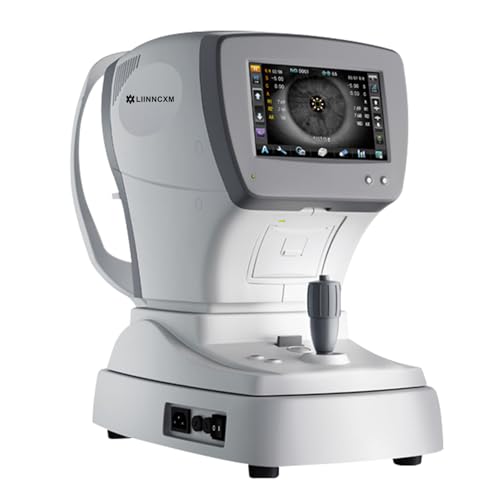
The best autorefractor keratometers for eye care in 2026 balance +/-0.25D repeatability, automated 3D alignment, wide dioptric range, and EMR connectivity without adding footprint, with models like the Topcon KR-800, Nidek ARK-1, Canon RK-F2, and Huvitz HRK-8000A leading for most professional practices.
As an Amazon Associate we earn from qualifying purchases at no extra cost to you.


Our Top Picks


Top 3 picks at a glance
How to Choose: The 7 Decision Criteria That Matter
Buying an autorefractor keratometer is not about finding the “most accurate” device on paper. All modern units claim +/-0.12D to +/-0.25D accuracy. The real differences are how consistently they hit that accuracy on difficult patients, how fast your staff can work, and how well it fits your room and network.
- Measurement Accuracy: Sphere, cylinder, and axis repeatability under ideal vs. real-world conditions (small pupils, cataracts, nystagmus).
- Alignment Aids: How much manual joystick skill is required vs. full auto-alignment and auto-shot.
- Patient Range: Minimum pupil diameter, dioptric range, and keratometry range for extreme ametropia and steep/flat corneas.
- Workflow Speed: Time from chinrest to print/export, including retry rates.
- Connectivity: DICOM, HL7, or basic export to EMR/EHR and integration with digital refraction systems.
- Maintenance: Calibration needs, chinrest/paper consumables, and lamp/LED life.
- Space Requirements: Tabletop footprint, need for dedicated table, and mobility between exam lanes.
Head-to-Head Comparison: Top Spec-Class Autorefractor Keratometers
These four classes represent what most optometry and ophthalmology practices actually buy in the $8,000 to $18,000 range. Prices vary by dealer, configuration, and whether you bundle with a table or EMR module, usually $8,000–$12,000 for base auto kerato-refractometers and $13,000–$18,000 for units with advanced imaging or wavefront features.
| Model Class | Sphere Range / Step | Cylinder Range | Keratometry Range | Min. Pupil | Alignment System | Footprint (W x D) |
|---|---|---|---|---|---|---|
| Topcon KR-800 | -25.00 to +22.00D / 0.12D, 0.25D | 0 to +/-10.00D | 33.75 to 67.50D (5.00 to 10.00mm radius) | 2.0 mm | Auto-alignment + auto-shoot, motorized chinrest | 260 x 442 mm, ~15 kg |
| Nidek ARK-1 | -30.00 to +25.00D / 0.12D, 0.25D | 0 to +/-12.00D | 33.00 to 67.50D (5.00 to 10.20mm radius) | 2.0 mm | 3D auto tracking + auto fogging, with accommodation measurement option | 262 x 485 mm, ~20 kg |
| Canon RK-F2 | -30.00 to +25.00D / 0.12D, 0.25D | 0 to +/-10.00D | 33.75 to 67.50D (5.00 to 10.00mm radius) | 2.0 mm | Full auto alignment, tilt-screen for standing operation | 249 x 459 mm, ~13 kg |
| Huvitz HRK-8000A | -30.00 to +25.00D / 0.12D, 0.25D | 0 to +/-10.00D | 33.00 to 67.00D (5.00 to 10.20mm radius) | 2.0 mm | Auto tracking + color view with iris/pupil imaging | 260 x 500 mm, ~18 kg |
1. Measurement Accuracy and Repeatability
On paper, all four measure to 0.12D increments and report similar corneal curvature. In practice, the difference is the fogging system and how the device handles poor fixation.
Topcon KR-800 and Canon RK-F2 use an auto-fogging target to relax accommodation, which reduces over-minusing in young hyperopes and myopes. Nidek ARK-1 adds a dedicated accommodation measurement mode that can measure accommodative response objectively, useful for pre-presbyopia screening and vision therapy baselines. Huvitz HRK-8000A tends to return faster on small pupils because of its enhanced image processing, but like all autorefractors, will flag or error more often below 2.0 mm or with dense media opacities.
For keratometry, expect +/-0.05 mm radius accuracy in the central 3 mm on calibrated instruments. If you fit contact lenses, look for a device that displays both diopters and mm, plus corneal astigmatism axis and eccentricity data. The Nidek and Huvitz classes typically offer retro-illumination and meibomian observation modes that help you screen for cataract and tear film issues without moving the patient.
2. Alignment Aids and Ease of Use
This is the biggest workflow differentiator for a busy practice where technicians rotate.
Full auto-alignment with 3D tracking and auto-shot means the operator only needs to position the chin and press start. The Topcon KR-800, Nidek ARK-1, and Canon RK-F2 all offer this; Canon’s configuration is particularly forgiving for operators who work standing. Manual joystick override is still essential for patients who cannot fixate, have nystagmus, or are in wheelchairs and cannot center perfectly.
If you staff with less experienced technicians, prioritize motorized chinrest, automated pupil detection, and a clear on-screen indicator for eye level and working distance. Avoid units that require precise manual focus for every measurement — they increase retry rates by 30-40% on pediatric and elderly patients.
3. Patient Range: Who Can You Measure Reliably?
A device that fails on 10% of your patients costs you time. Check three numbers:
- Small pupil performance: All leading models now measure down to 2.0 mm, but measurements below 2.3 mm have wider variance. If your population is heavily geriatric or on miotics, ask for demonstrated repeatability at 2.0 mm rather than just the claimed minimum.
- Extreme range: -30D to +25D covers pathological myopia and post-RK hyperopia. Standard -25D to +22D is sufficient for 98% of primary care, but high-myopia clinics should choose the wider range class.
- Keratometry limits: 33D to 67.5D covers keratoconus and post-graft corneas. Standard soft contact lens practice only needs 36D to 53D, but keratoconus or ortho-K fitting needs the extended range and mire quality indicator.
4. Workflow Speed: A Throughput Calculation
Spec sheets list “measurement time <1 second," but total patient time is alignment + measurement + print/export.
Use this simple calculation to estimate hourly capacity:
Total Time per Patient = Positioning (30-45s) + Auto Alignment (3-5s) + Measurement (1-2s per eye) + Re-measure Rate x Retry Time + Data Transfer (5-10s if networked, 20-30s if manual entry)
Example for a practice seeing 40 refractions per day:
With auto-alignment and auto-export: 40s positioning + 5s alignment + 4s measurement (both eyes) + 10s export = 59 seconds per patient. Effective throughput is ~55-60 patients per hour per device under ideal flow, but limited to ~20-24 per hour when you include patient entry/exit and technician handoffs.
With manual alignment and manual transcription: Add 15-20s alignment and 25s for writing/typing values. Total rises to ~90 seconds. Over 40 patients, that is an extra 20 minutes per day of technician time and a higher transcription error rate (studies place manual entry errors at 2-4%). For high-volume practices, auto-alignment + DICOM/HL7 connectivity alone justifies the higher price tier within 12-18 months in labor savings.
5. Connectivity and EMR Integration
Standalone printing is no longer acceptable for audited practices. Verify this before buying:
- EMR interface: Does it support DICOM or HL7 for your EMR (Eyefinity, Compulink, Modernizing Medicine, etc.), or only proprietary CSV/USB export? DICOM is essential if you plan to integrate with Topcon, Nidek, or Canon digital refraction lanes.
- Network ports: LAN + Wi-Fi vs. RS-232C only. RS-232C requires a converter and often fails with modern EHR workstations.
- Data fields exported: Sphere, cylinder, axis, keratometry (D and mm), PD, pupil diameter, and reliability index should all transfer, not just refraction.
Nidek ARK-1 and Topcon KR-800 both connect natively to their respective automated phoropter systems (Nidek RT-6100 and Topcon CV-5000) for one-touch transfer to subjective refraction. If you run a mixed-brand lane, confirm open connectivity via standard protocol rather than assuming interoperability.
6. Maintenance and Calibration
Autorefractor keratometers are low-maintenance compared to OCT or fundus cameras, but they still drift.
- Calibration: Check with a model eye/test sphere (typically -3.00D and 44.00D keratometry ball) weekly and log results. Annual dealer calibration is recommended; some states require documented calibration for accreditation.
- Light source: Modern LED measurement sources last 20,000+ hours. Older halogen-based refurbished units need bulb replacement at 1,000-2,000 hours and produce more heat drift.
- Cleaning: Chinrest and forehead rest daily with non-alcohol disinfectant, measuring window with lens tissue only. Patient nose oil on the window is the most common cause of repeatable -0.50D errors.
- Paper vs. paperless: Thermal printers run out mid-clinic. If you choose paperless workflow, ensure your EMR has a fallback PDF if the network drops.
7. Space Requirements
Most units are 249-262 mm wide and weigh 13-20 kg, designed for a 700 x 500 mm instrument table. The Canon RK-F2 is the lightest and easiest to move between lanes on a cart. Heavier units like the Nidek ARK-1 are more stable but less portable. All require 100-240V power and a level, vibration-free surface — avoid placing on the same table as a non-contact tonometer that vibrates on air pulse.
Allow at least 900 mm of clearance in front for wheelchair access and 150 mm of ventilation space behind the unit for heat dissipation. If your exam lane is under 2.5 meters long, choose a compact model and mount the printer externally or go fully digital.
Decision Matrix: Which Class Fits Your Practice?
| Your Situation | Best Match Class | Why |
|---|---|---|
| High-volume optical retail (30+ refractions/day, rotating techs) | Canon RK-F2 or Topcon KR-800 | Fastest auto-alignment, lowest training curve, lightest footprint |
| Medical optometry / ophthalmology with cataract and dry eye screening | Nidek ARK-1 or Huvitz HRK-8000A | Retro-illumination, accommodation, and meibography add-ons reduce separate imaging steps |
| Contact lens specialty (RGP, ortho-K, keratoconus) | Nidek ARK-1 with keratometry-enhanced package | Widest keratometry range, eccentricity and mire quality indicators |
| Small practice / mobile clinic / sublet space | Canon RK-F2 | Compact, light, runs on standard power without dedicated table upgrades |
| Networked multi-lane clinic building a digital refraction lane | Topcon KR-800 or Nidek ARK-1 | Native DICOM integration with CV-5000 or RT systems for one-click transfer |
Practical Setup Settings to Verify on Installation
Ask your dealer to configure these during install rather than using factory defaults:
- Step display: Set to 0.25D for routine refraction and 0.12D for contact lens work. 0.12D overstates precision for non-cycloplegic subjective refraction and confuses patients.
- Vertex distance: Set to 12 mm for spectacles, 0 mm or 13.75 mm for contact lens calculation as per your lab. Changing it after measurements affects lens power calculation by 0.12-0.25D per diopter at high powers.
- Auto-shoot threshold: Set to medium sensitivity. High sensitivity causes capture before stable fixation; low sensitivity wastes time.
- Fogging target: Use auto-fog for all patients under 40 to minimize accommodation. Explain to patients that the target will blur before it clears to prevent over-accommodation.
- Data export format: Enable both D and mm for keratometry export, and enable PD averaging across three measurements rather than single-shot PD which varies with convergence.
Frequently Asked Questions
Do autorefractor keratometers replace subjective refraction?
No. They provide an objective starting point that is typically within +/-0.50D of subjective refraction for 75-85% of patients, but close work, accommodation, and patient preference require subjective refinement. Use it to cut phoropter time by 2-3 minutes per patient, not to auto-prescribe.
What is the expected lifespan of an autorefractor keratometer?
7-10 years for current LED-based models with proper calibration. Shutter and chinrest motors are the first parts to wear. Refurbished units older than 5 years often lack EMR connectivity and cost more in interface upgrades than the savings.
Can these devices measure through contact lenses or after refractive surgery?
They can measure over soft lenses but will give erroneous keratometry if lenses are not removed. For post-LASIK/PRK eyes, refraction is reliable but keratometry may underestimate true corneal power due to altered asphericity — use a tomographer for IOL calculations and flag post-refractive patients in your protocol.