Our Top Picks


Top 3 picks at a glance

Best Handheld Anemometers for Wind Speed Accuracy
The best handheld anemometers for wind speed accuracy are the Kestrel 1000 for dependable field readings, the Testo 410-2 for compact professional measurements, and the Extech AN100 when you need a broader feature set at a lower general market price.
The right choice depends less on the highest advertised wind-speed limit than on four practical factors: how slowly the meter can measure, how consistently it responds to gusts, whether the display remains readable outdoors, and how well it survives transport and weather. A meter that starts measuring at 0.4 m/s can be more useful for HVAC commissioning or drone work than one that reaches 40 m/s but misses light airflow.
As an Amazon Associate we earn from qualifying purchases at no extra cost to you.


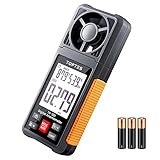
Best handheld anemometers compared
| Model | Wind-speed range | Stated accuracy | Display and functions | Battery and field suitability |
|---|---|---|---|---|
| Kestrel 1000 | Approximately 0.6–40 m/s | Typically about ±3% of reading or ±0.1 m/s | Large monochrome display; current, average, and maximum wind | Replaceable coin cell; compact, sealed, and impact resistant |
| Kestrel 2000 | Approximately 0.6–40 m/s | Typically about ±3% of reading or ±0.1 m/s | Wind speed plus temperature and wind chill | Replaceable coin cell; strong choice for outdoor work |
| Testo 410-2 | Approximately 0.4–20 m/s | Usually around ±0.2 m/s or ±2% of reading | Backlit display; wind speed, temperature, and humidity on some configurations | AA batteries; ergonomic professional instrument, but less suited to severe impact |
| Extech AN100 | Approximately 0.4–30 m/s | Generally around ±3% of reading | Large LCD; maximum, average, temperature, and selectable units | 9-volt battery; useful general-purpose meter, normally carried in a case |
| WeatherFlow WEATHERmeter | Broad outdoor wind range, depending on operating mode | Depends on the phone-connected sensor and calibration | Uses a smartphone app for logging, graphs, and location data | Very portable; the phone becomes the display and battery limitation |
Published specifications can vary by revision, measurement mode, and unit system. Treat the figures above as buying benchmarks, then confirm the current datasheet if a measurement must support an inspection report, engineering decision, or safety procedure.
Our top picks by use case
Best overall field meter: Kestrel 1000
The Kestrel 1000 is the safest recommendation when the priority is reliable wind-speed measurement in a small, rugged instrument. It concentrates on wind rather than adding a long list of environmental sensors, which keeps the interface quick to operate. Current wind, average wind, and maximum wind readings are more useful in the field than a single rapidly changing number.
Its practical advantage is durability. The compact housing, sealed construction, lanyard-friendly shape, and replaceable battery suit sailing, archery, model aviation, outdoor maintenance, and weather observations. The monochrome screen is not as polished as a modern color display, but it remains legible in direct daylight and does not depend on a phone connection.
Best for light airflow and professional inspection: Testo 410-2
The Testo 410-2 is a better fit when the meter will be used around ventilation grilles, ducts, workshops, or building services. Its lower starting range makes it more useful for detecting weak airflow, while the vane design provides an intuitive measurement method: point it into the flow and wait for the reading to settle.
The trade-off is a lower maximum wind-speed range than the Kestrel instruments. It is also better treated as professional measuring equipment than as something to leave loose in a tool bag. Use its protective case, keep the vane clear of dust, and avoid forcing or spinning the impeller by hand.
Best value for broad general measurements: Extech AN100
The Extech AN100 offers a useful combination of low-end sensitivity, a relatively high upper range, maximum and average readings, and a large LCD. It is a sensible choice for HVAC checks, workshop airflow, fans, and outdoor surveys where extreme weather sealing is not the primary requirement.
Its 9-volt battery is easy to replace but less convenient than a coin cell or AA batteries if the instrument is used frequently. A carrying case is particularly worthwhile because the vane is the most vulnerable part of any compact anemometer.
Best for phone-based logging: WeatherFlow WEATHERmeter
The WeatherFlow WEATHERmeter makes sense when the real requirement is recorded data rather than a standalone screen. A compatible smartphone can add graphs, location, notes, and session history, making it easier to compare wind at different sites.
However, app-connected instruments introduce extra failure points. Bluetooth range, phone battery, permissions, sunlight on the phone screen, and software compatibility all matter. For a quick safety check or a measurement where the phone may be inconvenient, a dedicated-display meter is usually faster.
How to choose for accuracy rather than headline range
1. Match the lower limit to the airflow
For outdoor gusts, a meter beginning around 0.6 m/s is usually adequate. For ventilation, indoor air balancing, and low-speed laboratory work, prefer a stated lower limit around 0.4 m/s or below. If the normal airflow is close to the instrument’s minimum, small changes in bearing friction, angle, and turbulence can create large percentage errors.
2. Read the accuracy formula correctly
An accuracy statement such as “±3% of reading or ±0.1 m/s” normally means the larger applicable error should be considered. At a measured 2 m/s, 3% is 0.06 m/s, so the ±0.1 m/s term dominates. At 10 m/s, 3% is 0.3 m/s, so the percentage term dominates.
That gives a practical error range of approximately 1.9–2.1 m/s for a 2 m/s reading and 9.7–10.3 m/s for a 10 m/s reading, before additional errors from turbulence, positioning, calibration, or changing wind.
3. Prioritize display readability
A large monochrome display is often easier to read in bright sunlight than a glossy color screen. Backlighting helps in a dark equipment room but can reduce outdoor battery life. Look for selectable units, a hold function, and a clear maximum or average indicator. These controls matter when you cannot stare at the screen while holding the meter in the airflow.
4. Consider battery runtime as a power budget
Suppose a meter draws an average of 8 mA from a 220 mAh coin cell. The theoretical runtime is:
220 mAh ÷ 8 mA = 27.5 hours
Real runtime will be lower because battery capacity changes with temperature, the display may consume more power, and the meter may not use the cell down to its nominal voltage. A practical planning figure might be 15–22 hours of continuous operation. If the meter is used for ten-minute checks, that still represents roughly 90–130 sessions. Phone-connected meters require a separate power budget for the sensor and smartphone, so carry a charged phone or power bank for long logging sessions.
Decision matrix
| Your situation | Best fit | Why |
|---|---|---|
| Outdoor work, gusts, rain exposure, frequent transport | Kestrel 1000 or 2000 | Rugged housing, simple controls, replaceable battery, direct display |
| HVAC vents, indoor airflow, low-speed measurements | Testo 410-2 | Low starting range and professional vane-meter layout |
| General maintenance and occasional outdoor checks | Extech AN100 | Broad range and useful maximum/average functions without premium pricing |
| Wind sessions that need graphs, locations, and records | WeatherFlow WEATHERmeter | Phone app adds logging that standalone displays generally lack |
| Very high wind or safety-critical decisions | Professional calibrated instrument | Confirm calibration traceability, operating limits, and required inspection procedures |
How to get more accurate readings in the field
- Align the vane with the airflow. Keep the impeller axis pointing directly into the wind. A sideways angle reduces the component of wind passing through the vane and usually produces a low reading.
- Move away from turbulence. Measure several feet from walls, vehicles, trees, and the leeward side of structures where possible. Take multiple readings because a single gust is not the same as average wind.
- Use an averaging mode. Hold the meter steadily for 10–30 seconds, depending on how quickly the wind changes. Use maximum mode separately when the purpose is to capture gusts.
- Do not block the sensor. Keep fingers behind the housing and avoid placing the meter close to your body, clothing, or a warm vehicle surface.
- Check the vane before measuring. Remove grit, thread, and salt deposits. If the impeller does not start smoothly in a light airflow, clean it or arrange service rather than trusting a slow reading.
- Verify the battery first. A low battery can cause a dim display, intermittent Bluetooth connection, or unexpected shutdown. Replace it before a long survey.
Frequently asked questions
What is the difference between the Kestrel 1000 and Kestrel 2000?
The Kestrel 1000 focuses on wind speed, while the Kestrel 2000 also measures temperature and wind chill. Both are described as compact, rugged instruments with approximately the same wind-speed range, replaceable coin cells, and similar stated accuracy. Choose the Kestrel 1000 when wind readings are enough; choose the Kestrel 2000 when temperature and wind-chill information is also useful.
Can a handheld anemometer measure airflow indoors?
Yes, several meters in the article are suited to indoor airflow measurements. The Testo 410-2 is recommended for ventilation grilles, ducts, workshops, and building services because its lower starting range helps detect weak airflow. The Extech AN100 is also presented as useful for HVAC checks, workshop airflow, and fans. Keep the vane aligned with the airflow and avoid turbulent locations.
Why should the vane be kept aligned with the wind?
The vane should be aligned because its impeller axis needs to point directly into the airflow. Holding it at a sideways angle reduces the component of wind passing through the vane and usually produces a low reading. For better field measurements, move away from walls, vehicles, trees, and the leeward side of structures, then take multiple readings when conditions are gusty.
Are phone-connected anemometers as convenient as meters with built-in displays?
Phone-connected anemometers can be more useful for recorded data because the app may provide graphs, location, notes, and session history. However, they add possible failure points, including Bluetooth range, phone battery, permissions, sunlight on the phone screen, and software compatibility. For a quick safety check or when carrying a phone is inconvenient, a dedicated-display meter is usually faster.
When should a measurement be confirmed with a professional calibrated instrument?
Use a professional calibrated instrument when the measurement supports a safety-critical decision, inspection report, or engineering decision. The article advises confirming calibration traceability, operating limits, and required inspection procedures in those situations. Published specifications can vary by revision, measurement mode, and unit system, so the current datasheet should also be checked when the result must be formally relied upon.
Final recommendation
Choose the Kestrel 1000 if you want the strongest balance of wind-speed accuracy, outdoor durability, readable operation, and battery simplicity. Select the Testo 410-2 when low-speed airflow and professional indoor measurement matter more than extreme wind range. Choose the Extech AN100 for broad general-purpose coverage, or the WeatherFlow WEATHERmeter when smartphone logging is central to the job.
Whichever model you buy, accuracy comes from using the correct range, holding the vane square to the airflow, averaging changing wind, and keeping the sensor clean. Those habits often make a larger difference than choosing between two meters with nearly identical published accuracy figures.