The best LED light bars for off road trucks are not the brightest on paper, but the ones that match beam pattern, bar length, and mounting location to how you actually drive off-road — a 20 to 30-inch combo-pattern bar on the bumper for trail crawling, a 40 to 50-inch spot/combo bar on the roof for high-speed desert running, and a dedicated flood or scene bar at the rear for work and recovery.
As an Amazon Associate we earn from qualifying purchases at no extra cost to you.



Our Top Picks
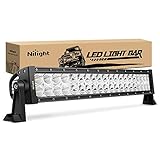
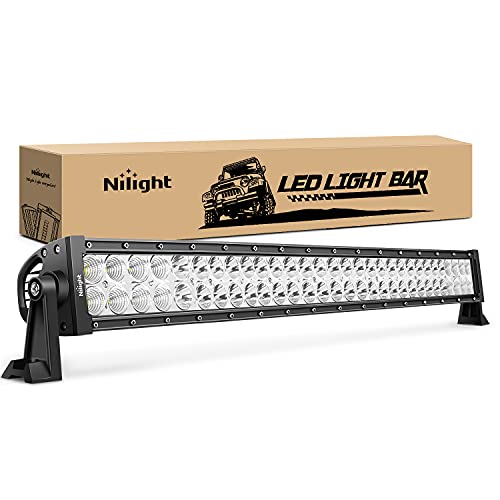 Nilight LED Light Bar 32 Inch 180W 12600LM32 Inch 180W Light Bar32 x 5 x 5 inches4 poundsCheck on Amazon


Top 3 picks at a glance
How Beam Pattern Decides What You Can See
Lumens sell light bars, beam pattern determines whether that light is useful. Most off-road bars fall into four optics types, and the best setups combine at least two.
Spot, Flood, Combo, and Driving Beams
- Spot (8-15 degree): Tight, long-throw pencil beam. Throws 800m+ on high-end reflector models. Best for high-speed open desert, fire roads, and pre-running where you need to see far ahead. Useless alone at low speed because it leaves dark zones to the sides.
- Flood (40-60 degree): Wide, short throw with soft edges. Illuminates the ditch, A-pillar blind spots, and the immediate 30-50m in front of the truck. Ideal for rock crawling, tight trails, and camp/work lighting. Creates too much foreground glare if roof-mounted without a spot complement.
- Combo: The most common and most practical for trucks. Typically spot optics in the center and flood on the outer ends of the bar. Gives you distance and width in one housing. For a single-bar truck, a combo is almost always the right answer.
- Driving / SAE Wide: A regulated pattern with a sharp horizontal cutoff, similar to a fog light but more powerful. Designed to put light on the road without blinding oncoming traffic. If you need any on-pavement usability, this is the only pattern that has a chance of being road-legal.
| Beam Pattern | Typical Effective Range | Horizontal Spread | Best Mounting Position | Best Use Case |
|---|---|---|---|---|
| Spot | 600-900m (at 1 lux) | 8-15 degrees | Roof / Upper windshield | High-speed desert, open plains |
| Flood | 80-150m | 45-60 degrees | Bumper / Lower grille / Rear | Crawling, tight woods, camp |
| Combo | 400-700m center, 150m sides | 25-40 degrees effective | Bumper or Roof (single-bar solution) | All-around trail truck |
| SAE Driving | 250-400m | 35-45 degrees with cutoff | Bumper / Fog pocket | Dusty roads, supplemental road use where legal |
A house-style recommendation matters here: cheaper bars with generic TIR optics often advertise a combo but are actually all flood with poor collimation. Look for models that specify optic type per segment, such as the Rigid Industries E-Series Pro, Baja Designs OnX6+, or KC HiLiTES Gravity LED Pro6 bar, where spot and flood sections are clearly divided and documented.
Measured Brightness vs. Claimed Lumens
Ignore raw LED lumen claims. A “30,000 lumen” bar is quoting the theoretical maximum of the emitters at 25°C, not the output after optics, lens losses, and thermal throttling. The comparable numbers are raw lux at a distance and efficiency.
Use this rule: effective lux at 10m for a quality 20-inch combo bar is usually 4,000-7,000 lux center spot, while budget bars of the same size often measure 1,800-3,000 lux despite similar lumen claims. At 100m that difference means seeing an obstacle clearly versus seeing a dim glow.
For reference, a common spec class breakdown in 2026 looks like this:
- 10-12 inch single-row: Usually 60-90W total, 6,000-9,000 raw lumens, adequate as ditch or supplemental light, usually $150-$300
- 20-22 inch dual-row combo: Usually 120-180W total, 12,000-18,000 raw lumens, the sweet spot for most half-ton trucks, usually $300-$600
- 40-50 inch dual-row / curved: Usually 250-400W total, 25,000-40,000 raw lumens, requires significant power and wind management, usually $600-$1,200+
Bar Length and Mounting Location Tradeoffs
Length is not just aesthetics. It changes aerodynamics, vibration load, and where the light actually lands.
Where to Mount
- Bumper / Grille (20-30 inch): Lowest glare, least wind noise, easiest wiring. Light hits the trail from a low angle so ruts and rocks cast shadows you can read. Best for technical terrain and daily-driven trucks. Does not illuminate over crests.
- Roof / Above Windshield (40-52 inch): Maximum distance and width, clears the hood line to see over rises. Downsides are significant: hood glare if the bar sits behind the windshield header, 1-3 dB more wind noise, and highest vibration. Needs a curved bar to match roof contour and rubber-isolated mounts.
- A-Pillar / Ditch Lights (pairs, 3-6 inch pods or 10-inch bar): Not a primary light bar but the best complement to any setup. Adds side fill that a forward-facing bar cannot provide.
- Rear Bumper / Chase Bar (10-20 inch): Flood or red/amber chase function for dust, reversing, and recovery. Often overlooked but essential if you run in groups.
If you can only have one bar, a 20-30 inch combo in the bumper or lower grille is more usable year-round than a 50-inch roof bar. If you run desert or high-speed two-track at night, add the roof bar as a second, switched circuit.
Weather Sealing and Durability That Matters Off-Road
A light bar lives in pressure washers, river crossings, and freezing mud. Two ratings are non-negotiable.
IP67 minimum, IP68/IP69K preferred. IP67 is 1m submersion for 30 minutes. IP68 is continuous submersion and IP69K is high-pressure, high-temperature washdown. For trucks that see snow, salt, and mud, breather valves and IP69K-rated housings prevent internal condensation that kills budget bars in one winter.
Housing and lens: Extruded 6061 or 6063 aluminum housing with polycarbonate lens and UV hard coating is the standard for long life. Avoid bars with exposed, uncoated aluminum end caps – they corrode at the steel mount interface. Look for stainless hardware, Deutch DT or DT04 connectors instead of unterminated pigtails, and a stated operating temperature of -40°C to 65°C.
Vibration is the hidden killer on roof mounts. Single-row bars with low-profile heat sinks crack mounts less often than tall dual-row bars on thin roof brackets. If you go 40-inch+, use a three-point or four-point mount with a center support, not just two end feet.
Wiring Complexity and Power Budget: A Worked Calculation
This is where builds fail. A light bar is a high-current DC load that needs correctly sized wire, relay, and fuse. Never power a bar larger than 60W from a factory aux switch without checking its rating, and never skip a relay on a direct-to-battery circuit.
Here is a worked power budget for a common 300W 42-inch dual-row combo bar:
1. Current draw: At a running alternator voltage of 13.8-14.4V, Power / Voltage = Current. 300W / 14.0V = 21.4 amps. At battery-only voltage (12.2V), the same bar tries to pull 24.6 amps.
2. Fuse sizing: Fuse at 125-150% of running current to handle cold start. For 21.4A, use a 30A fuse and relay. Do not use a 20A circuit.
3. Wire gauge: For a typical 15-foot run from battery to roof (30 feet round trip), 14 AWG at 25A would drop ~0.9V (7% loss) and run hot. 12 AWG drops ~0.55V (4%) and 10 AWG drops ~0.34V (2.5%). Use 12 AWG minimum for this load, 10 AWG if the run exceeds 15 feet one-way or passes through a hot engine bay.
4. Total electrical budget: A stock 150A alternator on a modern half-ton typically has 40-60A of headroom after ignition, fuel, HVAC, and factory lighting. A 21A light bar plus two 3A ditch pods puts you at 27A continuous – safe while moving. Add a 20A air compressor and a 15A fridge and you are at 62A, which will drain the battery at idle. If your auxiliary lighting totals over 400W, consider a 220A+ high-output alternator or a dual-battery system.
For simplified installations, look for bars that include a full harness with relay, 40A switch, and DT connectors, or use the factory upfitter/aux switches (Ford, Ram, GM) that already provide 25-40A fused circuits to the engine bay or overhead console.
Road-Use Legality: When You Must Cover It
In most U.S. states and in the EU/UK, an off-road LED light bar is not legal for on-road use when illuminated, regardless of how it is aimed. There are two exceptions:
- Auxiliary lights that are SAE J581 (driving) or SAE J583 (fog) compliant and mounted within height limits (typically 16-42 inches from ground) may be used with low beams where state law allows. True off-road combo/spot bars never meet this.
- Covered lights. Many states require an opaque cover on any auxiliary light above a certain height or with more than a set number of lights when on public roads. Check your state vehicle code – for example, several western states specifically require covers on roof-mounted off-road lights.
Practical rule for a truck that sees pavement: wire the main off-road bar through a relay that is disabled unless high beams are on, add a dedicated dash switch in series so it cannot be accidentally left on, and keep a clip-on cover in the truck. For any on-road supplemental light, use a dedicated SAE-compliant pod or small bar in the bumper, not your main off-road bar.
Decision Matrix: Which Bar Type for Your Truck
Match your primary terrain and truck use to the bar class. This avoids buying an oversized roof bar for a truck that spends 90% of its time on tight eastern trails.
| If You Primarily Drive… | Start With This Setup | Mount | Beam | Power Class |
|---|---|---|---|---|
| Tight woods / rock crawling / overlanding | 20-inch combo + 2x ditch pods | Bumper + A-pillar | Combo center + floods on ends | 120-180W main |
| Mixed trails + daily driving | 22-30 inch combo | Lower grille / bumper | Combo with driving optics | 150-200W |
| Desert / high-speed fire roads / pre-running | 40-50 inch combo + bumper flood | Roof + bumper (two circuits) | Spot-heavy combo on roof, flood on bumper | 250-400W roof |
| Work truck / snow / recovery | 12-20 inch flood + rear scene bar | Front bumper + rear bumper | Flood / scene + amber chase | 60-120W each |
| Need street-legal supplement | SAE driving pods or 10-inch SAE bar | Bumper at 18-30 inch height | SAE J581 driving pattern | 40-80W |
Buying Checklist for 2026
- Prioritize optic quality and IP69K/Deutsch connectors over the highest lumen claim. A 15,000-lumen bar with proper collimators will outperform a 30,000-lumen bar with diffuse optics.
- Measure before you order. A 52-inch bar rarely fits between factory roof mounts without overhang. Use 50-inch straight or 42-inch curved for most full-size trucks.
- Plan two circuits from the start: one for forward distance, one for near-field/ditch/rear. Being able to run just floods in dust or snow without the spot bar reduces backscatter dramatically.
- Budget for mounts and harness, not just the bar. Quality stainless brackets, anti-vibration isolators, and a relay harness can add $80-$200 but prevent the failures that send bars flying on washboard roads.
FAQ
Can I mount a 50-inch light bar on a stock roof without drilling?
Yes on most full-size trucks using gutter or door-jamb brackets, but you must use a no-drill clamp that spreads load and add a center stabilizer for bars over 40 inches. Direct sheet-metal screws into the roof will crack paint and leak. Check roof load limits – the bar itself is 8-15 lbs but wind load at 70 mph adds significant force on the mounts.
Why does my light bar flicker or shut off after 10 minutes?
Usually thermal protection or voltage drop. Check that the wire gauge matches the calculation above, that the ground goes to bare chassis metal or directly to the battery negative, and that the bar has airflow. Bars recessed tightly behind a grille without airflow overheat and throttle. If it flickers at idle but not at 2000 RPM, your alternator is at its limit and voltage is sagging below 12.5V.
Do curved bars perform better than straight bars?
Curved bars give a slightly wider apparent spread because the ends point outward, which helps peripheral vision on a roof mount. Straight bars give slightly better forward intensity for the same emitter count because all optics point forward. The difference is less than 10% in measured lux – choose based on fitment to your roof or bumper contour, not performance claims.