The best steam tables for catering are countertop units for small, mobile service, half-size tables for roughly 50–120 guests, and full-size six-pan tables for high-volume buffets where capacity and recovery speed matter more than compact transport.
The right choice depends less on the table’s maximum pan count than on how many servings must remain hot at once, how quickly the setup must be ready, whether power or water is available at the venue, and how much equipment your crew can safely move. Use the comparison below as a starting point for 2026 catering jobs.
As an Amazon Associate we earn from qualifying purchases at no extra cost to you.



Our Top Picks
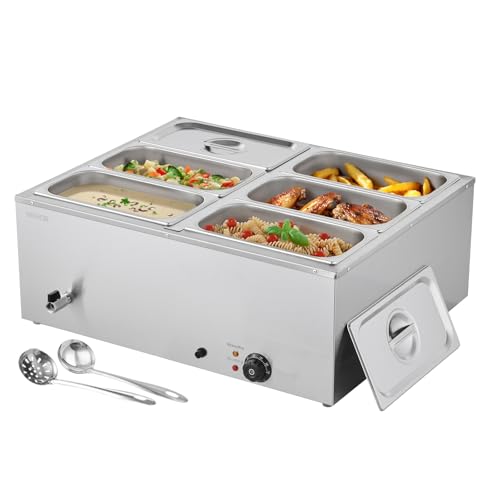 VEVOR 6-Pan Commercial Food Warmer 1500W Electric Steam6x1/3Pan ;48QT21.3 x 13.4 x 9.64 inches17.5 poundsCheck on Amazon

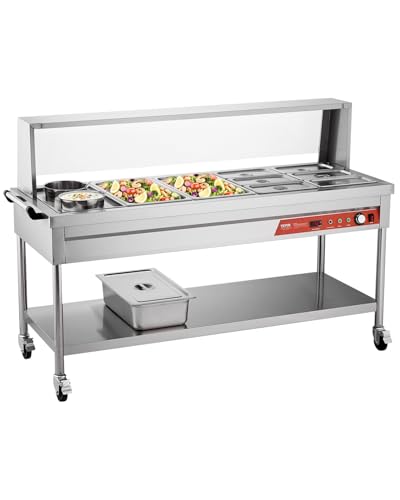
Top 3 picks at a glance
Steam table sizes compared
| Table type | Typical pan capacity | Typical footprint | Best service volume | Typical weight | Typical market range |
|---|---|---|---|---|---|
| Countertop | 2–3 full-size pans, or 4–6 half pans | 24–36 inches wide | Up to about 50 guests | 25–55 lb | Usually $250–$700 |
| Half-size floor table | 4–5 full-size pans | 48–60 inches wide | About 50–120 guests | 60–110 lb | Usually $600–$1,500 |
| Full-size floor table | 6–8 full-size pans | 72–96 inches wide | About 100–250 guests | 100–220 lb | Usually $1,000–$3,000 |
These capacities assume standard full-size hotel pans measuring approximately 12 by 20 inches. Actual capacity changes when you combine full, half, third, or sixth pans, and when the well includes dividers or a cutting board section.
Choose by catering volume, not maximum pan count
Up to 50 guests: countertop steam table
A countertop unit is usually the best steam table for catering small breakfasts, office lunches, tasting events, and buffet stations with only two or three hot dishes. It can sit on a sturdy prep table and often fits in a van or SUV without requiring a dedicated cart.
Choose one with removable wells, a drain valve, adjustable heat controls, and enough clearance below the controls to remove pans safely. A two-pan table may be sufficient for an entrée and side, while a three-pan model gives you room for a vegetable, starch, and protein.
The limitation is working height and surface area. A countertop unit does not provide much room for serving utensils, chafing-dish fuel, labels, or sneeze protection, so plan on adding a separate folding table.
About 50–120 guests: half-size floor table
A half-size floor table is the practical middle choice for recurring catering work. It provides enough pan space for a complete buffet without the transport and power demands of a full-size unit. It also keeps food at a comfortable serving height, reducing the need for guests or staff to bend over a countertop.
For a four-pan setup, reserve one pan position for the main protein, one for a starch, one for a vegetable, and one for a sauce, vegetarian entrée, or backup pan. If the menu includes several toppings or cold items, a five-pan model may be more useful than a larger table loaded with only hot food.
Over 120 guests: full-size steam table
A full-size table makes sense when several hot dishes must be available simultaneously or when service will continue for multiple hours. Six full-size pans can support a substantial buffet, but the table needs a clear service lane, adequate electrical capacity, and at least two people for safer movement during setup.
For very large events, do not assume one oversized table is always better. Two half-size tables can be easier to transport, position, and refill than one long unit. They also let you separate an entrée station from sides or create two shorter queues.
Wet heat versus dry heat
Wet heat
Wet steam tables use a water-filled well to transfer gentle, even heat to the pans. They are generally the safer choice for long buffet holding because water reduces hot spots and helps prevent food around the pan edges from drying out.
They require more setup: the table must be level, the drain must be closed, and the well must be filled to the manufacturer’s marked level before heating. A typical well may require roughly 1–3 gallons of water, depending on its size. Use hot water when the venue permits it to shorten warm-up time.
Dry heat
Dry tables heat pans directly without a water bath. They are faster to deploy and avoid carrying water into a venue, but they require closer temperature management. Food can dry or scorch more quickly, especially in shallow pans or near uncovered heating elements.
Dry heat is useful for short service windows, mobile events with limited water access, and foods that do not benefit from humid holding. For long events, use covered pans and check food temperature and texture more frequently.
Power planning: a calculation that prevents overloaded circuits
Electrical capacity is one of the most overlooked differences between countertop and full-size tables. A table’s wattage must fit the venue’s circuit after accounting for every other appliance plugged into that circuit.
Use this calculation:
Amps = watts ÷ volts
For example, a 1,800-watt steam table on a 120-volt circuit draws:
1,800 ÷ 120 = 15 amps
That leaves little usable capacity on a typical 20-amp circuit once safety margin and other equipment are considered. If you add a 1,200-watt coffee brewer, the combined load becomes 3,000 watts, or 25 amps at 120 volts. Those appliances must be placed on separate circuits, or the menu and equipment plan must change.
| Table class | Common rated power | Approximate current at 120 V | Planning implication |
|---|---|---|---|
| 2-pan countertop | 800–1,200 W | 7–10 A | Often manageable on a dedicated household-style circuit |
| 3-pan countertop | 1,200–1,800 W | 10–15 A | Check what else shares the circuit |
| 4–5 pan floor table | 1,800–2,500 W | 15–21 A | May require a dedicated circuit |
| 6–8 pan floor table | 2,500–4,000 W | 21–33 A | Confirm venue power before booking the equipment |
Actual electrical specifications vary by heating method and model. Use the nameplate rating, not a general category estimate, when planning an event. Never use an extension cord that is too light for the load, and keep electrical connections away from wet areas.
Decision matrix for common catering situations
| Your situation | Recommended setup | Why |
|---|---|---|
| Small office lunch, two hot dishes, quick teardown | 2-pan countertop dry or wet table | Low transport burden and short setup time |
| Wedding buffet for 80 guests with four hot dishes | 4–5 pan half-size wet table | Enough capacity for a complete menu and steadier holding |
| Outdoor event with no reliable electricity | Fuel-heated or insulated holding system approved for the venue | Electric steam tables may be unusable without safe power |
| 250-guest buffet with long service | Two full-size tables or multiple half-size tables | Improves queue flow, refilling, and circuit distribution |
| Frequent venue changes and stair access | Compact countertop units or two smaller floor tables | Lower individual lift weight and easier positioning |
| Menu with many sauces and toppings | Table compatible with half, third, and sixth pans | More flexible portioning than a full-pan-only layout |
Setup time and portability
A countertop table can often be positioned and connected in 5–10 minutes, excluding warm-up. A floor table may take 15–30 minutes once you include unfolding legs, leveling, positioning, filling the well, routing power, and installing pans.
For mobile work, prioritize:
- Foldable or removable legs.
- Side handles or compatible transport carts.
- Locking casters on floor models.
- A drain valve that can be reached without moving a hot table.
- Standard pan dimensions that match your existing lids and inserts.
- A cord long enough to reach the planned outlet without creating a walkway hazard.
Remember that food pans add substantial weight. A full-size pan filled with dense food can weigh roughly 20–35 pounds. A six-pan table carrying full pans may therefore exceed 250 pounds before staff, carts, and accessories are counted.
Cleanup and food-safety details that affect the purchase
Choose stainless steel construction with smooth, accessible corners and removable components. A drain is valuable on wet models, but only if it can be opened safely after the water has cooled. Tables with permanently trapped seams, difficult control panels, or inaccessible heating elements take longer to clean and are more likely to accumulate residue.
A practical cleanup sequence is:
- Switch off and unplug the table, then allow the wells and pans to cool.
- Remove food pans and scrape food residue into the correct waste container.
- Drain or remove the well water only when it is safe to handle.
- Wash removable parts with approved detergent, rinse, and sanitize.
- Wipe the table, controls, legs, and undershelf, then dry stainless surfaces.
- Inspect the drain, cord, plug, and heating controls before storing the unit.
Steam tables are for hot holding, not rapid cooking or reheating large quantities from cold. Prepare food to the required temperature before loading the table, use lids whenever possible, and monitor the food according to your local food-safety rules. A table that holds temperature well cannot compensate for poor initial heating or excessive pan depth.
Frequently asked questions
Can one steam table handle both hot and cold foods?
A steam table is intended for hot food, while cold items should be planned separately. The article notes that a buffet may need room for serving utensils, labels, sneeze protection, toppings, or cold items, so a table with fewer hot pans can sometimes be more useful than a larger table filled only with hot food. Choose the layout around the complete menu.
How much space should I leave around a steam table?
Leave enough room for a clear service lane, safe electrical routing, serving utensils, labels, and refilling pans. Full-size tables especially need adequate space for guests and staff to move safely. A countertop unit also needs a separate folding table because it provides limited surface area below and around the wells. Keep electrical connections away from wet areas.
Can I move a full steam table by myself?
Moving a full steam table alone may be unsafe, especially after pans are filled. The article recommends at least two people for safer movement of a full-size unit and notes that floor models may weigh substantially more than countertop units. Food pans add considerable weight, so use side handles, compatible transport carts, removable legs, or locking casters where available.
Should I fill a wet steam table before turning it on?
Yes. A wet steam table should be level, its drain should be closed, and its well should be filled to the manufacturer’s marked level before heating. Using hot water can shorten warm-up time when the venue permits it. The water requirement varies by well size, so follow the equipment’s specified fill level rather than relying on a general estimate.
What should I check before buying pans for a steam table?
Check that the table accepts the pan sizes your menu and existing equipment require. Standard full-size hotel pans are approximately twelve by twenty inches, but tables may also use half, third, or sixth pans. Dividers and cutting-board sections can change usable capacity, so confirm the well layout and make sure your lids and inserts match the table.
Final buying recommendation
For occasional small events, buy a countertop table with two or three pan positions. For regular service of 50–120 guests, a four- or five-pan wet-heated floor table offers the best balance of capacity, stability, and holding quality. For larger buffets, choose a full-size unit only after confirming electrical service, transport access, and staffing; two smaller tables may be the more efficient solution.
The best steam tables for catering are the ones that match your actual pan layout and venue constraints. Count the dishes that must stay hot, calculate the electrical load, measure your transport path, and select the smallest table that can serve the menu without constant refilling.