Our Top Picks

Top 3 picks at a glance

Quick Answer
The Rode NT-USB Mini is worth buying if you want a compact USB microphone that sounds clean for streaming, podcasting and voice work without any setup beyond plugging in a USB-C cable. Its cardioid condenser capsule, built-in pop filter and zero-latency headphone monitoring cover the essentials, and the detachable magnetic stand keeps it small on a desk. Choose it over cheaper rivals when build quality and monitoring matter; skip it if you need multiple pickup patterns or an onboard mute button.
The real decision with a first USB microphone is rarely about raw sound alone. It is about what surrounds the capsule: whether you can monitor your own voice without delay, whether the stand keeps the mic at mouth height, and whether the controls you reach for mid-stream actually exist on the body. A mic that records well but forces you into software menus for every adjustment becomes friction during live sessions, calls and recordings.
This review is for gamers setting up a first streaming desk, podcasters recording at home, and remote workers who want to sound clearer on calls. Every product below was selected from its Amazon listing: the model names, capsule and pattern details, included accessories and connection types stated there. The Rode NT-USB Mini gets the fullest treatment as the headline product, followed by the three closest compact USB alternatives in its class.
Quick Picks
As an Amazon Associate we earn from qualifying purchases
| Product | Best for | Key spec from title |
|---|---|---|
| Rode NT-USB Mini | Streamers who want monitoring and a tiny footprint | Studio-quality condenser USB mic with headphone amplifier |
| HyperX SoloCast | Gamers who want tap-to-mute on the mic itself | USB condenser gaming mic with tap-to-mute sensor |
| Razer Seiren Mini | Noisy rooms where background rejection matters most | Compact USB mic with supercardioid polar pattern |
| Logitech Blue Yeti Nano | Creators who switch between solo and group recording | Premium USB mic with cardioid and omni patterns |
How to Choose
Pickup pattern decides what else the mic hears
A cardioid capsule listens mainly to what sits in front of it, which suits a single speaker at a desk and rejects some sound from the sides and rear. The NT-USB Mini, SoloCast and Yeti Nano all offer cardioid; the Seiren Mini goes further with a supercardioid pattern that narrows the pickup zone, useful when a keyboard, fan or family noise shares the room. Omni mode, found on the Yeti Nano, captures the whole space and only makes sense for group recordings. Match the pattern to your room before comparing anything else, because no software setting fully fixes a pattern that hears too much.
Monitoring separates a recording mic from a guessing game
Zero-latency headphone monitoring lets you hear your own voice through the microphone as you speak, with no echo or delay, so you catch clipping, plosives and drifting distance before your audience does. The NT-USB Mini builds this in through a 3.5mm headphone output with its own volume control, and the Yeti Nano offers no-latency monitoring as well. The SoloCast and Seiren Mini omit a headphone jack entirely, which means you monitor through your software instead and accept its delay. If you record long sessions or stream with game audio in your ears, a monitoring jack on the mic body is worth prioritising.
Controls on the body versus controls in software
What you can adjust without opening an app matters during a live moment. The SoloCast puts a tap-to-mute sensor on top with an LED indicator, the fastest mute in this group. The Yeti Nano carries headphone volume and mute controls on the mic. The NT-USB Mini keeps things simpler: a volume dial for the headphone output, with gain handled in your recording software or through Rode’s free companion apps. The Seiren Mini has no onboard controls at all. Decide whether you are a set-and-forget user or someone who rides levels constantly, then check the body for the buttons your habit needs.
Stand, mounting and desk footprint
All four microphones ship with a desk stand, but the details differ. The NT-USB Mini sits on a detachable magnetic stand that pops off so the mic can mount to a boom arm using the included thread adaptor, and its compact body leaves room for a keyboard in front of it. The SoloCast stand adjusts its angle and hides cable routing underneath. The Seiren Mini uses a tilting stand and a built-in shock absorber to dull desk bumps. The Yeti Nano base includes cable management. Measure your desk depth and decide early whether a boom arm is in your future, because thread compatibility decides how painless that upgrade is.
The 4 Best Options
Rode NT-USB Mini

The NT-USB Mini is the microphone this review centres on, and its appeal is how much of the recording chain Rode packed into a body small enough to sit beside a keyboard. The cardioid condenser capsule is voiced for speech, the pop filter is built into the grille rather than clipped on, and the integrated headphone amplifier with a front volume dial makes zero-latency monitoring effortless. The magnetic stand detaches in a second for boom mounting, and the metal build feels a step above plastic rivals. For streamers, podcasters and call-heavy remote workers who want one tidy plug-and-play mic, it is the most complete package here.
Specs
- Brand: Rode
- Model: NT-USB Mini (NTUSBMINI)
- Microphone type: Studio condenser, cardioid (unidirectional) polar pattern
- Frequency response: 20 Hz – 20 kHz
- Signal-to-noise ratio: 82 dB
- Connectivity: USB, with SC20 USB-C cable included
- Headphone output: 3.5mm jack with volume control for zero-latency monitoring
- Built-in pop filter and detachable magnetic stand
- Included components: NT-USB Mini, SC20 cable, thread mount adaptor
- Compatible devices: Personal computer, tablet, gaming console, headphone
Best for: Streamers and podcasters who want monitoring, a pop filter and a metal build in one compact desk mic.
Watch out for: There is no mute button or gain dial on the body, so level changes happen in software.
ASIN: B084P1CXFD
HyperX SoloCast
The SoloCast aims squarely at gamers and streamers who want the fewest possible steps between the box and a live session. Its headline feature is the tap-to-mute sensor on top of the mic: one touch silences it, and the LED ring shows your status at a glance, which is genuinely useful mid-game. The cardioid condenser capsule connects over USB-C with the cable included, and the flexible stand adjusts its angle and routes the cable underneath. It lacks a headphone jack, so monitoring runs through software, but for Discord, Twitch and YouTube use where simplicity wins, it is a strong alternative.
Specs
- Brand: HyperX
- Model: SoloCast (HMIS1X-XX-BK/G)
- Microphone type: USB condenser, cardioid polar pattern
- Tap-to-mute sensor with LED status indicator
- Connectivity: USB-C, USB Type-C to USB-A cable (2 m) included
- Adjustable stand with cable management
- Compatible devices: PC, PS4, PS5 and Mac
- Included components: Microphone, stand, USB cable
Best for: Gamers who want a physical tap-to-mute control and a fast plug-and-play setup for streaming and Discord.
Watch out for: No headphone output, so you cannot monitor your voice directly from the microphone.
ASIN: B08KFL3SFV
Razer Seiren Mini
Razer’s Seiren Mini takes a different route to clean audio: instead of adding features, it narrows what the microphone hears. The 14mm condenser capsule uses a supercardioid pickup pattern, tighter than the cardioid designs elsewhere in this roundup, so it focuses on your voice and turns away more of the room behind and beside you. That makes it the natural pick for untreated rooms, shared spaces and desks near a window. The heavy-duty tilting stand and integrated shock absorber help with stability and bumps. There are no onboard controls and no headphone jack, so it is a deliberately minimal tool: plug in, position it close, and let the pattern do the work.
Specs
- Brand: Razer
- Model: Seiren Mini (RZ19-03450100-R3U1), Classic Black
- Microphone type: USB condenser, 14mm capsule
- Polar pattern: Supercardioid
- Connectivity: USB Type-A
- Heavy-duty tilting stand
- Integrated shock absorber for desk-bump resistance
- Form factor: Mini, ultra-compact build
Best for: Creators in noisy or untreated rooms who need maximum background rejection from the pattern alone.
Watch out for: The supercardioid pattern punishes poor placement; speak off-axis and your voice thins out quickly.
ASIN: B08HH3FTYT
Logitech Blue Yeti Nano
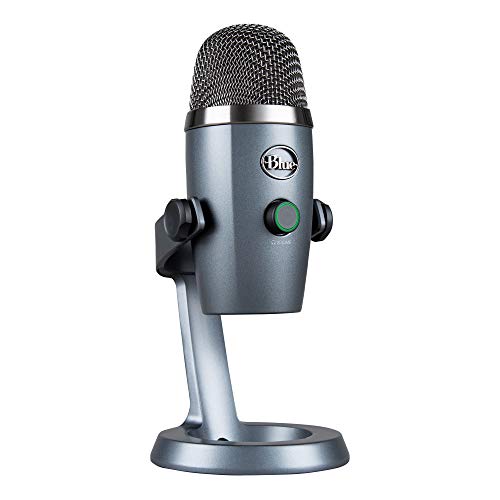
The Yeti Nano is the flexibility pick of the four. Where the others commit to one pickup pattern, it offers two: cardioid for solo streaming and podcasting, and omnidirectional for recording several people around a table or capturing a room. It records at 24-bit quality, supports Blue VO!CE vocal effects through Logitech’s software, and provides no-latency headphone monitoring with volume and mute controls on the body. The custom base includes cable management, and an adapter for boom mounting is in the box. If your recording alternates between solo commentary and group sessions, this is the only microphone here that covers both without a second purchase.
Specs
- Brand: Logitech for Creators (Logitech G)
- Model: Blue Yeti Nano (988-000088), Shadow Grey
- Microphone type: Premium USB condenser
- Polar patterns: Cardioid and omnidirectional
- 24-bit sound quality with Blue VO!CE effects support
- No-latency headphone monitoring
- Onboard headphone volume and mute controls
- Included: Yeti Nano mic, custom base with cable management, USB cable, 1/4-inch to 5/8-inch adapter, Quick Start Guide
- Compatible devices: PC and Mac
Best for: Creators who record both solo commentary and multi-person sessions and want pattern switching on one mic.
Watch out for: It is the bulkiest option here, so very small desks may feel crowded with it in place.
ASIN: B07DTTGZ7M
Which One Fits Your Situation
You stream games from a small desk
Pick the Rode NT-USB Mini. Its compact body and magnetic stand leave room for your keyboard and mouse, the built-in pop filter handles excited commentary, and the headphone output lets you hear your voice over game audio without delay. When the desk eventually grows, the stand detaches and the included thread adaptor moves the mic onto a boom arm, so it grows with the setup instead of being replaced.
Your room is noisy and untreated
Pick the Razer Seiren Mini. The supercardioid pattern is the tightest in this group, so it captures less of the fan, traffic and household noise surrounding you. Position it close to your mouth and slightly angled, keep your voice on-axis, and the pattern does most of the noise control before any software processing. Just accept the trade: no monitoring jack and no onboard controls.
You record podcasts or meetings with other people in the room
Pick the Logitech Blue Yeti Nano. Its omnidirectional mode records everyone around a table evenly, which neither the NT-USB Mini nor the SoloCast can do with their fixed cardioid patterns. Switch back to cardioid when you record alone. The onboard mute and headphone volume also help when a session turns into a discussion and levels need adjusting on the fly.
You want the simplest setup for Discord and casual streaming
Pick the HyperX SoloCast. One USB-C cable, an adjustable stand and a tap-to-mute top cover everything casual use demands, and the LED indicator ends the classic “am I muted?” moment in voice chat. You give up direct monitoring, but for gaming sessions where the microphone just needs to work every time, that trade is easy to accept.
Common Mistakes
- Placing the microphone too far away: USB condensers sound best within roughly a hand’s length of your mouth; distance adds room echo that no pattern fully removes.
- Assuming a mute button exists: the NT-USB Mini and Seiren Mini have no onboard mute, so set a push-to-mute key in your streaming or chat software before going live.
- Monitoring through software when the mic has a headphone jack: routing your voice through an app adds delay; plug headphones into the NT-USB Mini or Yeti Nano for zero-latency monitoring.
- Buying a single-pattern mic for group recording: cardioid and supercardioid mics capture one main speaker well; a table of voices needs the Yeti Nano’s omni mode instead.
- Ignoring the stand thread: check the included adaptor and thread size before ordering a boom arm, or the upgrade turns into a second accessory hunt.
Frequently Asked Questions
Is the Rode NT-USB Mini good for streaming and gaming?
Yes. Its cardioid condenser capsule is voiced for speech, the built-in pop filter softens plosives during animated commentary, and the headphone output provides zero-latency monitoring so you can balance your voice against game audio. It connects over USB-C and works as a plug-and-play device on PC, which covers the typical streaming and Discord setup without extra hardware.
Does the NT-USB Mini need any software to work?
No software is required for basic recording: plug in the USB-C cable and select it as your input device. Rode also offers free companion software for additional processing and routing on supported platforms, and the listing advertises free software with the microphone. Your streaming or recording app handles gain either way, since the mic body has no gain dial.
How does the NT-USB Mini compare with the HyperX SoloCast?
Both are compact cardioid USB condensers aimed at streamers. The NT-USB Mini adds a headphone jack with a volume dial for zero-latency monitoring, a built-in pop filter and a detachable magnetic stand. The SoloCast counters with a tap-to-mute sensor and LED indicator on the mic itself. Choose the Rode for monitoring and build; choose the HyperX for the fastest physical mute.
Can the NT-USB Mini be mounted on a boom arm?
Yes. The desk stand is magnetic and detaches, and Rode includes a thread mount adaptor in the box, so the microphone can attach to a standard boom arm or mic stand. Boom mounting also improves placement: the capsule can sit closer to your mouth and away from keyboard noise, which improves clarity more than most settings changes.
Related guides
More from Amazon
Programs that pair well with the guide above. Offers and eligibility are set by Amazon and may change.
Free shipping on eligible items, Prime Video and more. Eligible new members can start with a free trial.
Start a Prime free trialAd-free music streaming. Eligible new subscribers can start with a free trial.
Try Music Unlimited freeA Prime membership for ages 18-24 with a trial period. Eligibility is set by Amazon.
See Prime for Young AdultsAudiobooks and podcasts to listen to on the go. Eligible new members can start with a free trial.
Try Audible freeAs an Amazon Associate we earn from qualifying purchases.