
Top 3 picks at a glance
The Short Answer
For most people, the best fan size for a laptop cooling pad is 120 mm to 140 mm. A pad with one or two fans in this range provides a useful balance of airflow coverage, noise control, portability, and desk-friendly dimensions. It is especially well suited to 14-inch through 17.3-inch laptops.
Smaller 70 mm to 90 mm fans can work well in slim, travel-oriented cooling pads, but they generally need to spin faster to move comparable air. That can mean a higher-pitched sound. Larger 180 mm to 220 mm fans are often the better choice for thick gaming laptops and desktop-replacement models because a single large, slower-spinning fan can cover more of the underside.
As an Amazon Associate we earn from qualifying purchases at no extra cost to you.


Do not choose by fan diameter alone. The pad’s overall footprint must support your laptop, its intake vents need to line up with the fan area, and the pad should remain stable at your preferred typing angle. In 2026, a practical buying rule is simple: match the cooling pad to your laptop’s screen class and chassis width, then choose the largest fan arrangement that still fits your desk, bag, and noise preferences.
Standard Sizes
Cooling-pad fan sizes are usually stated in millimeters, while laptop buyers often think in screen inches. The two measurements are related only loosely: a 17-inch laptop does not require a 17-inch fan. What matters is whether moving air reaches the laptop’s bottom intake zones.
| Fan size | Fan diameter in inches | Fan diameter in cm | Typical cooling-pad footprint | Best laptop range | Best use |
|---|---|---|---|---|---|
| 70–80 mm | 2.8–3.1 in. | 7–8 cm | About 11.5–14.5 in. wide × 8.5–10.5 in. deep | 11–14 in. | Compact travel pads and light office laptops |
| 90 mm | 3.5 in. | 9 cm | About 12.5–15.5 in. wide × 9–11.5 in. deep | 12–15.6 in. | Everyday portable use |
| 100–110 mm | 3.9–4.3 in. | 10–11 cm | About 13.5–16.5 in. wide × 10–12 in. deep | 13–16 in. | Balanced home, school, and office setups |
| 120–140 mm | 4.7–5.5 in. | 12–14 cm | About 14–17.5 in. wide × 10.5–13 in. deep | 14–17.3 in. | Most buyers, including moderate gaming |
| 180–220 mm | 7.1–8.7 in. | 18–22 cm | About 16–19.5 in. wide × 11.5–15 in. deep | 15.6–19.3 in. | Large gaming laptops and stationary desks |
A multi-fan pad can be just as effective as a pad with one large fan, but the layout matters. For example, two 120 mm fans often cover a broad central area under a 15.6-inch or 17.3-inch laptop. A five-fan model may combine one larger center fan with smaller corner fans to reach several intake locations. Nine-fan pads are usually designed for especially wide 17-inch to 19.3-inch gaming chassis, where distributed airflow is more important than a minimal profile.
Expect a basic USB-powered pad to draw roughly 2.5 to 5 watts. High-speed RGB gaming pads can use roughly 5 to 10 watts, depending on fan settings and lighting. Check whether the pad has a pass-through USB port if your laptop has limited connections.
How to Measure Your Space
- Measure the laptop’s actual width and depth. Close the lid and measure the chassis, not the screen. A typical 15.6-inch laptop may be about 14.1 inches wide by 9.5 inches deep, but dimensions vary substantially by bezel size and design.
- Add a stability margin. Choose a cooling pad at least 0.5 inch wider than the laptop on each side when possible. A laptop that is 14.1 inches wide is more secure on a pad at least 15.1 inches wide, and 16 inches wide is better if you use the stand at a steep angle.
- Check the bottom vent positions. Turn the laptop over and note where the intake grilles are located. Some models pull air through a large center panel; others use two long rear vents. Select a fan layout that sits beneath those areas rather than one that blows mainly at solid plastic.
- Measure the desk depth. Allow at least 2 inches behind the pad for cables and 2 to 3 inches in front for wrist room. On a shallow 20-inch desk, a 12-inch-deep cooling pad can feel cramped once the laptop and power cord are in place.
- Measure travel storage if portability matters. For a backpack sleeve that is 15.5 inches wide, a 17-inch-wide cooling pad is unlikely to fit. Slim pads for 12-inch to 17-inch laptops commonly weigh about 1.3 to 2 pounds; larger RGB models can weigh 2.5 to 4 pounds.
- Consider the height range. A pad usually adds 1 to 3 inches at the front and can raise the rear 4 to 8 inches when adjusted. Test your chair and desk arrangement so your wrists do not bend sharply upward while typing.
By Room or Use Case
Small Desk, Dorm Room, or Shared Workspace
Choose a slim pad with two 80 mm to 100 mm fans, or a compact design with one 120 mm fan. Look for a footprint no larger than about 15 inches wide by 11 inches deep. This is the most sensible size for a 13-inch or 14-inch laptop used for schoolwork, browsing, video calls, and documents. A basic pad in this category typically costs $20 to $30.
The TECKNET-style portable format is a good reference point: these pads are intended for 12-inch to 17-inch laptops but are generally best for people who value a lightweight, low-profile stand over maximum airflow.
Home Office and Everyday 15.6-Inch Laptop Use
For a standard 15.6-inch laptop, aim for a pad about 15 to 16.5 inches wide and 10.5 to 12 inches deep. Two 120 mm fans are an excellent all-purpose configuration. They cover enough area for common bottom-vent layouts without making the pad excessively bulky.
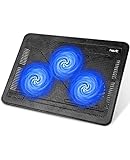
A model such as the Havit HV-F2056 type, designed for 15.6-inch to 17-inch laptops and priced around $28, represents this category well. It is a sensible choice when the laptop gets warm during long work sessions but does not need an oversized gaming accessory.
Gaming Desk for 15.6-Inch or 17.3-Inch Laptops
Gaming laptops benefit from a wider pad with either two 120 mm to 140 mm fans or a mixed multi-fan arrangement. Target a footprint of roughly 16 to 18 inches wide by 11.5 to 13 inches deep. This provides a stable platform for heavier machines, which often weigh 5 to 8 pounds before the charger is added.
A five-fan design, such as a Kootek-style cooler for 12-inch to 17-inch laptops at around $30, can make sense if your laptop has multiple intake zones. More fans do not automatically mean better cooling, but they can improve coverage on a broad chassis. Prioritize adjustable fan speed and a front lip that keeps the laptop from sliding.
Large Desktop-Replacement and 18-Inch Gaming Laptops
For 17.3-inch, 18-inch, and 19.3-inch laptops, choose a pad at least 17 inches wide; 18 to 19 inches wide is preferable for secure support. Large 180 mm to 220 mm fans, or dense arrays of smaller fans, are appropriate here. These pads are usually better left on a desk than carried daily.
An RGB nine-fan pad intended for 15.6-inch to 19.3-inch laptops, such as the ChillCore A21 type at about $35, suits this category. Its value is broad airflow coverage and multiple height settings, not merely decorative lighting. Confirm the front edge is deep enough to support a thick laptop without blocking exhaust vents.
Travel, Couch, and Occasional Use
Use a lightweight pad with 80 mm to 100 mm fans and a shallow profile. Avoid very large fans and elaborate stands if the pad will live in a backpack. For couch use, remember that the primary benefit may be keeping fabric from blocking the laptop’s underside. A rigid pad that raises the laptop even slightly can be more useful than a louder, heavier high-fan-count model.
Common Sizing Mistakes
Buying according to screen size only. Two 16-inch laptops can differ by more than an inch in width. Always compare chassis measurements with the cooling pad’s usable support area.
Assuming more small fans are always better. Multiple fans can improve coverage, but a well-positioned pair of 120 mm fans may be quieter and more practical than several tiny high-speed fans.
Ignoring intake placement. A fan under a solid battery compartment does little. Check where your laptop actually draws air from before choosing a center-fan or multi-fan layout.
Choosing a pad that is too narrow. A cooling pad can technically list compatibility with a 17-inch laptop while offering minimal side support. For frequent typing or gaming, select a platform that is wider than the laptop rather than exactly equal to it.
Blocking rear exhaust. Cooling pads are meant to feed cool air into bottom intakes, not seal off side or rear exhaust ports. Check that raised lips, rear rails, and desk walls do not restrict hot-air outlets.
Forgetting the power and cable setup. USB-powered pads are convenient, but a short cable may pull taut on a large desk. If the pad occupies a USB-A port, make sure its pass-through port meets your needs for a mouse receiver or flash drive.
FAQ
Is a 120 mm fan good for a laptop cooling pad?
Yes. A 120 mm fan is one of the best all-around sizes for a cooling pad. One 120 mm fan works well for compact and mid-size laptops, while two 120 mm fans are a strong choice for 14-inch through 17.3-inch models. They offer broad airflow without requiring the very large footprint of a 200 mm fan.
Are two large fans better than five small fans?
Not necessarily. Two large fans often provide quieter, broad airflow, while five smaller fans can target several vent locations. Choose two large fans for a simpler, lower-profile setup; choose a multi-fan layout when your laptop has widely spaced intake grilles or a particularly wide gaming chassis.
What cooling pad size should I get for a 17-inch laptop?
Look for a pad at least 16 inches wide and about 11 inches deep, with 17 to 18 inches of width being more comfortable for stability. Two 120 mm or 140 mm fans are suitable for many 17-inch laptops. For a thick, high-performance 17.3-inch machine, consider a larger 180 mm to 220 mm fan design or a broad multi-fan pad.
Can a cooling pad be too big for a laptop?
Yes, although an oversized pad is usually a convenience issue rather than a performance problem. A very large 19-inch-wide pad can consume unnecessary desk space, add weight, and be awkward to transport with a 13-inch laptop. It may also place the fan airflow away from the laptop’s intake vents. Match the pad footprint and fan layout to the laptop rather than simply buying the largest option.
Related guides
- Alienware 16 Aurora RTX 5070 Review: Display, Portability and Configuration Gaps
- Lenovo Legion Pro 7i Gen 10 Review: 64GB RAM and Dual-SSD Configuration
- MSI Katana 15.6-inch RTX 5050 Review: Configuration Strengths and Upgrade Unknowns
- ASUS ROG Strix SCAR 16 G635LX-XS97 Review: Display Ambition, Upgrade Questions


