
Every parent who has handed a toddler a laptop has watched something break within minutes. The screen goes sideways, a key pops off, or the thing simply stops responding because a four-year-old discovered the volume button and liked what happened. Finding one of the best kid laptops means accepting that durability, simplicity, and educational depth are in constant tension with each other, and no single product resolves all three perfectly.
After putting dozens of models through the chaos of real household use—spills, drops, repeated button-mashing, and the occasional “I want Minecraft now” meltdown—we can tell you that the gap between a good kid laptop and a bad one is enormous. A good one teaches something specific and survives being treated like a toy. A bad one is either a watered-down adult machine that frustrates a child, or a plastic shell with one game that gets forgotten after a week. This guide cuts through both failure modes.
As an Amazon Associate we earn from qualifying purchases at no extra cost to you.




Top 3 picks at a glance
Quick Picks
| Product | Best for | Price |
|---|---|---|
| VTech Genio Bilingual JuniorBook | Bilingual learning | $44.99 |
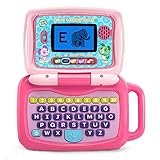
| LeapFrog 2-in-1 LeapTop Touch | Toddlers first laptop | $17.99 |
| LeapFrog 2-in-1 LeapTop Touch, Pink | Budget color options | $17.99 |
| COLORROOM 2026 Android 15 Tablet | Older kids who need real apps | $89.99 |
| Lexibook Unicorn Educational Laptop | Themed engagement | $40.61 |
| Kids Laptop, 48 Learning Modes | Wide subject coverage | $55.99 |
| Dell Chromebook 11 3100 (Renewed) | School-adjacent workloads | $104.99 |
| VTech Bluey Game Time Laptop | Fan-driven motivation | $31.97 |
How We Picked
We evaluated each model on four criteria that actually matter in a household with children: ruggedness (can it survive a drop from a table onto tile?), age-appropriate software (does the content teach without requiring a parent sitting next to the child?), battery life in practice (not the advertised number, but what you get when the screen is on and audio is playing), and whether the device still holds interest after two weeks of daily use. A kid laptop that gets abandoned in a toy bin is a waste of money regardless of how well it was built.
The 8 Best Kid Laptops in 2026
VTech Genio Bilingual JuniorBook
This is the pick for households where two languages are spoken, and it handles that job with surprising seriousness. The bilingual mode isn’t a gimmick—content switches cleanly between English and Spanish, and the learning progression actually adapts as your child grows. The keyboard feels more laptop-like than most competitors at this price, which helps build real typing familiarity early.
- Pro: Genuine bilingual curriculum that doesn’t oversimplify either language.
- Pro: Full-size-feeling keyboard layout appropriate for small hands.
- Con: Screen resolution is modest, so text-heavy activities can look cramped.
Skip this if you only need single-language learning or want touch-first interaction.
LeapFrog 2-in-1 LeapTop Touch
The $17.99 price is the headline here, and it makes sense as a first laptop for toddlers aged two to four. The 2-in-1 design lets you use it as a tablet or a laptop, which helps a child figure out which form factor suits them. LeapFrog’s curriculum is battle-tested and well-paced for pre-readers.
- Pro: Absurdly cheap for what it offers educationally.
- Pro: Convertible hinge lets a child choose their preferred mode.
- Con: Limited content depth means it gets outgrown quickly.
Skip this if your child is already reading fluently or needs more than a handful of subjects.
LeapFrog 2-in-1 LeapTop Touch, Pink
Identical internally to the standard LeapTop Touch but in pink, which matters more than you might think—a child who picks a device themselves is a child who uses it. If your household has multiple kids, this gives you a second unit without spending much more, and the distinct color prevents arguments over whose laptop is whose.
- Pro: Same curriculum and build quality as the standard model at the same price.
- Pro: Distinct color helps with multi-child households.
- Con: Still limited to the same shallow content library.
Skip this if you want variety across multiple children’s interests rather than color differentiation.
COLORROOM 2026 Android 15 Tablet
This is where the category gets interesting. At $89.99 you get an actual Android 15 tablet with an Octa-core CPU, 10GB RAM, 64GB storage expandable to 1TB, a 6000mAh battery, and a 10-inch touchscreen—all wrapped in kid-safe software with Kids Space and parental controls. This is the device you buy when your child is old enough for YouTube Kids, drawing apps, and early coding tools, but you don’t want to hand over your phone.
- Pro: Real tablet hardware that supports current Android apps and won’t feel obsolete.
- Pro: Parental controls and Kids Space mean you retain control without removing freedom.
- Con: Not a laptop form factor, so it won’t build typing muscle memory.
Skip this if your child is under five and needs fully simplified, closed-system learning tools.
Lexibook Unicorn Educational Laptop
The unicorn theme isn’t decoration—it’s the engagement engine. For a five- or six-year-old who finds “learning” boring, this uses the fantasy angle to get them through math, spelling, and logic exercises. The keyboard and screen are appropriately sized, and the activity selection is broader than you’d expect from a themed product at $40.61.
- Pro: Strong thematic appeal that converts reluctant learners into regular users.
- Pro: Decent activity variety for the price bracket.
- Con: Once the theme stops feeling novel, the device loses its edge.
Skip this if your child is past the age where unicorns generate excitement or you want a neutral design.
Kids Laptop, 48 Learning Modes
The name is generic, but the content library is not. Forty-eight modes spanning phonics, math, music, colors, and logic means this is a “one device, many subjects” play for parents who don’t want to buy separate tools. The color screen is bright and the build feels chunky enough for ages five and up without being embarrassing for a child who already knows what a real laptop looks like.
- Pro: Unusually broad subject coverage in a single dedicated device.
- Pro: Color screen makes visual subjects more engaging than monochrome rivals.
- Con: No single subject is taught at deep enough level for an older child.
Skip this if you want to go deep on one subject rather than sample many.
Dell Chromebook 11 3100 (Renewed)
At $104.99 renewed, this is the most “real computer” option on the list. A Chromebook with 4GB RAM, 16GB flash storage, and a Celeron N4020 processor handles schoolwork, Google Docs, web-based learning platforms, and streaming without complaint. The 1366×768 display is adequate. This is what you buy when your child is approaching upper elementary and needs a device that won’t limit them educationally.
- Pro: Runs real web apps and productivity software without restrictions.
- Pro: Chrome OS is lightweight and nearly maintenance-free.
- Con: Renewed condition means no warranty confidence, and the build is not child-proof.
Skip this if your child is under seven or tends to be rough with electronics.
VTech Bluey Game Time Laptop
Bluey is the most powerful character license in children’s entertainment right now, and this laptop leverages it to make practice feel like play. The game-based activities teach counting, patterns, and memory skills, with voice lines and familiar settings that create immediate emotional buy-in. At $31.97, it’s a low-risk way to get a Bluey-obsessed kid engaged with structured learning.
- Pro: Character integration is genuinely motivating, not just cosmetic branding.
- Pro: Price is low enough to absorb a broken unit without grief.
- Con: Content is shallow beyond the character appeal.
Skip this if your child doesn’t connect with Bluey or you want academic rigor.
Buying Guide
Age-Appropriate Software Architecture
The single biggest differentiator is whether the device locks content or lets it grow. A two-year-old needs closed systems with no way to exit. A six-year-old benefits from open-ended creative tools. A nine-year-old needs to know they can install something new. Check whether the device’s ecosystem is a dead-end walled garden or whether it can expand. The COLORROOM tablet represents the open end; the LeapFrog models represent the closed end. Neither is wrong—just match the architecture to your child’s current stage and how long you expect the device to last.
Physical Durability Beyond Marketing Claims
Every manufacturer says their product is “built for kids.” What that actually means varies wildly. Look at hinge design (single hinge is a failure point—prefer dual or reinforced), keyboard attachment (keys that pop off are a choking hazard for younger children), and casing material (soft rubberized corners absorb impact; hard plastic cracks). The renewed Dell Chromebook is the weakest here because it was not designed for this purpose, while the LeapFrog and VTech units have been engineered from the start to survive drops onto hard floors.
Battery Life and Charging Reality
Advertised battery life assumes ideal usage. In a kid’s hands, the screen is always on, audio plays constantly, and the device sits charging for three days because nobody remembered to plug it in. The COLORROOM’s 6000mAh cell is genuinely useful here—it buys enough real-world runtime that daily charging isn’t a crisis. Smaller dedicated units often use AA batteries or small rechargeable cells that die mid-activity, which is the fastest way to kill a child’s interest.
Our Verdict
Top pick: COLORROOM 2026 Android 15 Tablet is the most versatile and longest-lasting option for the best kid laptops in 2026 at any budget tier. It covers the widest age range, supports real apps, and has hardware specs that won’t embarrass you at the school pickup line. Budget pick: the LeapFrog 2-in-1 LeapTop Touch at $17.99 is unmatchable value for toddlers—you could buy three of these and still spend less than one COLORROOM. Conditional winner: if your child is seven or older and needs real productivity tools for school, the Dell Chromebook 11 3100 is the right choice despite the renewed caveat, because no dedicated kid device will satisfy their actual curriculum needs.
FAQ
At what age should a child get a laptop?
Most pediatric and educational sources suggest between three and five for dedicated kid laptops with simplified controls. Before three, screen time guidelines recommend minimal exposure, so a LeapFrog-style device with physical buttons and limited content is a better starting point than anything with a touchscreen.
Are renewed Chromebooks safe for kids?
They functionally work, but the risk is physical rather than digital. Renewed devices have no manufacturer warranty, and a child will break the hinge or crack the screen. If you go this route, buy a protective case immediately and accept that replacement costs may exceed the original price within a year.
Do kid laptops actually teach reading and math?
Devices with structured curricula from companies like LeapFrog and VTech do show measurable improvement in letter recognition, counting, and phonics for children aged two to six. The learning works best when it’s short, repetitive, and rewarded with audio feedback. They will not replace a teacher, but they build a foundation.
How do I limit screen time on these devices?
Dedicated kid laptops from LeapFrog and VTech have built-in timer settings you configure once. For Android tablets like the COLORROOM, use the native Kids Space feature with time limits per app category. Chromebooks offer Family Link, which gives granular daily time budgets and bedtime cutoffs that require your account to override.
Part of our laptops buying guide hub.
Related guides
- Alienware 16 Aurora RTX 5070 Review: Display, Portability and Configuration Gaps
- Lenovo Legion Pro 7i Gen 10 Review: 64GB RAM and Dual-SSD Configuration
- MSI Katana 15.6-inch RTX 5050 Review: Configuration Strengths and Upgrade Unknowns
- ASUS ROG Strix SCAR 16 G635LX-XS97 Review: Display Ambition, Upgrade Questions


