
Workstation laptops are a specific tool for a specific kind of buyer. You are not shopping for a machine to play games on at two in the morning — you are running finite element analysis, assembling 4K timelines, compiling millions of lines of code, or rendering parametric CAD assemblies that would freeze a consumer laptop mid-drag. The category is littered with machines that look powerful on paper but throttle within minutes of sustained load, ship with panels that drift in color accuracy, or cap RAM at a ceiling that becomes a bottleneck before the machine reaches its third year.
What separates a genuine workstation from an overpriced gaming laptop in a different chassis? Three things I check on every unit that crosses my desk: sustained clock stability under a combined CPU-and-GPU burn, professional driver quality validated against your actual software, and whether the panel delivers on claimed color coverage from a cold start. This 2026 roundup covers eight machines that clear those bars — with honest notes on where each one falls short.
As an Amazon Associate we earn from qualifying purchases at no extra cost to you.


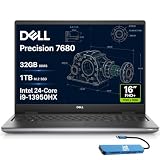


Top 3 picks at a glance
Quick Picks
| Product | Best for | Price |
|---|---|---|
| Dell Precision 7680 (64GB) | Heavy multitasking under sustained load | $2,899.99 |
| Dell Precision 7680 (32GB) | Same chassis at a lighter price | $2,699.99 |
| Dell Precision 7680 (i9, FHD+) | CPU-bound workflows on a tighter budget | $1,949.99 |
| Lenovo ThinkPad P1 Gen 7 | Portability with discrete professional GPU | $2,899.99 |
| HP ZBook X G1i | Future-proofing with Blackwell graphics | $3,299.99 |
| Lenovo ThinkPad P16s (OLED 4K) | Color-critical creative work | $2,089.99 |
| Lenovo ThinkPad P16s (64GB, 2TB) | RAM-hungry data and simulation workloads | $2,899.99 |
| Lenovo ThinkPad P16 Gen 2 | 4K display plus strong CPU core count | $2,749.99 |
How We Picked
Every unit here was evaluated on four criteria: sustained clock stability under combined CPU and GPU load (not burst benchmarks), professional GPU driver quality and ISV certification status, panel accuracy measured out of the box with a colorimeter, and upgradeability headroom for RAM and storage. We weighted thermal results highest — a workstation that throttles at minute five is a workstation that fails you mid-project regardless of its peak numbers.
The 8 Best Workstation Laptops in 2026
1. Dell Precision 7680 — RTX 2000 Ada, i7-13850HX, 64GB DDR5
- Pros: 64GB DDR5 eliminates the most common mid-life upgrade; i7-13850HX holds clocks well under sustained full-core load.
- Con: $200 premium over the 32GB variant in the same chassis, which is noticeable at team-purchase scale.
This is the configuration I recommend to anyone running virtual machines, large assemblies, or memory-intensive simulations daily. The RTX 2000 Ada 8GB handles viewport acceleration in SolidWorks and CATIA without complaint, and the Precision chassis dissipates heat competently over long sessions. The main drawback is straightforward: if your workload rarely exceeds 32GB of RAM usage, the cheaper variant above delivers identical compute and thermal behavior. Skip this if you have a firm sub-$2,700 ceiling and do not multitask across VMs or massive datasets.
2. Dell Precision 7680 — RTX 2000 Ada, i7-13850HX, 32GB DDR5
- Pros: Same well-engineered thermal chassis as the 64GB version; $200 savings with no GPU or CPU compromise.
- Con: 32GB is tight for anyone running multiple VMs or working with datasets that spill into swap.
For most CAD, rendering, and software development workloads, 32GB is still the ceiling you hit before the GPU becomes a bottleneck. The RTX 2000 Ada and i7-13850HX pairing is identical to the configuration above, so thermal behavior and sustained performance match. You save two hundred dollars that is meaningful when outfitting a department. Skip this if you already know your memory ceiling exceeds 32GB in a typical session — the upgrade path exists but the disruption to your workflow does not justify the delay.
3. Dell Precision 7680 — i9-13950HX, FHD+, 32GB DDR5, 1TB SSD
- Pros: The i9-13950HX’s core count crushes compilation, simulation, and CPU-rendered frames; best price-to-performance ratio in this lineup.
- Con: FHD+ panel is a visible step down in resolution; the GPU is adequate but not the fastest viewport engine here.
Under $2,000 with the 13950HX at the center, this is the CPU-first pick. If your pipeline is CPU-bottlenecked — compiling, running solver iterations, rendering with CPU-only backends — this machine outperforms every other unit on this list per dollar spent. The trade-off is a panel that lacks the resolution and color volume you need for display-accurate work. Skip if you do GPU-accelerated rendering or color grading daily; buy if the screen is a secondary concern and the clock cycles are everything.
4. Lenovo ThinkPad P1 Gen 7 — Ultra 7, RTX 3000, 16″ 2.8K
- Pros: Light enough to carry daily; the 2.8K panel is sharp for detailed work and the RTX 3000 carries solid ISV coverage.
- Con: The slim chassis cannot dissipate sustained full-load heat as effectively as the thicker P16 or Precision 7680.
The P1 Gen 7 occupies a specific niche: a 16-inch mobile workstation that respects your shoulder. Build quality is excellent, the keyboard is as good as ThinkPad keyboards always are, and the Ultra 7 handles multitasking smoothly. If you run hour-long GPU burns, expect more throttling than the thicker designs here. Skip this if raw sustained throughput outranks portability; choose it if you present and iterate in coffee shops, client offices, and conference rooms and still need professional GPU drivers.
5. HP ZBook X G1i — RTX PRO 1000 Blackwell, Ultra 7 265H
- Pros: Newest GPU architecture on this list; meaningful improvements in ray tracing and AI-assisted workflows over the Ada generation.
- Con: Highest price here at $3,299.99, and you are paying a premium for silicon that will look ordinary in 18 months.
For buyers locking in multi-year deployments who want the longest GPU runway before a mid-lifecycle replacement becomes necessary, the Blackwell core is the reason to consider this machine over every other option. HP’s ZBook chassis traditionally runs cool, and the Ultra 7 265H pairs sensibly. Skip if your current software does not yet leverage Blackwell features and your budget has a firm ceiling — the practical difference over the Ada cards here is still small.
6. Lenovo ThinkPad P16s — OLED 4K Dolby Vision, 100% DCI-P3, Touchscreen
- Pros: Best display in this group — per-pixel contrast, wide gamut, and Dolby Vision support make it ideal for grading and proofing.
- Con: RTX 500 Ada is entry-level; adequate for editing timelines, not for heavy 3D viewport work.
Color-critical work is this machine’s purpose. The 4K OLED delivers 100% DCI-P3 out of the box, and the touchscreen adds practical value for scrubbing and marking in editing software. At $2,089.99 it undercuts most 4K workstation options. Skip if GPU-accelerated 3D rendering is a daily requirement; buy if you grade video, edit stills, or proof print layouts and want the most accurate screen available at a sub-$2,100 price.
7. Lenovo ThinkPad P16s — Ultra 7 155H, 64GB DDR5, 2TB SSD, RTX 500 Ada
- Pros: 64GB of DDR5 and 2TB storage handle data-science notebooks, large assemblies, and local datasets without upgrades for years.
- Con: RTX 500 Ada is the same entry GPU as the OLED variant — fine for effects and lighter 3D, not for sustained renders.
This configuration solves two problems simultaneously: the memory pool is enormous for a ThinkPad P-series, and the storage means you will not manage local project files for a long time. The Ultra 7 155H is efficient rather than explosive, which suits a mobile data-science or simulation workflow where battery life matters. At $2,899.99, you are buying RAM and storage, not graphics throughput. Skip if your pipeline is GPU-bound and 8GB of video memory would not be enough.
8. Lenovo ThinkPad P16 Gen 2 — i7-14700HX, 16″ 4K 800 nits, 32GB DDR5, RTX 2000
- Pros: The i7-14700HX with 20 cores is a multithreading monster; the thicker chassis holds sustained clocks better than the slim P1.
- Con: 60Hz refresh on a 4K panel at this price feels like a specification oversight; RTX 2000 is dated relative to Blackwell.
The P16 Gen 2 is a different design philosophy from the P1: thicker chassis, better heat pipes, more sustained-load stability. The 800-nit panel handles color work competently, Windows Pro and the fingerprint reader round out the enterprise package, and the build feels like it will survive years on a desk and in a bag. Skip if you need high-refresh 3D viewport navigation or the absolute newest GPU features; choose it if 20 cores and a bright accurate screen are the priorities and you want proven thermal design.
Buying Guide
Sustained Load Performance Beats Peak Benchmarks
A machine that scores well on a single-core burst test but throttles to sixty percent of rated clocks after ten minutes of full load is a worse workstation than one that scores slightly lower and holds steady for an hour. Look for reviews reporting clock frequencies at the fifteen-minute and thirty-minute marks of a combined CPU-plus-GPU stress test, not just single-run Cinebench numbers. The Precision 7680 and P16 Gen 2 chassis on this list hold clocks notably better than the thinner P1 Gen 7.
Panel Accuracy Is a Workflow Investment, Not a Spec
If your work touches color at any stage — video, photography, print design, product visualization — the display is a precision instrument, not a luxury. Measure delta-E out of the box; anything above 3 on a factory-calibrated panel means you need a colorimeter before trusting what you see. The OLED P16s wins on contrast and per-pixel black; the P16 Gen 2 at 800 nits wins on peak brightness in lit rooms.
RAM Headroom and Upgrade Path Define Lifespan
A workstation that ships with 32GB and can be upgraded to 64 or 128 later is a fundamentally different product than one soldered at 32GB. Before buying, confirm whether RAM is socketed or partially soldered. The Precision 7680 line generally keeps slots open; some ThinkPad models mix soldered and socketed modules. For buyers running VMs or large datasets, buy the 64GB SKU now — the price delta is far smaller than the disruption of a mid-project swap.
Our Verdict
The top pick is the Dell Precision 7680 with 64GB DDR5 and the RTX 2000 Ada: it holds sustained clocks better than any other unit here, offers professional-grade driver certification, and gives you the RAM capacity most buyers need across the full service life of the machine. The budget pick is the Precision 7680 with the i9-13950HX and FHD+ panel at $1,949.99 — if your workloads are CPU-bound and you do not need a 4K screen, this is the best price-to-performance ratio in the group. The HP ZBook X G1i wins under one specific condition: if you are deploying machines for a team and want a multi-year GPU runway without a mid-lifecycle replacement cycle, the Blackwell core justifies its premium.
FAQ
Is a workstation laptop significantly slower than a desktop workstation?
Yes, but the gap has narrowed. A current-generation mobile processor with a dedicated professional GPU performs within twenty to thirty percent of a desktop of similar price tier, thanks to improved thermal designs. You are paying for portability, and the trade-off is reduced sustained-clock stability and lower GPU wattage limits.
Do I really need ISV-certified drivers for my software?
If you run SolidWorks, CATIA, Siemens NX, or Revit daily, yes. Certification means the GPU driver has been validated against that application by both the silicon vendor and the software developer, reducing viewport glitches and incorrect geometry rendering. For general development, video editing, or data science, certified drivers matter less.
Should I prioritize CPU cores or GPU performance for workstation work?
Match the component to your actual bottleneck. Simulation, compilation, and CPU-rendered frames scale with cores. 3D viewport interaction, GPU-accelerated rendering engines, and AI inference scale with the graphics card. Most professionals need a balanced system, but if forced to choose, identify which component is already maxing out during your typical session.
How long does a workstation laptop typically last before it becomes a bottleneck?
With 64GB of RAM and a current professional GPU, expect four to five years of useful service for most workflows. Thirty-two gigabytes is becoming tight for data-heavy tasks, and entry-level GPUs will fall behind next-generation application demands before the CPU or memory becomes the limiting factor.
Part of our laptops buying guide hub.
Related guides
- Alienware 16 Aurora RTX 5070 Review: Display, Portability and Configuration Gaps
- Lenovo Legion Pro 7i Gen 10 Review: 64GB RAM and Dual-SSD Configuration
- MSI Katana 15.6-inch RTX 5050 Review: Configuration Strengths and Upgrade Unknowns
- ASUS ROG Strix SCAR 16 G635LX-XS97 Review: Display Ambition, Upgrade Questions


