- Top Pick: Cable Matters VESA Certified 80Gbps DisplayPort 2.1 Cable, 6.6 ft
- Runner-up: Silkland 80Gbps DisplayPort 2.1 Cable, 6.6 ft
- Also consider: UGREEN 16K DisplayPort Cable 2.1, 6.6 ft
A gaming monitor only runs at the refresh rate the whole signal chain can carry, and the cable is the link builders replace most often. An older DP 1.2 cord bundled with a past monitor can quietly cap a 1440p 240Hz panel, while a certified DP80 cable gives a DisplayPort 2.1 graphics card and monitor the full 80 Gbps path they were built for. The five cables below are all standalone DisplayPort-to-DisplayPort cords with published bandwidth figures, and each one suits a different desk, length, and generation of hardware.
Bandwidth classes decide almost everything here. DisplayPort 1.4 with HBR3 carries 32.4 Gbps, enough for 1440p at 240Hz and 4K at 144Hz. DisplayPort 2.1 splits into tiers: UHBR10 cables carry 40 Gbps, while VESA certified DP80 cables carry the full 80 Gbps UHBR20 rate that uncompressed 4K at 240Hz and DSC-fed 8K modes call for. Every pick below names its class plainly, so you can match the cable to the ports on your card and panel instead of paying a premium tier for headroom your hardware cannot use.
As an Amazon Associate, we earn from qualifying purchases.
Top 3 picks at a glance
Quick answer
For a DisplayPort 2.1 rig, the Cable Matters DP80 in 6.6 ft is the safest buy, with VESA certification and the 80 Gbps UHBR20 rate. The Silkland DP80 adds latching plugs and a braided jacket at the same length. UGREEN covers mid-range DP 2.1 builds at 40 Gbps, Maxonar reaches 10 ft at DP80 speed, and the IVANKY DP 1.4 remains the budget HBR3 pick for 240Hz panels.
The picks
Cable Matters VESA Certified 80Gbps DisplayPort 2.1 Cable, 6.6 ft

Specs
- Standard: DisplayPort 2.1, VESA certified DP80
- Bandwidth: 80 Gbps (UHBR20)
- Length: 6.6 ft (2 m); 3.3 ft and 4.9 ft versions also listed
- Published modes: 16K at 60Hz, 8K at 240Hz, 4K at 240Hz with DSC
- Features: HDR, FreeSync and G-Sync support, backward compatible with DisplayPort 2.0, 1.4, and 1.2
- Model: 102095-2m
This is the reference pick for a new DP 2.1 build. Cable Matters publishes the full DP80 figure rather than a vague 2.1 label, and the certification means the 2 m length is rated for the complete UHBR20 rate, which is exactly where uncertified long cables tend to fall short. Owners of RTX 50-series and Radeon RX 9000 cards driving 4K 240Hz OLED panels get uncompressed headroom here, and DSC support covers the 8K and 16K modes in the published list. The plain black jacket and non-latching plugs keep it simple to route behind a desk.
Silkland 80Gbps DisplayPort 2.1 Cable, 6.6 ft

Specs
- Standard: DisplayPort 2.1, VESA certified DP80
- Bandwidth: 80 Gbps (UHBR20)
- Length: 6.6 ft (2 m)
- Published modes: 16K at 60Hz, 8K at 240Hz, 4K at 480Hz and 240Hz with DSC
- Features: Secure latch connectors, braided jacket, DSC 1.2a, HDR
- Model: S1334
Silkland built its name on this cable family, and the details suit gaming desks that move. The latch on each plug locks into the port, so a monitor arm swing or a cable tug is less likely to loosen the connection mid-session, and the braided jacket shrugs off the abrasion that a plain PVC cord picks up along desk edges. Signal figures match the Cable Matters pick at the full DP80 rate, with DSC 1.2a published for the compressed high-refresh modes. Pick this one over the reference cable when the rig gets rearranged often or the plugs sit under tension.
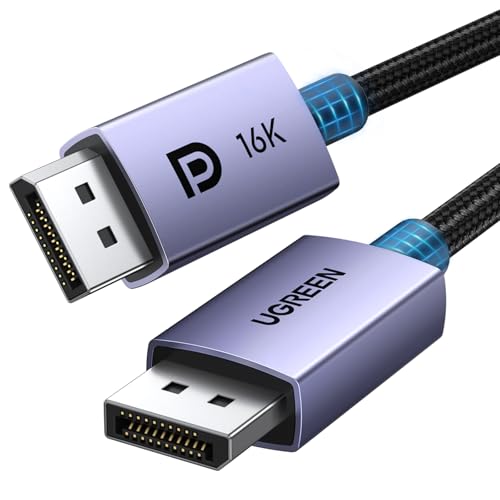
UGREEN 16K DisplayPort Cable 2.1, 6.6 ft
Specs
- Standard: DisplayPort 2.1, VESA certified
- Bandwidth: 40 Gbps (UHBR10)
- Length: 6.6 ft (2 m)
- Published modes: 8K at 240Hz and 4K at 240Hz with DSC, uncompressed 4K at 144Hz
- Features: Braided nylon jacket, DSC 1.2a, FEC, HDR, HDCP 2.2, MST support
Not every DP 2.1 port needs the full DP80 rate. Plenty of gaming laptops and mid-range cards expose UHBR10 outputs, and this UGREEN cable matches them at 40 Gbps with VESA certification and a braided nylon jacket. The published mode list still covers 4K at 240Hz through DSC, which is the mode most high-refresh 4K panels actually run, and MST support suits a daisy-chained dual-monitor desk. It sits in the mid-range tier: a sensible match when your hardware tops out at UHBR10 and a DP80 cord would add headroom nothing in the chain can spend.
Maxonar VESA Certified DisplayPort 2.1 Cable, 10 ft

Specs
- Standard: DisplayPort 2.1, VESA certified
- Bandwidth: 80 Gbps
- Length: 10 ft (3 m)
- Published modes: 16K at 60Hz, 8K at 240Hz, 4K at 540Hz and 360Hz with DSC
- Features: HDR, HDCP 2.3, 3D, ARC
Length is where DP80 cables usually give up: most certified DP80 cords stop at 2 m because holding UHBR20 over copper gets harder with every added metre. This Maxonar is the rare long option, a 3 m cable that still publishes the full 80 Gbps figure with VESA certification behind it. That reach suits a tower parked on the floor beside the desk, a wall-mounted panel, or a sim rig set back from the PC. The trade-off is bulk and a thinner set of published build details than the 6.6 ft picks, so treat it as the reach-first choice rather than the default.
IVANKY 8K DisplayPort Cable 1.4, 6.6 ft

Specs
- Standard: DisplayPort 1.4, VESA certified, HBR3
- Bandwidth: 32.4 Gbps
- Length: 6.6 ft (2 m)
- Published modes: 8K at 60Hz, 4K at 144Hz, 2K at 240Hz, HDR
- Features: Braided nylon jacket, gold-plated connectors, HDCP 2.2, FreeSync and G-Sync support
- Model: VBC31
Most gaming monitors in service today are DP 1.4 panels, and for them this is the rational buy. HBR3 bandwidth carries the modes those screens run: 1440p at 240Hz, 4K at 144Hz, and ultrawide high-refresh modes, with DSC available on supported hardware for more. IVANKY publishes VESA certification, a braided jacket, and gold-plated contacts, which puts it a step above the anonymous cords bundled in monitor boxes. It is the budget tier of this roundup, and it only gives up ground a DP 2.1 rig could actually use.
How to choose
Match the cable class to the weakest port in the chain. A DP 2.1 card feeding a DP 1.4 monitor runs at DP 1.4 rates no matter what the cable says, so check the published port specs on both ends before choosing a tier. If both ends are DP 2.1 with UHBR20 support, a certified DP80 cable is the only way to use the full rate; if either end is UHBR10, the UGREEN tier is enough.
Buy the shortest length that reaches with a gentle bend to spare. Passive copper DP80 cables are certified at 2 m or under for a reason, and excess cable coiled behind a desk adds clutter without adding signal. The 10 ft Maxonar is the exception for rigs that genuinely need the reach. Prefer VESA certified listings and a named bandwidth figure over headline resolution claims: a cable labelled 2.1 can be a 40 Gbps part, and the certification tier (DP40, DP80, or an HBR3 rating on DP 1.4) is the number that decides which modes lock in.
Connector style matters at a busy desk. Latching plugs such as the Silkland resist pull-out on monitor arms, while latch-free plugs release faster during swaps; either way, seat the plug fully, since a half-seated DisplayPort connector is a common cause of flicker blamed on the cable itself. Braided jackets hold up better along desk edges and through cable trays.
Who should skip
Skip this roundup if your monitor connects over HDMI only, if your laptop outputs video solely through USB-C (you need a USB-C to DisplayPort cable, a different product), or if your setup runs through a KVM switch or dock whose own video ceiling sits below your monitor’s modes, since the switch becomes the bottleneck. Owners of 1080p 60Hz or 1440p 144Hz panels with a working DP 1.2 or 1.4 cord already in place will see no change from an upgrade, and anyone whose flicker traces to a failing monitor or card should fix that hardware first.
FAQ
Does a DisplayPort 2.1 cable raise the refresh rate of a DP 1.4 monitor?
No. The chain runs at the rate the card, cable, and monitor all share, so a DP 1.4 panel stays capped by its HBR3 input. A DP80 cable is future-proofing for a later panel rather than an unlock for the current one, and the IVANKY pick covers DP 1.4 screens at their full published modes.
How long can a DP80 cable be at full bandwidth?
VESA certified passive DP80 cables top out around 2 m, which is why four of the five picks sit at 6.6 ft. The 10 ft Maxonar is unusual in publishing 80 Gbps at 3 m with certification. Beyond that reach, an active or fiber cable is the usual route, and those sit outside this roundup.
Is VESA certification worth insisting on for a gaming cable?
Yes, because it is the one claim on the listing that an outside body checks. Certification ties the bandwidth figure to a specific cable at a specific length, which removes the guesswork from listings that print a version number and little else. Every pick here carries it.
Can one of these cables carry audio and adaptive sync?
Yes. DisplayPort carries multi-channel audio alongside video, and the published feature lists on these cables include FreeSync and G-Sync support plus HDR. A single cord from card to monitor is all a gaming desk needs for picture, sound to monitor speakers or a passthrough jack, and variable refresh.
Final verdict
Buy by port generation first and length second. Full DP 2.1 rigs belong on a certified DP80 cable: the Cable Matters for a plain, proven 6.6 ft run, the Silkland when latching plugs and a braided jacket suit a moving desk, and the Maxonar when 10 ft of reach is non-negotiable. UHBR10 hardware is well served by the UGREEN at the mid-range tier, and the huge installed base of DP 1.4 monitors loses nothing with the IVANKY HBR3 cord. Any of the five replaces a mystery bundled cable with a published, certified figure you can plan a build around.
Related guides
More from Amazon
Programs that pair well with the guide above. Offers and eligibility are set by Amazon and may change.
Free shipping on eligible items, Prime Video and more. Eligible new members can start with a free trial.
Start a Prime free trialAd-free music streaming. Eligible new subscribers can start with a free trial.
Try Music Unlimited freeA Prime membership for ages 18-24 with a trial period. Eligibility is set by Amazon.
See Prime for Young AdultsAudiobooks and podcasts to listen to on the go. Eligible new members can start with a free trial.
Try Audible freeAs an Amazon Associate we earn from qualifying purchases.