Search for “fpv drone cameras” and you land in two different hobbies at once. One is the build-it-yourself world, where a tiny analog camera with a built-in video transmitter gets bolted onto a Tiny Whoop or a cinewhoop frame and you fly through a gap in a fence wearing goggles. The other is the ready-to-fly world, where a foldable quadcopter ships with an HD camera, a controller with a screen, and a promise that the first flight takes five minutes. The right pick depends entirely on which side of that line you stand on.
This guide sorts eight listings across both sides. Three are camera and transmitter modules for racing or micro-quad builders, and five are complete drones with FPV cameras aimed at beginners, teens, and adults who want video in the air without soldering anything. Everything here is judged only from facts in the product titles: sensor lines, transmitter power, flight time, camera angles, and flight features. Shopping in 2026 still comes down to knowing whether you want to fly the camera or fly the aircraft.
Our Top Picks



Top 3 picks at a glance
Quick Picks
As an Amazon Associate we earn from qualifying purchases at no extra cost to you.




| Product | Best for | Key spec taken from the title |
|---|---|---|
| F417PRO FPV Drone | First drone with a built-in screen | 1080P, LCD screen remote, brushless |
| AKK KC04 | Racing quad builds | 5.8G 600mW transmitter, 700TVL, 120 degree view |
| Mini Drone with HD FPV Camera | Teen beginners | 90 degree tilt lens, altitude hold |
| FPV Drone with Screen Remote | Longer sessions for beginners | 20-minute flight time, foldable |
| 2K HD FPV Drone | Spare-battery flying | 2K camera, 2 batteries, headless mode |
| AKK BA3 | Micro whoop builds | Switchable 0/25/50/200mW VTX, 600TVL |
| 4K GPS Drone | Automated shots | 4K, GPS return, Follow Me, waypoints |
| Caddx Ant | Ultralight cinewhoop builds | 1200TVL, global WDR, 1.8mm lens |
How to Choose
Decide between a camera module and a complete drone
A bare FPV camera has no motors, no battery, and no controller, so it only makes sense if you already own or plan to build a quad. A ready-to-fly drone includes everything but removes the ability to swap parts. If you have never flown, a complete drone with altitude hold and one-key takeoff is the lower-risk start. If you own a frame, a flight controller, and goggles, the module is what you need.
Read the video system numbers
For analog cameras, TVL (television lines) measures horizontal resolution: 600TVL is basic, 700TVL is sharper, and 1200TVL is the high end of what analog offers. Lens focal length matters too; 2.8mm gives a wide, forgiving view for racing, while 1.8mm gives an ultra-wide image suited to tiny frames. Transmitter power is listed in milliwatts, and switchable output such as 25, 50, and 200mW lets you fly indoors at low power and open fields at high power. Higher power draws more current and runs hotter.
Check flight aids and battery
Altitude hold keeps the drone steady at a set height, headless mode removes the need to track which way the nose points, and one-key takeoff and landing take the hardest moments out of the first flight. Flight time quoted around 20 minutes usually comes from more than one battery, so a pack of two is worth more than a single large claim. GPS return, Follow Me, and waypoint flight add automation but also add weight and a longer setup.
Mind motors and screens
Brushless motors last longer and run more efficiently than brushed ones, which matters if you fly often. A controller with a built-in screen means no phone pairing, while a phone-based view adds latency on cheaper models. Where budget kits cut corners is the controller and the spare parts supply, so check that propellers are replaceable.
Before you fly, check local flight rules for your area, including registration, height limits, no-fly zones around airports, and restrictions on flying over people or private property.
The 8 Best Options
F417PRO FPV Drone
The F417PRO is a complete beginner package: a 1080P adjustable mini drone with a brushless motor system and a controller that has an LCD screen, so no phone is needed. It also lists 3D flips for when the basics are mastered. This is the pick for someone who wants to hand a kid or a new hobbyist a single box and get flying.
- Strength: the screen remote removes phone pairing from the setup.
- Strength: an adjustable 1080P camera and brushless power for a mini frame.
- Trade-off: the listing shows no flight time or range figure in the title.
Skip it if you want a camera module for a custom build, or if you need documented flight time before you buy. It is a toy-adjacent starter rather than a platform for upgrades, and builders who like tinkering will outgrow it quickly.
AKK KC04
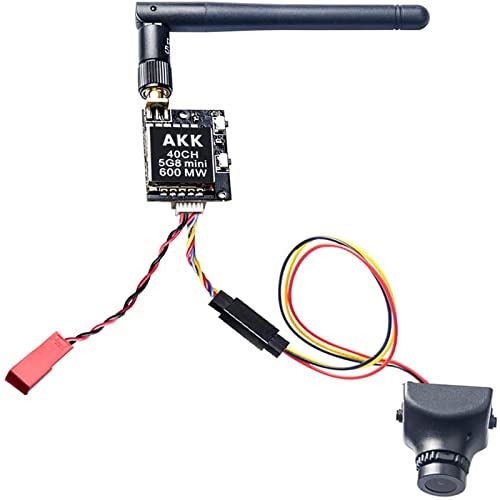
The KC04 combines a 700TVL camera with a 5.8G transmitter rated at 600mW and a 120 degree view through a 2.8mm lens. It is built for racing quadcopters, where a wider field of view and a stronger signal help in open fields. Builders who want one unit that does both jobs will like the all-in-one arrangement.
- Strength: 600mW of transmitter power gives strong signal headroom.
- Strength: 700TVL with a 2.8mm lens suits racing sightlines.
- Trade-off: 600mW demands good cooling and careful power wiring.
Skip it if you fly a micro whoop where weight is critical or if you need a camera with on-screen display. The title also does not list a weight, so check the spec page before choosing it for a small frame, and plan for a separate battery and flight controller.
Mini Drone with HD FPV Camera
This mini drone is aimed at teens and adults who are learning, with an HD FPV camera, a 90 degree tilt lens, altitude hold, one-key takeoff, 3D flips, and three speed modes. The tilting lens lets you aim the view down at a yard or forward at a flight line, and the speed modes make it easy to tame the aircraft while you build confidence.
- Strength: three speed modes grow with the pilot.
- Strength: altitude hold and one-key takeoff simplify first flights.
- Trade-off: the title does not list a resolution number, battery capacity, or flight time.
Skip it if you need a spec-heavy listing or advanced camera stabilization. Buyers comparing it against the others should note it competes on ease of flying rather than on camera quality, and the title leaves out the details that would settle the question.
FPV Drone with Screen Remote
This foldable brushless drone lists a 20-minute flight time, a screen on the remote, and one-key start. The folding frame makes it easier to carry in a backpack, and the brushless motor claim suggests longer service life than basic toys. It is a reasonable first-drone choice for adults and kids who want to take it on trips.
- Strength: 20-minute flight time stated in the title.
- Strength: foldable body and a controller with its own screen.
- Trade-off: no resolution or range number appears in the title.
Skip it if you want GPS features or a particular camera resolution. If you plan to carry the drone often, the folding design is the main attraction, and buyers should confirm the box includes spare propellers for the inevitable first crashes.
2K HD FPV Drone
This one advertises a 2K HD camera, altitude hold, one-key takeoff and landing, adjustable speed, headless mode, and two batteries. The extra battery is the practical highlight, since it doubles your flying before a recharge. It suits adults who want a simple upgrade over a toy-grade quad.
- Strength: two batteries in the box extend each session.
- Strength: headless mode and one-key landing help new pilots.
- Trade-off: the title lacks a GPS or range figure.
Skip it if you need GPS return or follow modes. The headless mode is especially handy for people who lose track of the nose direction, and the speed adjustment lets a parent or teacher keep a lid on enthusiasm while the pilot learns the controls.
AKK BA3
The BA3 is an all-in-one camera and transmitter for tiny whoop-style frames, listing 40 channels, switchable output of 0, 25, 50, and 200mW, and a 600TVL one-third inch CMOS sensor. It names Tiny Whoop, Blade, and Inductrix airframes, so you know the target. Switchable power lets you stay legal and cool when flying indoors.
- Strength: 40 channels plus switchable output suit group flying.
- Strength: micro AIO format saves weight on small frames.
- Trade-off: 600TVL is basic compared with sharper analog options.
Skip it if you want the sharpest analog image. It works best for builders who already know they want a compact all-in-one rather than separate parts, and flying with the lowest output indoors is easier on batteries and on other pilots sharing the same band.
4K GPS Drone
This foldable brushless drone lists a 4K camera, GPS with auto return, Follow Me, circle fly, waypoint fly, optical flow, and 5G transmission. It is the only complete drone here with automated flight modes, which suits adults who want repeatable shots rather than racing. GPS return also gives a safety net if the signal drops.
- Strength: GPS return and optical flow add stability and recovery.
- Strength: Follow Me, circle, and waypoint modes automate filming.
- Trade-off: more features mean a heavier, more complex setup than a toy quad.
Skip it if you want a micro frame for tight indoor flying. Pilots who care about gimbal-grade smoothness should read the full spec page, since the title lists neither flight time nor weight, and automated modes only help in open space with a clear view of the sky.
SoloGood Caddx Ant
The Caddx Ant is a nano FPV camera listing 1200TVL, global WDR, OSD, and a 1.8mm lens in a 16:9 format with NTSC and PAL support. It targets cinewhoop and tinywhoop builds where every gram counts. Wide dynamic range helps when you fly between bright windows and dark rooms.
- Strength: 1200TVL is the sharpest analog line count here.
- Strength: global WDR and OSD for tricky light.
- Trade-off: it has no transmitter, so you need a separate video transmitter.
Skip it if you want a camera and transmitter in one piece. The nano size is the draw, and it pairs naturally with a lightweight transmitter and a small frame, so factor the extra part and wiring into your build plan before ordering.
Which One Fits Your Situation
You are building your first racing quad
Go with the AKK KC04. Camera and 600mW transmitter come together, and the 120 degree view is forgiving in open fields.
You fly a tiny whoop in the living room
Pick the AKK BA3 for its switchable low output or the Caddx Ant if you already have a transmitter and want sharper 1200TVL video.
You have never flown anything
The F417PRO is the easiest on-ramp, since the controller has its own screen and nothing needs pairing.
You want automatic shots of a hike or trip
The 4K GPS Drone covers the job with Follow Me, waypoint flight, and return-to-home.
Common Mistakes
- Buying a bare camera module expecting a ready-to-fly drone.
- Pairing a high-power transmitter with no airflow, which overheats the unit.
- Judging analog sharpness by megapixels rather than TVL.
- Forgetting spare propellers and a second battery.
- Flying without checking local flight rules, registration, and no-fly zones.
Related guides
- Gaming Laptop Battery Draining While Plugged In Fix
- Graphics Cards For Low Wattage Power Supplies
- How To Stop Laptop Thermal Throttling In Software
Frequently Asked Questions
What does TVL mean?
TVL stands for television lines and measures the horizontal detail of an analog camera. Higher numbers such as 1200TVL look sharper than 600TVL.
Do I need goggles?
Complete drones with a screen remote do not. Camera modules for racing or whoop builds usually pair with goggles or a receiver.
Is brushless worth it?
Generally yes for frequent flyers. Brushless motors tend to last longer and run more efficiently than brushed ones.
Are there rules for flying a drone?
Yes. Rules vary by country and by drone weight, so check local flight regulations, registration requirements, and restricted areas before every outing.