Thermal imaging cameras sell on a confusing mix of numbers: a native sensor resolution, a processed “super resolution” figure, a refresh rate, and a temperature range. A buyer searching for the best thermal imaging cameras usually has a concrete job in mind, such as finding a missing insulation patch, tracing a warm electrical connection, spotting a leaking pipe behind drywall, or checking an HVAC duct. The right answer depends on whether you need to see a scene in a picture or just read a temperature at a spot.
The eight handhelds below cover both approaches. Some are spot thermometers with a small infrared sensor, and others are image-first cameras with 240 x 240, 512 x 384, or 640 x 480 outputs. This guide is aimed at homeowners, inspectors, HVAC technicians, electricians, and hobbyists who want a pocketable tool. In 2026 the interesting divide is between plain native resolution and boosted output, so we pay attention to which number each title is quoting.
Our Top Picks




Top 3 picks at a glance
Quick Picks
As an Amazon Associate we earn from qualifying purchases at no extra cost to you.




| Product | Best for | Key spec taken from the title |
|---|---|---|
| TOPDON TC004 Mini | Everyday home checks | 240 x 240 TISR, 15H battery, 25Hz |
| Flagfront Thermal Camera | Home inspection basics | 240 x 240 TISR, -4 to 1022 degrees F |
| GT14S | Hot-surface work | -4 to 1202 degrees F, 240g, 25Hz |
| TOPDON TC004 3.5-inch | Sharper detail with PC analysis | 512 x 384 TISR, 8-hour battery |
| Flir TG165-X | Spot readings on a worksite | 80×60 IR, bullseye laser, IP54 |
| AccuMEMS GT14S | Longer shifts | 14H runtime, live tracking |
| HSFTOOLS F2VW | Visual plus thermal overlay | 640×480 output, 2MP visual camera |
| Thermal Master Thor002 | Accuracy-minded imaging | 512 x 384, 5 imaging modes, plus or minus 3.6 degrees F |
How to Choose
Native resolution versus boosted output
Native resolution is the number of real infrared pixels. A 256 x 192 sensor produces a far crisper picture than an 80 x 60 one, and super-resolution processing, labeled TISR or similar, enlarges and sharpens the image without adding new sensor data. A 240 x 240 or 512 x 384 output from processing can still help you read a scene more easily, but compare the sensor behind it. For finding a cold wall or a hot breaker, even modest sensors work when you stand close.
Temperature range and accuracy
Household tasks live between about 0 and 400 degrees F, while industrial work may reach 1000 or more. Ranges of -4 to 1022 degrees F cover nearly everything a homeowner will meet, and 1202 degrees F stretches to hot machinery. Accuracy figures such as plus or minus 3.6 degrees F matter if you compare readings over time. Always check emissivity settings, because shiny metal reads cooler than it is.
Refresh rate and display
Listings with 25Hz refresh feel smooth when you pan across a room, while slower rates lag and blur. A screen of 3.2 to 3.5 inches is easy to read in the field, and a full-sized IPS display helps in bright light. Imaging modes, edge enhancement, and live tracking assist with spotting small hot spots. Where budget models cut corners is the interface and the PC software.
Battery, build, and extras
Claims of 8, 14, or 15 hours suit all-day inspections, and an IP54 rating handles dust and splashes on a worksite. A laser aimed at a spot helps you verify where a spot reading comes from. Software for analysis on a computer is valuable if you write reports, and high and low temperature alerts save time when scanning panels.
The 8 Best Options
TOPDON TC004 Mini
This compact handheld lists a 240 x 240 TISR output, a 15 hour battery, a 25Hz refresh, and high and low temperature alerts. It suits homeowners and weekend inspectors who want smooth viewing and a long runtime in a small body. The alerts make it practical for sweeping a panel or a wall for outliers.
- Strength: 15 hours of battery life listed in the title.
- Strength: 25Hz refresh with temperature alerts.
- Trade-off: the 240 x 240 figure refers to processed output, not a larger native sensor.
Skip it if you need the detail of a 512 x 384 image or a rugged industrial rating. A long runtime is the quiet advantage, since a full weekend of walk-throughs rarely needs a recharge, and the alerts spare you from staring at the screen the whole time.
Flagfront Thermal Camera
The Flagfront lists a 240 x 240 TISR output for home inspection, 25Hz, a -4 to 1022 degrees F range, and high and low temperature alarms. Its target is clear: home inspection and basic troubleshooting. The temperature range is wide enough for everything from drafty windows to warm wiring, and the alarms let you flag anything outside the band you set.
- Strength: wide range and temperature alarms for inspections.
- Strength: 25Hz refresh for smooth panning.
- Trade-off: the title is cut off, so battery and extras need checking.
Skip it if battery runtime is critical or if you need a name with a long track record in the trades. First-time buyers should read the full listing for what ships in the box, because the title ends before the accessory list does.
GT14S
The GT14S lists edge enhancement, a thermometer mode, a -4 to 1202 degrees F range, a compact 240g body, and a 25Hz image frequency. The range tops the group, which is useful near stoves, exhausts, and machinery. Edge enhancement outlines shapes so you can identify what you are looking at, which helps when a small camera has a small screen.
- Strength: the highest listed range at 1202 degrees F.
- Strength: edge enhancement and a 240g body.
- Trade-off: the title does not state resolution or battery life.
Skip it if you need a documented resolution before buying or a battery figure to plan a shift. Because the title gives only two clear figures, its appeal is a high-temperature range in a light body rather than a data-rich spec sheet.
TOPDON TC004 3.5-inch
This version of the TC004 lists a 3.5 inch screen, a -4 to 1022 degrees F range, 512 x 384 TISR resolution, an 8 hour battery, and PC analysis software. The jump to 512 x 384 gives a clearer view of small targets, and the PC link supports reports. It suits inspectors who document findings.
- Strength: 512 x 384 TISR output with a 3.5-inch screen.
- Strength: PC analysis helps with reporting.
- Trade-off: an 8-hour battery is shorter than other listings here.
Skip it if all-day runtime is more important than detail, or if you never plan to use a computer for analysis. Buyers choosing between the two TC004 listings are essentially trading about seven hours of battery for a sharper picture and software support.
Flir TG165-X
The TG165-X is more of a thermometer with a camera than an image-first imager: 80×60 IR, a bullseye laser, spot IR readings, a -25 to 300C range, MSX, IP54, and a strap for building, HVAC, and electrical work. It is meant for trade professionals who want a quick spot reading and a rough picture rather than detail.
- Strength: bullseye laser and IP54 for worksites.
- Strength: MSX blends visual detail into the thermal image.
- Trade-off: 80×60 is a much coarser sensor than others listed here.
Skip it if you want a detailed, high-resolution view of small targets. Its value is in speed and ruggedness rather than picture quality, and it pairs well with a second imager when a job needs both a spot check and a full thermal scene.
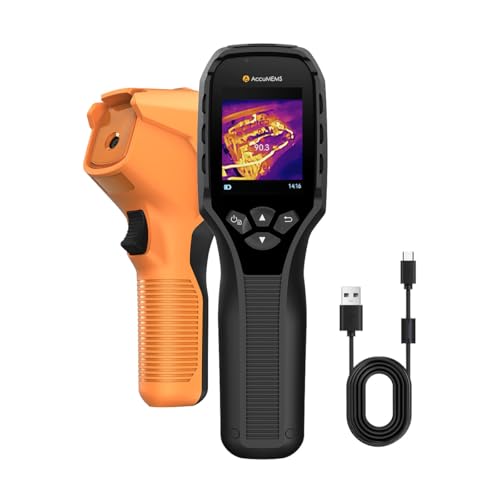
AccuMEMS GT14S
Another GT14S listing, this one from AccuMEMS, lists thermometer mode, ultra-light 240g, a range up to 1022 degrees F, 14 hours of runtime, and live tracking with an edge-enhanced display. The runtime figure is the standout, and tracking helps follow hot or cold points while you move. That combination suits long walk-through inspections, where a camera that lasts the shift matters more than the last bit of image detail.
- Strength: 14 hours of runtime listed.
- Strength: live tracking and edge-enhanced display.
- Trade-off: resolution is not visible in the title.
Skip it if you want a stated resolution or a larger screen. Buyers who compare it with the other GT14S listing should note the shared name, then read both product pages closely, since the titles differ in range and runtime figures.
HSFTOOLS F2VW
The F2VW adds a 2MP visual camera, a 640×480 super resolution output, a 3.2 inch screen, and intelligent scene detection, and lists 256×192 alongside. The visual camera lets you blend a normal picture with the thermal image, which makes the heat map easier to interpret. It appeals to those who want a report-ready image.
- Strength: 2MP visual camera alongside a thermal sensor.
- Strength: 640×480 output with scene detection.
- Trade-off: the 256×192 number suggests the native sensor is smaller than the output.
Skip it if you want only native-resolution figures or the compact simplicity of a basic unit. The multiple resolution numbers in the title mean it pays to read the specification page and confirm which one describes the real sensor.
Thermal Master Thor002
The Thor002 lists 512 x 384 X3 resolution, a 3.5 inch IPS screen, five imaging modes, a -4 to 1022 degrees F range, and a plus or minus 3.6 degrees F accuracy figure. The stated accuracy is a plus for buyers who compare readings over time, and the IPS screen suits bright rooms and attics. With 512 x 384 output it competes directly with the other 512 x 384 models, so it deserves a look from anyone who values documented accuracy.
- Strength: stated accuracy and a 3.5-inch IPS screen.
- Strength: five imaging modes for different scenes.
- Trade-off: the title does not list battery life.
Skip it if runtime is your top concern or if you want a smaller screen and a simpler menu. Five imaging modes add flexibility, though they also mean a few more settings to learn before the first inspection.
Which One Fits Your Situation
You are checking a house for drafts and leaks
The TOPDON TC004 Mini offers a long battery and temperature alerts, which suits slow sweeps along walls and windows.
You work as an inspector who writes reports
The TOPDON TC004 3.5-inch pairs 512 x 384 output with PC analysis, which helps when documenting findings.
You are a tradesperson who needs spot readings fast
The Flir TG165-X has a bullseye laser, IP54, and a strap suited to HVAC and electrical work.
You like blended thermal and visual images
The HSFTOOLS F2VW adds a 2MP visual camera that helps you identify what a hot spot belongs to.
Common Mistakes
- Comparing boosted resolution to native resolution as if they were equal.
- Ignoring emissivity, which makes shiny metal read cooler than it is.
- Choosing a range that tops out below your actual job.
- Expecting a thermal camera to see through walls rather than surface heat.
- Skipping the battery figure on a camera you plan to use all day.
Related guides
- Gaming Laptop Battery Draining While Plugged In Fix
- Graphics Cards For Low Wattage Power Supplies
- How To Stop Laptop Thermal Throttling In Software
Frequently Asked Questions
Can a thermal camera see through walls?
No. It reads surface temperature, so it shows heat patterns on a wall that can hint at what lies behind it.
Is higher resolution always better?
Generally yes for detail, but check whether the number is native or processed. A native sensor adds real information.
What does 25Hz mean?
It means the image refreshes 25 times per second, which feels smooth when moving the camera.
What is MSX?
MSX blends outlines from a visual camera into the thermal image so objects are easier to recognize.