
Running SolidWorks on a laptop is a different problem than running it on a desktop. You need sustained clock speeds, professional-grade graphics drivers that won’t crash mid-assembly, and enough RAM to keep a multi-thousand-part model from crawling. The laptop market is full of machines that look impressive on paper but throttle within ten minutes of opening a real assembly, and the gap between a workstation-class GPU and a consumer gaming GPU shows up immediately when you rotate a complex part or run a simulation tab.
What separates a genuinely good SolidWorks laptop from a mediocre one comes down to driver certification, thermal headroom, and memory bandwidth. A machine with a certified Quadro or RTX workstation GPU handles large assemblies without the visual glitches that plague consumer cards, and it gets validated driver updates from SOLIDWORKS itself. Beyond that, the practical workflow question is how fast you can execute commands without reaching for a mouse, which is where keyboard shortcut accessories become a legitimate productivity tool rather than a gimmick. This guide covers both sides of that equation.
As an Amazon Associate we earn from qualifying purchases at no extra cost to you.



Top 3 picks at a glance
Quick Picks
| Product | Best For | Price |
|---|---|---|
| Lenovo ThinkPad P17 | Heavy assemblies and simulations | $3299.99 |
| HP ZBook Ultra G1a | Lightweight mobile CAD work | $1999.99 |
| ThinkPad P17 (Keyboard Decals) | Shortcut muscle memory training | $9.76 |
| ThinkPad P17 (Layout Labels) | Visual command layout reference | $9.76 |
| ThinkPad P17 (Stickers) | Temporary shortcut reference | $9.76 |
| ThinkPad P17 (Label Shortcuts) | Desktop-to-laptop consistency | $9.76 |
How We Picked
We evaluated machines on three criteria: ISV certification for SOLIDWORKS (meaning drivers are validated and stable under load), sustained performance thermals (not just burst specs), and portability trade-offs. For accessories, we looked at adhesion durability, print clarity at small font sizes, and whether the keycap coverage interfered with backlighting. A machine that scores well on benchmarks but throttles during a 45-minute rendering session fails the real-world test, and that is what matters here.
The 6 Best Laptops For Solidworks in 2026
Lenovo ThinkPad P17
This is the workhorse choice for engineers who open 2,000-part assemblies daily and need them to stay responsive. The 64GB of RAM is the headline spec, letting you keep massive models loaded without swapping to disk, and the 2TB SSD means project files live on the machine. The 17.3-inch FHD IPS panel is bright and color-accurate for design reviews. The Quadro T2000 provides certified SOLIDWORKS drivers, so you avoid the visual artifacts that consumer GPUs introduce during rotation and sectioning. The main trade-off is weight and thickness, making this more of a desk-replacement than a true laptop. Skip this if you carry your machine to client sites multiple times per week and prioritize portability.
- Pro: 64GB RAM handles complex assemblies without bottleneck
- Pro: Quadro T2000 with certified SOLIDWORKS drivers eliminates rendering glitches
- Con: Heavy and bulky chassis limits genuine mobility
HP ZBook Ultra G1a
The ZBook Ultra G1a is for the engineer who actually moves between offices, conference rooms, and client meetings. At 14 inches with the Ryzen AI Max PRO 385, it delivers competent SolidWorks performance for parts and small-to-mid assemblies while staying genuinely portable. The 32GB DDR5 memory is the floor here, fine for routine modeling but you will feel limits on large configurations. The FHD+ display is crisp and the overall build quality matches the ZBook reputation. The 512GB SSD is the weak point, so budget for external storage or cloud sync. Skip this if your typical session involves assemblies over 800 parts or you run frequent simulations.
- Pro: Truly portable at 14 inches without sacrificing workstation credentials
- Pro: Ryzen AI Max PRO 385 handles multitasking and AI-accelerated workflows well
- Con: 512GB SSD fills quickly with large assembly files
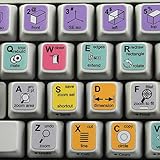
SOLIDWORKS Keyboard Decals Shortcuts
These decals are the most durable option among the four accessory picks here, designed to adhere flat onto keycaps without raising edges that catch on fabric or finger oils. The print is high-contrast, readable under dim office lighting, and specifically maps the shortcuts for common SOLIDWORKS commands like fillet, chamfer, and mirror. At under ten dollars, they pay for themselves if they save you even a few seconds per operation across a full workday. The trade-off is that they are a one-time application, so if you swap laptops frequently, reapplying them is tedious. Skip this if you prefer removable solutions or switch between multiple machines regularly.
- Pro: Flat adhesive profile does not interfere with backlighting or key travel
- Pro: High-contrast print remains legible under varied lighting conditions
- Con: Semi-permanent adhesion makes laptop swaps frustrating
SOLIDWORKS Keyboard Labels Layout
The Layout variant takes a different approach, presenting the shortcuts grouped by functional context rather than mapping one label per key. This means you get a visual command hierarchy on your keyboard, which helps newer SOLIDWORKS users understand which shortcuts cluster together for sketching, features, and views. The labels are slightly larger than standard single-key decals, making them easier to read at a glance during fast work sessions. The downside is that larger surface area means more chance of peeling at the edges over months of use. Skip this if you already know all your shortcuts and just need quick physical reminders for rarely-used commands.
- Pro: Grouped layout aids learning and spatial memory of command families
- Pro: Larger text improves readability during rapid workflows
- Con: Broader coverage increases edge-peeling risk over extended use
SOLIDWORKS Keyboard Stickers Shortcuts
These stickers sit in the middle of the adhesion spectrum, removable without residue but still staying put during normal use. The shortcut mapping is identical to the decal version, but the material is slightly more flexible, conforming better to curved keycaps on laptops with sculpted keyboard wells. This matters on the ThinkPad P17 specifically, where the keycap profile has noticeable curvature. At the same price point, you are paying for the removability and reusability that the decals lack. Skip this if you want the most permanent, wrinkle-free solution and never swap machines.
- Pro: Removable without residue, reusable across multiple keyboards
- Pro: Flexible material conforms to curved keycap profiles
- Con: Less rigid than decals, edges can lift with heavy thumb use
SOLIDWORKS Keyboard Labels Shortcuts
This final variant emphasizes desktop-to-laptop consistency. If you work across a desktop keyboard at the office and a laptop on the road, these labels let you replicate the same shortcut mapping on both, building muscle memory that transfers between devices. The font size is tuned for smaller laptop keys, making them slightly more compact than the Layout version. The adhesion is standard, and the packaging includes enough pieces for both a full-size and a compact keyboard. Skip this if you only use one machine and do not need cross-device consistency.
- Pro: Enables identical shortcut layout across desktop and laptop for muscle memory
- Pro: Compact font sizing fits smaller laptop keycaps cleanly
- Con: Standard adhesion offers no advantage over the decal variant for single-device users
Buying Guide
Graphics Certification Matters More Than Raw Power
SOLIDWORKS is validated against specific GPU drivers. A workstation card like the Quadro T2000 receives driver updates co-tested with SOLIDWORKS, meaning realview mode, section views, and large assembly performance are predictable. A consumer GPU might have higher benchmark scores but will show rendering errors, flickering, or missing edges in complex models. For best laptops for Solidworks, certified graphics is non-negotiable if you produce deliverables that must look correct on every view.
RAM Is the First Bottleneck You Will Hit
SOLIDWORKS keeps the entire active assembly in memory. If your model has 1,500 parts, 16GB of RAM will force disk swaps that destroy responsiveness. Thirty-two gigabytes is the practical floor for mid-size work, and sixty-four is what you need if assemblies regularly exceed 2,000 components or you run Simulation alongside modeling. Always check whether the RAM is soldered or upgradable before committing to a configuration.
Thermal Design Determines Real Sustained Performance
A laptop that throttles after fifteen minutes of rendering is functionally worse than a desktop-class machine at half the spec sheet numbers. Look for review data showing sustained clock speeds under long loads, not just short benchmark bursts. Larger chassis like the 17.3-inch P17 have more room for heat dissipation, which is why they remain competitive against newer but thinner designs in prolonged sessions.
Our Verdict
The top pick is the Lenovo ThinkPad P17. Its 64GB RAM and certified Quadro graphics handle the worst-case SolidWorks workloads without compromise, and the build quality justifies the premium over years of daily use. The budget pick is the HP ZBook Ultra G1a, which gets you a genuinely portable, certified workstation for under two thousand dollars at the cost of storage headroom. The one condition under which another product wins: if your primary bottleneck is not hardware but workflow speed, any of the keyboard shortcut accessories at under ten dollars will deliver more measurable time savings than a GPU upgrade for a mid-range model.
FAQ
Can a gaming laptop run SolidWorks?
It can open and run basic parts, but consumer GeForce drivers are not validated by SOLIDWORKS, so you will encounter rendering artifacts in complex assemblies, RealView performance issues, and potential crashes during simulation. For professional deliverables, a workstation-certified GPU is the safe choice.
How much RAM do I need for SolidWorks?
Thirty-two gigabytes is the minimum for productive mid-size assembly work. If you regularly handle configurations over 1,500 parts, run Simulation, or keep multiple large files open simultaneously, 64GB is the practical requirement to avoid disk-swap lag.
Do keyboard shortcut stickers actually help?
For intermediate users who know what they want to do but fumble through menus to find it, yes. The time saved on repeated operations compounds over an eight-hour workday. They are most effective when you already understand the shortcut system conceptually and need a physical prompt until recall becomes automatic.
Is the ThinkPad P17 still a good buy compared to newer models?
The 10th-generation i7-10750H is older architecture, but with 64GB RAM and a Quadro T2000, the sustained workstation performance remains solid for SolidWorks specifically. If you find it at the listed price and your priority is memory capacity over single-core speed, it holds up well against thinner machines that compromise thermal headroom.
Related guides
- Alienware 16 Aurora RTX 5070 Review: Display, Portability and Configuration Gaps
- Lenovo Legion Pro 7i Gen 10 Review: 64GB RAM and Dual-SSD Configuration
- MSI Katana 15.6-inch RTX 5050 Review: Configuration Strengths and Upgrade Unknowns
- ASUS ROG Strix SCAR 16 G635LX-XS97 Review: Display Ambition, Upgrade Questions


