- Top Pick: InnoGear Microphone Boom Arm
- Runner-up: Samson MBA38 Microphone Boom Arm
- Also consider: Blue Compass Premium Broadcast Boom Arm
A microphone sitting on a desk stand picks up every keyboard tap, mouse click, and vibration that travels through the desk. A boom arm lifts the microphone off the desk surface, floats it in front of the mouth, and keeps it there while the hands stay free for the keyboard and mouse. For gaming sessions, streams, and voice calls, that change alone makes speech clearer and the desk tidier.
This guide covers five boom arms that span the main designs: scissor arms that fold away, tube-style broadcast arms with hidden springs, and a low-profile arm that sits below the monitor line. Each one is judged on load capacity, reach, mounting, and how quietly it moves, so the choice comes down to the microphone on the desk and the space around it.
As an Amazon Associate, we earn from qualifying purchases.
Our Top Picks
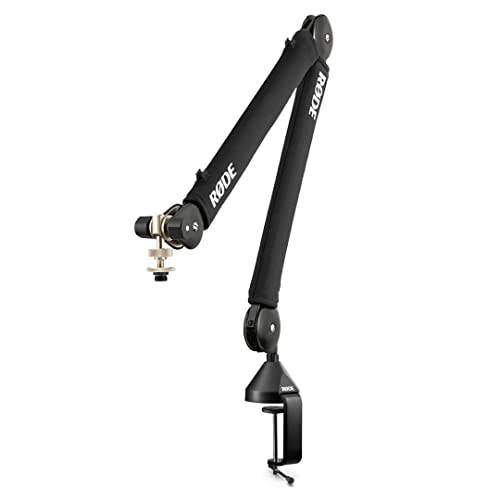 RØDE PSA1+ Professional Studio Boom Arm with Spring8.25" W x 21.25" L x 3.25" H21.25 x 8.25 x 3.25 inches3.4 poundsCheck on Amazon
Top 3 picks at a glance
Quick answer
For most buyers, the Samson MBA38 is the sensible first pick: a steel broadcast arm with 38 inches of reach and a 5 lb load capacity that handles heavy dynamic microphones without sagging. Light USB microphones suit the InnoGear scissor arm, while the Rode PSA1+ and Elgato Wave Mic Arm LP serve heavier or low-profile setups.
The 5 Best Microphone Boom Arms
InnoGear Microphone Boom Arm
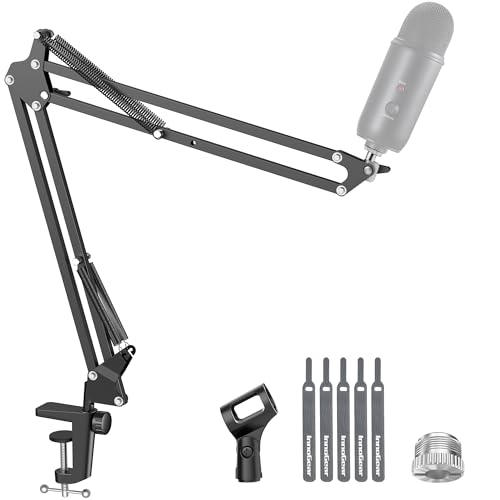
The InnoGear arm is the plain, dependable entry point. A scissor-style arm built from alloy steel, it folds flat against the desk when idle and swings out to hold the microphone in front of the mouth when a session begins. The 360-degree base rotation, 135-degree extension, and 180-degree arm shaft movement give plenty of angles to work with, and the 270-degree metal adapter lets the microphone sit at the angle that sounds best.
Load capacity is the detail that sets this arm apart from other arms in its tier. The published figure is 3.3 lb, which covers most USB condenser microphones and lighter dynamic microphones with a shock mount attached. The desk clamp grips squared desk edges up to 2 inches thick, and the included 5/8-inch to 3/8-inch adapter covers the thread sizes found on most microphone clips and shock mounts.
Specs
– Design: Scissor-style suspension boom arm, alloy steel
– Load capacity: 3.3 lb
– Base rotation: 360 degrees
– Arm movement: 135-degree extension, 180-degree shaft movement, 270-degree adapter
– Desk clamp: Fits squared edges up to 2 inches thick
– Threading: 5/8-inch clip with 3/8-inch adapter included
– Weight: 1.35 lb
– Folding: Folds flat for storage
Samson MBA38 Microphone Boom Arm

The Samson MBA38 is the workhorse of this roundup. A steel broadcast arm with internal springs, it moves quietly when repositioned during a live session, and the enclosed spring design keeps the mechanism out of sight. The headline figure is 38 inches of horizontal and vertical reach, which lets the arm travel from the rear corner of a wide desk to a seated recording position without a second mount.
Two mounting options come in the box. The C-clamp attaches to a desk edge for a temporary setup, while the flange mount bolts to the surface for a permanent installation. The arm supports microphones up to 5 lb, which covers heavy broadcast dynamics and large condensers with their shock mounts. Standard 5/8-inch-27 threading fits most microphone clips directly, and the arm rotates a full 360 degrees at the base.
Specs
– Design: Articulating broadcast boom arm, steel, internal springs
– Maximum reach: 38 inches horizontal and vertical
– Load capacity: 5 lb
– Mounting: C-clamp and flange mount included
– Threading: 5/8-inch-27
– Base rotation: 360 degrees
– Arm movement: 180-degree flexibility
– Weight: 4 lb
Blue Compass Premium Broadcast Boom Arm

The Blue Compass is the cleanest-looking arm in this roundup. A tube-style arm built from enclosed aluminum, it hides its springs inside the tubing and routes the microphone cable through a hidden channel, so nothing dangles on camera. Hand-tightened friction hinges lock the arm at the chosen angle without tools, and the matte black finish suits a gaming setup that appears on stream.
Reach runs to 32 inches horizontally, which covers a standard desk depth with room to spare. The published load capacity is 2.4 lb including the microphone and shock mount, which suits USB condensers and lighter dynamic microphones. One point to note is the tension screw at the base: the arm ships with the spring set tight, so a light microphone can drift upward until the tension is loosened to match its weight.
Specs
– Design: Tube-style broadcast boom arm, enclosed aluminum, internal springs
– Maximum reach: 32 inches horizontal
– Load capacity: 2.4 lb, including microphone and shock mount
– Cable management: Hidden internal channel
– Desk clamp: Fits edges up to 2 5/8 inches thick
– Threading: 3/8-inch with 5/8-inch adapter included
– Base rotation: 360 degrees
– Hinges: Hand-tightened friction hinges
Elgato Wave Mic Arm LP

The Elgato Wave Mic Arm LP takes a different approach from the arms above it. Instead of rising above the monitor, it sits below the shoulder line, which keeps the microphone close without blocking the view of the screen. That low-profile shape suits streamers who run dual monitors or a single ultrawide display and want the microphone in frame without a tall arm crossing the shot.
Build is all metal, with hidden cable channels that carry the microphone cable out of sight. The arm rotates a full 360 degrees, and the desk clamp mounts to the desk edge with a ball head that adjusts the microphone angle. Load capacity is 4.4 lb, which covers heavy broadcast microphones and their shock mounts. Three thread adapters come in the box: 1/4-inch to 3/8-inch and 1/4-inch to 5/8-inch, so the arm fits most microphone mounts without extra parts.
Specs
– Design: Low-profile broadcast boom arm, all metal
– Load capacity: 4.4 lb
– Profile: Sits below the shoulder line
– Cable management: Hidden cable channels
– Base rotation: 360 degrees
– Mounting: Desk clamp with ball head
– Thread adapters: 1/4-inch to 3/8-inch and 1/4-inch to 5/8-inch included
– First available: August 17, 2021
Rode PSA1+ Professional Studio Arm
The Rode PSA1+ is the premium pick in this roundup. A parallelogram arm with fully damped internal springs, it repositions without the creak or bounce that simpler spring arms produce, and the neoprene-covered linkage absorbs mechanical noise while the arm moves. That quiet movement matters when the microphone is live and the arm needs a small adjustment mid-sentence.
Reach runs to 37 inches horizontally and 34 inches vertically, which clears deep desks and tall monitor stands. The desk clamp fits desks up to 2.8 inches thick, and a threaded desk insert fits desks up to 2.2 inches thick for a permanent mount. Four integrated clips route the cable along the top of the arm, and a 3/8-inch to 5/8-inch adapter is included.
Specs
– Design: Parallelogram studio arm, damped internal springs, neoprene-covered linkage
– Horizontal reach: 37 inches
– Vertical reach: 34 inches
– Load window: 0.2 lb to 2.7 lb
– Desk clamp: Fits desks up to 2.8 inches thick
– Desk insert: Fits desks up to 2.2 inches thick
– Base rotation: 360 degrees
– Cable management: Four integrated clips
– Threading: 3/8-inch with 5/8-inch adapter included
– First available: October 5, 2021
How to choose
Load capacity comes first. Weigh the microphone together with its shock mount, pop filter, and cable, then compare that total against the arm’s published figure. An arm loaded past its rating sags slowly during a session, which pulls the microphone away from the mouth and adds handling noise. Leave margin below the maximum: a heavy broadcast dynamic with a full shock mount belongs on an arm rated for 4 lb or more, while a light USB condenser is fine on a 3.3 lb scissor arm.
Reach comes second. Measure from the desk edge where the clamp will sit to the spot where the mouth will be, then add a few inches for adjustment. A 32-inch arm covers a standard desk, but a deep desk or a clamp mounted at the rear corner needs 37 or 38 inches. Low-profile arms suit monitor-heavy setups, while tall parallelogram arms suit standing desks and deep workstations.
Mounting comes third. A C-clamp suits renters and anyone who rearranges the desk, while a flange mount or threaded desk insert suits a permanent studio corner. Check the desk edge thickness against the clamp figure before buying, and confirm the desk edge is flat and squared, since a clamp cannot grip a slanted or rounded edge securely.
Noise comes last. Internal springs and damped linkages move quietly, while exposed external springs can ping when bumped. A quiet arm matters most when the microphone is live, since every creak lands in the recording.
Who should skip
A boom arm is the wrong buy for a microphone that lives in a bag. Streamers who record on the move, or who share a desk with family members, may find a small desktop tripod stand easier to pack away and set up again. A boom arm also suits a fixed desk; a folding table or a glass-top desk with a thin edge may not hold a clamp securely.
Very light microphones deserve a caution. Tube-style arms ship with the tension set for a heavier microphone, and a featherweight USB microphone can drift upward until the tension screw is loosened. Anyone running a microphone under half a pound should check that the arm’s minimum load window covers it, or pick a scissor arm with a simpler tension setup.
Owners of heavy broadcast microphones should skip the budget scissor arms entirely. A microphone and shock mount that together weigh over 3 lb needs a broadcast arm rated for 4 lb or more, or the arm will sag and the microphone will drift out of position during long sessions.
FAQ
How much weight can a microphone boom arm hold?
It depends on the arm. Budget scissor arms in this guide hold 3.3 lb, tube-style broadcast arms hold 2.4 lb to 5 lb, and premium parallelogram arms hold up to 4.4 lb. Always weigh the microphone with its shock mount and pop filter attached, then pick an arm rated above that total.
Does a boom arm reduce keyboard noise in recordings?
Yes, in most setups. A boom arm lifts the microphone off the desk surface, so vibrations from keyboard taps and mouse clicks travel through the air instead of through the desk and into the microphone. A shock mount adds further isolation, and the combination is the standard setup for streamers and podcasters.
Will a boom arm fit any microphone?
Most boom arms use 3/8-inch or 5/8-inch threading, and adapters for both sizes come in the box with the arms in this guide. The main limit is weight, not threading: check the microphone and shock mount against the arm’s load capacity before buying.
Should I choose a low-profile arm or a tall arm?
A low-profile arm suits setups where the microphone must stay below the monitor line, such as dual-monitor desks or ultrawide displays. A tall parallelogram or broadcast arm suits deep desks, standing desks, and setups where the microphone mounts from the rear corner of the desk.
Final verdict
The Samson MBA38 is the best microphone boom arm for most gaming setups: 38 inches of reach, a 5 lb load capacity, and quiet internal springs cover heavy microphones on wide desks. The InnoGear scissor arm is the sensible budget pick for light USB microphones, while the Rode PSA1+ is the premium pick for anyone who repositions a live microphone often and needs silent movement. The Elgato Wave Mic Arm LP earns its place on monitor-heavy desks where a tall arm would block the view, and the Blue Compass suits on-camera setups where a clean, cable-free look matters most. Match the arm to the microphone weight first, the desk depth second, and the rest follows.
Related guides
More from Amazon
Programs that pair well with the guide above. Offers and eligibility are set by Amazon and may change.
Free shipping on eligible items, Prime Video and more. Eligible new members can start with a free trial.
Start a Prime free trialAd-free music streaming. Eligible new subscribers can start with a free trial.
Try Music Unlimited freeA Prime membership for ages 18-24 with a trial period. Eligibility is set by Amazon.
See Prime for Young AdultsAudiobooks and podcasts to listen to on the go. Eligible new members can start with a free trial.
Try Audible freeAs an Amazon Associate we earn from qualifying purchases.