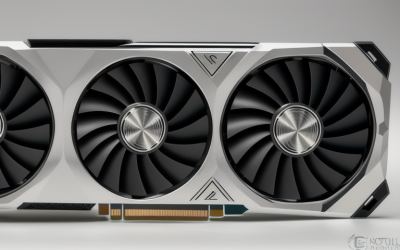
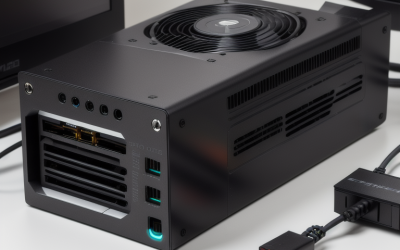
The NVIDIA RTX 4000 Ada Generation is a single-slot professional desktop graphics card with 6,144 CUDA cores, 20 GB of ECC GDDR6 memory on a 160-bit bus and a 130 W board power rating, built for CAD, rendering, AI and visualisation work; it can play games, but it is not the card to buy for that purpose.
Official specifications
NVIDIA’s datasheet, along with partner pages from PNY, Leadtek and Lenovo, lists the following. The chip is an AD104 on a 4 nm-class process with about 35.8 billion transistors, a 294.5 square millimetre die and the Ada Lovelace architecture. It carries 48 third-generation RT cores and 192 fourth-generation Tensor cores.
| Specification | RTX 4000 Ada Generation |
|---|---|
| CUDA cores | 6,144 |
| RT cores / Tensor cores | 48 (3rd gen) / 192 (4th gen) |
| Memory | 20 GB GDDR6 with ECC, 160-bit |
| Memory bandwidth | 360 GB/s |
| Single-precision performance | 26.7 TFLOPS |
| RT core performance | 61.8 TFLOPS |
| Tensor performance | 327.6 TFLOPS (maker datasheet figure) |
| Board power | 130 W |
| Form factor | Single slot, active cooling, 4.4 inches high, 9.5 inches long |
| Interface | PCIe 4.0 x16 |
| Display outputs | 4 x DisplayPort 1.4a |
| NVLink | Not supported |
A few third-party sites list different numbers, such as a higher tensor figure, a 300 W rating or a wider memory bus. The tensor difference is explained by sparsity: one site’s larger number is an FP8 rate with sparsity, while the datasheet figure is the non-sparse one. The wattage and bus figures that contradict the datasheet appear to be errors, so the maker’s numbers are the ones to rely on.
Where it sits in the Ada professional lineup
The “4000” name suggests a mid-tier part, and the numbers back that up: it uses the same core count as the small-form-factor card but runs at a higher power limit.
| Card | CUDA cores | Memory | Power | Notes |
|---|---|---|---|---|
| RTX 2000 Ada | 2,816 | 16 GB GDDR6 | 70 W, slot-powered | Compact, no external power cable |
| RTX 4000 SFF Ada | 6,144 | 20 GB GDDR6 ECC | 70 W, slot-powered | Low-profile cousin of the RTX 4000 |
| RTX 4000 Ada | 6,144 | 20 GB GDDR6 ECC | 130 W | Single slot with a 6-pin style connector |
| RTX 4500 Ada | 7,680 | 24 GB | 210 W | Dual slot, step up |
The practical difference between the two 6,144-core cards is the power limit. The SFF version is capped at 70 W so it can live in small cases without extra cabling, while the full-height RTX 4000 Ada is allowed 130 W and can sustain higher clocks.
Who it suits
Professional users
The 20 GB memory pool with ECC is what separates this card from consumer GPUs in the same price conversation. CAD assemblies, large textures, scientific visualisation and local AI experiments often hit memory limits before they hit compute limits. The single-slot design also lets builders fit several in a workstation chassis where dual-slot cards would block neighbouring slots. ISV certification for professional applications is another reason studios choose this line.
Builders considering it for games
The AD104 chip is the same family used in the GeForce RTX 4070 class, so it has plenty of raw capability for games, and DLSS 3 hardware is present. However, the maker does not publish gaming benchmarks for it, and no official frame-rate figures exist. Its drivers are tuned for stability in professional software, and its price class is well above that of GeForce cards with similar gaming results. For a gaming PC, a GeForce card is the more sensible route.
AI and small-scale compute
Twenty gigabytes is enough for many inference tasks that overflow 8 GB or 12 GB cards. The card has no NVLink, so multi-GPU memory pooling is not an option.
Platform, power and cooling notes
- Slot: PCIe 4.0 x16, but it also works in older PCIe slots at reduced link speed. A single-slot card does not need more than one slot of clearance.
- Power: the maker lists 130 W total board power. Use the power cable type the card ships with or specifies, and make sure the power supply has the connector available.
- Cooling: the single-slot blower design exhausts air out of the back of the case. It is louder under sustained load than a large dual-fan gaming cooler, so noise tolerance is a factor in quiet builds.
- Displays: four DisplayPort 1.4a outputs suit multi-monitor workstations. Adapters are needed for HDMI-only displays.
- Drivers: use NVIDIA’s professional driver branch for certified software behaviour.
Pick this card if …
| Situation | Fit |
|---|---|
| You need ECC memory and 20 GB in a single slot | Strong |
| Your software lists certified professional GPUs | Strong |
| You want a low-profile, slot-powered card | Look at the RTX 4000 SFF Ada instead |
| You need more cores and memory | RTX 4500 Ada and above |
| You mainly play games | Weak; GeForce is better aligned |
| You need multi-GPU memory pooling | Not supported, no NVLink |
Common mistakes
- Mixing up the RTX 4000 Ada with the RTX 4000 SFF Ada. They share cores and memory but differ in power and size.
- Trusting aggregator sites that show a 300 W or 256-bit figure. The datasheet says 130 W and 160-bit.
- Assuming ECC memory gives higher frame rates. It improves data integrity, not speed.
- Forgetting that older workstation cases may not have the right power connector.
- Comparing the tensor number directly with sparsity-based numbers from other pages.
Reading the datasheet without confusion
Professional GPU pages mix several kinds of numbers. Single-precision TFLOPS describes general shader throughput, RT core TFLOPS describes ray-tracing hardware, and Tensor TFLOPS describes AI matrix math, often quoted with or without sparsity. These figures are not interchangeable, and comparing one outlet sparsity-adjusted number with another non-sparse number produces false conclusions. Stick to one source per comparison and note which convention it uses.
Memory type is another common mix-up. The RTX 4000 Ada uses GDDR6 with ECC on a 160-bit bus, which is why its bandwidth sits at 360 GB/s. Consumer cards that use GDDR6X on wider buses list much larger bandwidth, so a simple bandwidth comparison between a workstation card and a GeForce card can mislead. For professional use, capacity, ECC and driver certification usually matter more than that single number.
Frequently Asked Questions
How many CUDA cores does the RTX 4000 Ada have?
NVIDIA lists 6,144 CUDA cores, 48 RT cores and 192 Tensor cores. It uses the AD104 chip, the same silicon family as GeForce RTX 4070 class cards.
How much power does it use?
The maker’s datasheet lists a total board power of 130 W. The SFF version of the same chip is limited to 70 W and draws power from the slot alone.
Can it be used for gaming?
It can run games, but it is designed for professional applications and no official gaming benchmarks are published. A GeForce card gives better gaming value and driver tuning.
Does it support NVLink?
No. The datasheet lists NVLink as not supported, so memory cannot be pooled across two cards.
What display outputs does it have?
Four DisplayPort 1.4a connectors. Users with HDMI monitors need active or passive adapters depending on the display.
Is it a single-slot or dual-slot card?
Single slot, with an active cooler. The size is listed as 4.4 inches high and 9.5 inches long, which suits compact workstation cases.
Related guides
More from Amazon
Programs that pair well with the guide above. Offers and eligibility are set by Amazon and may change.
Free shipping on eligible items, Prime Video and more. Eligible new members can start with a free trial.
Start a Prime free trialAd-free music streaming. Eligible new subscribers can start with a free trial.
Try Music Unlimited freeA Prime membership for ages 18-24 with a trial period. Eligibility is set by Amazon.
See Prime for Young AdultsAudiobooks and podcasts to listen to on the go. Eligible new members can start with a free trial.
Try Audible freeAs an Amazon Associate we earn from qualifying purchases.