Video editing punishes storage in a way gaming rarely does. A timeline pulls several clips at once, the preview cache writes constantly, and an export reads one large file while writing another. A drive that looks quick on its box can still stall when a long sequential transfer outlasts its cache, which is why a project that scrubs smoothly in the first ten minutes can begin to hiccup an hour later. The question behind this keyword is not simply which M.2 SSD is fastest, but which one stays steady while you scrub, cache and render, at a capacity that will not fill up after two shoots.
The six drives below cover the realistic range for desktop editors: PCIe 4.0 models around 7,000 MB/s, a budget 4.0 option, and two PCIe 5.0 drives that advertise up to 14,000 MB/s. They suit creators building a new editing tower, upgraders adding a project drive, and anyone replacing a cramped system disk. All remarks come from the listing wording, so confirm current specifications, heatsink needs and warranty terms before buying in 2026.
Our Top Picks


Top 3 picks at a glance
Quick Picks
As an Amazon Associate we earn from qualifying purchases at no extra cost to you.


| Product | Best for | Key spec from the title |
|---|---|---|
| Samsung 990 PRO 2TB | Reliable high-end project drive | PCIe 4.0 M.2 2280, up to 7,450 MB/s |
| Kingston NV3 1TB | Budget system or cache drive | PCIe 4.0 Gen 4×4, up to 6000 MB/s |
| fanxiang 1TB PCIe 5.0 | Fast transfers at a modest capacity | PCIe 5.0, up to 14000 MB/s |
| Aiibe 1TB NVMe | Low-cost 4.0 capacity | PCIe 4.0 M.2 2280, up to 7450MB/s |
| Ediloca 2TB PCIe 5.0 | Heavy 4K and 8K workflows | 14,000MB/s read, 10,000MB/s write, 2GB DRAM |
| Bestoss 2TB Gen4 | Large, low-cost working drive | Gen4, up to 7350MB/s, SLC cache and HMB |
The 6 Best Options
Four listings from the source group are left out. One is a second Samsung 990 PRO 2TB listing that only adds a heatsink to the same drive. Two are Patriot 256GB PCIe Gen 3 drives whose capacity is too small for video work. The last is a Crucial P310 in the short M.2 2230 size, meant for handhelds and ultrabooks rather than standard desktop slots.
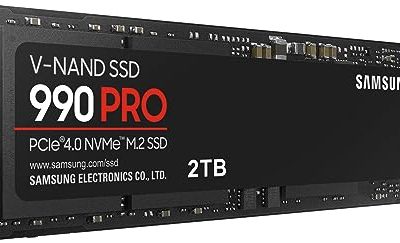
Samsung 990 PRO 2TB
The 990 PRO is the established reference point for a high-end PCIe 4.0 project drive. The title lists a 2TB capacity, PCIe 4.0 M.2 2280 format, read speeds up to 7,450 MB/s, the NVMe protocol, and positioning for high-end computing, gaming and heavy-duty workloads. A separate listing offers the same 2TB drive with a heatsink, which suits machines where the motherboard does not provide its own cover.
For editing, 2TB is a practical size: it holds an operating system, editing software and active projects without constant housekeeping. Samsung’s name also brings easy firmware tools and a clear warranty path, though the visible title does not state the warranty length. This is the drive for an editor who would rather pay a little more and stop thinking about storage.
Picture a freelancer who delivers weekly edits and cannot afford a lost afternoon to a flaky drive. That person gains most from a single, well-supported 2TB module that holds the active project, the cache and the editing software together, with the footage archive kept elsewhere. If your motherboard has two M.2 slots, a second identical drive later gives you a simple project-and-cache split.
- 2TB capacity gives breathing room for active projects.
- PCIe 4.0 speeds up to 7,450 MB/s suit 4K timelines.
- Established brand with straightforward support channels.
- It costs more per terabyte than the budget drives in this guide.
- The listed speed is a peak read figure, not a sustained write figure.
One practical note: because the 990 PRO appears with and without a heatsink, check which version you are ordering. A board that already has a metal cover over the slot does not need the extra part, while a bare slot, or a tight space under a graphics card, may benefit from it. Fit the thermal pad in the correct place and never stack two covers.
Skip it if you want the biggest capacity for the least money. Next to the Kingston NV3, it is the premium pick, while the Kingston is the budget-minded one with half the capacity.
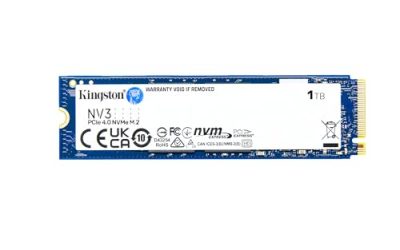
Kingston NV3 1TB
The NV3 is the plain, affordable PCIe 4.0 drive. The title lists a 1TB capacity, M.2 2280, NVMe, PCIe 4.0 Gen 4×4, speeds up to 6000 MB/s and the model number SNV3S/1000G.
It targets buyers who want a dependable drive for the operating system and the cache without paying for peak numbers. At 1TB, it fits a boot-and-cache role well, with large footage stored on a bigger drive. Kingston is a name most buyers recognize, and the model number makes it easy to look up the exact datasheet before purchase.
Think of a student or hobby editor whose projects are short and whose system drive is an aging SATA disk. Dropping an NVMe drive into a free slot changes boot time, project load time and cache speed in one move, and 1TB is plenty if finished videos are moved to an external drive after delivery. It is also a sensible second drive in a larger workstation.
- PCIe 4.0 Gen 4×4 interface at a modest tier.
- Recognizable brand and a clear model number.
- Good fit for a system or scratch drive.
- 1TB fills quickly with 4K footage.
- The listed top speed is lower than the premium drives.
Its trade-offs are the usual ones for a value NVMe drive. Speeds drop once the fast cache is exhausted, so a very long copy will finish more slowly than the opening seconds suggest, and the lower top speed is a visible gap next to the premium drives. For the system and cache roles it was chosen for, neither point is likely to be noticed.
Skip it if your work involves long 4K or 8K projects on a single drive. Against the fanxiang next, it gives up a speed headline in exchange for a calmer, cooler interface.
fanxiang 1TB PCIe 5.0
This is the entry point to PCIe 5.0 speeds. The title lists a 1TB capacity, a PCIe 5.0 NVMe M.2 interface, speeds up to 14000 MB/s, and uses including 8K video editing, AI training, gaming, PC and laptop.
The speed figure is attractive for large file moves, but drives in this class generally run warm, and a PCIe 5.0 slot is required to reach the headline numbers. Editors should confirm that the motherboard has a 5.0 M.2 slot and a heatsink, and should treat the 8K claim as marketing language until they have checked sustained write behavior.
This drive suits a builder with a new PCIe 5.0 motherboard who wants to use the fast slot without paying for 2TB. A typical use is a dedicated cache drive for an editing program, where fast small and large reads matter and capacity needs are modest. Pair it with a bigger, slower drive for the footage itself.
- PCIe 5.0 interface with the highest listed speed in the guide.
- Marketed for 8K editing workloads.
- 1TB capacity at a more accessible tier than the 2TB 5.0 option.
- Requires a PCIe 5.0 slot for full speed.
- Faster drives usually run hotter and may throttle without cooling.
It also pays to remember that an AI-training label on a storage listing is a marketing tag, not a hardware feature. What counts for an editor is whether the drive holds its write speed once the cache fills, and the title does not answer that, so look for independent measurements before relying on the 8K wording.
Skip it if your board only supports PCIe 4.0, or if you want a drive from a long-established brand. Compared with the Ediloca later, it is the smaller and cheaper 5.0 drive, and it lacks the DRAM details in that listing.
Aiibe 1TB NVMe
The Aiibe is a low-cost PCIe 4.0 drive that advertises the same 7450MB/s read figure as the Samsung. The title lists 1TB, NVMe M.2 PCIe 4.0 2280, read speeds up to 7450MB/s and use in laptops, PCs, gaming, video editing and PS5.
It will appeal to buyers who need extra capacity on a modest budget. The brand is less known, so warranty terms and controller details deserve checking, since those determine sustained performance. For a scratch drive that holds cache files, the risk is small; for the only copy of client footage, it is higher.
It fits a cost-conscious builder equipping a secondary machine or a laptop with a spare slot, where the priority is more room for clips and the work is not mission-critical. Because the listing is general in nature, with uses ranging from editing to a console, buyers should treat it as a capable all-purpose drive rather than a specialist tool for production work.
- PCIe 4.0 speeds at a lower tier.
- Listing mentions use in a PC, laptop or PS5.
- 1TB capacity for projects and cache.
- Unfamiliar brand with less public track record.
- The title gives no details about cache design or endurance.
Because the listing lists the same 7450MB/s figure as a far better-known drive, a careful buyer will ask why the two differ in price. The usual answers are controller choice, flash quality, warranty length and sustained write behavior, none of which the title covers, so do the extra reading before you buy.
Skip it if you need proven long-term reliability for client work. It is the budget alternative to the Samsung, with half the capacity and fewer assurances.
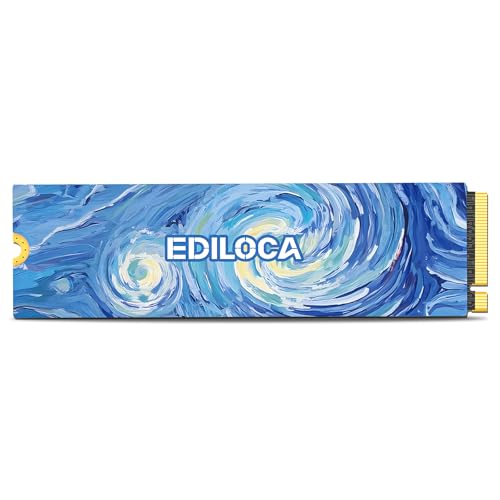
Ediloca 2TB PCIe 5.0
The Ediloca is the most detailed listing here. The title lists 2TB, NVMe PCIe 5.0×4, up to 14,000MB/s read, 10,000MB/s write, 2GB of LPDDR4 DRAM, a dynamic SLC cache, M.2 2280 format and 3D TLC flash.
The DRAM cache is meaningful for editors because it helps the drive manage data under heavy load, and the write figure suggests strong sequential writes during exports. At 2TB, it offers working space for 4K and beyond. Be ready to give it a heatsink and a PCIe 5.0 slot, because the headline numbers depend on both.
This is the drive for editors with high-bitrate footage, large multicam projects or frequent transfers between machines. Because a 5.0 drive can move data faster than most other parts of the system, the benefits show most clearly when you copy large folders or export to the same drive that holds the source. Give it airflow and check the temperature during the first long render.
- 2TB capacity with 2GB of DRAM cache.
- Listed 10,000MB/s write speed.
- 3D TLC flash is a common mainstream choice.
- Requires a PCIe 5.0 slot and good cooling.
- Less established brand than Samsung.
Skip it if your board lacks a 5.0 slot. Compared with the fanxiang, it doubles capacity and adds DRAM and write-speed details, which makes it the more complete 5.0 listing.
Bestoss 2TB Gen4
The Bestoss is a high-capacity drive at a budget tier. The title lists M.2 2280 NVMe, 2TB, Gen4, up to 7350MB/s, TLC flash, PS5 and PC use, an SLC cache and HMB (host memory buffer), and mentions laptops, gamers and video editors.
HMB means the drive borrows a small amount of system memory in place of its own DRAM, a cost-saving approach. For editors, that can mean less consistent performance during very long writes, though it remains a reasonable fit for project and cache use. The appeal is plain: two terabytes without a premium price.
Buyers who reach for this drive usually have a long list of projects and a short budget, and they want a single large volume rather than two small ones. It works as a working drive for active footage as long as finished edits are backed up elsewhere. Think of it as bulk space with decent speed, not as a premium scratch drive.
- 2TB capacity at a Gen4 tier.
- Listing mentions PC and PS5 use.
- SLC cache supports short burst writes.
- HMB design instead of onboard DRAM.
- Unfamiliar brand with limited public history.
The mention of console use in the listing is a reminder that this drive is built for broad appeal. That is fine for a project volume, but it means the maker is balancing several audiences at a tight cost, and an editor who needs guaranteed sustained performance should weigh that carefully against the extra terabyte.
Skip it if you run long, sustained exports and want predictable write speed. It closes the list as the large-capacity, lower-cost option.
Who Needs a Fast M.2 SSD for Video Editing
Editors with 4K and higher footage
High-resolution files are large, and smooth scrubbing requires quick reads. A fast NVMe drive keeps the timeline responsive when several clips and layers are active, and it shortens the wait when a project opens.
Anyone using a cache or scratch disk
Editing programs write preview and render caches continuously. A dedicated drive for that job keeps your system disk free and responsive, and it is the cheapest way to improve a machine that feels sluggish while rendering.
Upgraders from hard drives or SATA
Moving from a hard drive or a SATA SSD to NVMe is among the most noticeable storage upgrades for load times, file copies and scrubbing. Many older desktops have a free M.2 slot that has never been used.
If you only trim short phone clips for social media, a basic 1TB NVMe drive is enough, and spending on PCIe 5.0 would be wasted. The money is better spent on memory or a second drive for archives. Editors who work from external drives on a laptop have a different reason to care: an internal M.2 drive of 2TB can hold the current project and avoid the delays of a slow external connection.
How to Choose
Choose capacity first
Plan for at least 1TB for the system and software, and 2TB or more for active projects. A single hour of 4K footage can occupy tens of gigabytes, and caches add more, so 2TB is the practical standard for working editors. Buying a small fast drive and a large slow one is often smarter than buying one medium drive. A common split is a 1TB NVMe drive for the system and cache, a 2TB NVMe drive for the active project, and a large external or SATA drive for the archive, so that the fast storage only holds what you are working on this month.
Leave free space, too. Solid state drives slow down as they fill, because the controller has less room to move data around, so a drive that is 90 percent full behaves worse than the same drive at 60 percent. Treat the marked capacity as a number you will use roughly two-thirds of.
Match the interface to your slot
PCIe 4.0 drives work in both 4.0 and 5.0 slots, but 5.0 drives need a 5.0 slot to reach their listed speed. Check your motherboard manual for the M.2 slots and which of them run at which speed, because boards often provide only one 5.0 slot and several 4.0 or slower ones. The slot wired to the processor is usually the fastest, while slots wired through the chipset can be slower and may share bandwidth with other ports. For an editing drive, put the busiest volume in the processor-connected slot.
Look past peak speed to sustained performance
Peak read speed is a marketing number. For editing, sustained write speed and cache behavior matter more, because exports write large files for minutes at a time. Drives with onboard DRAM, such as the Ediloca, tend to hold their speed more consistently, while HMB designs like the Bestoss depend more on system memory and a cache that can fill.
Plan for heat
Fast drives produce heat and may slow themselves to protect the flash. Use the motherboard heatsink or the one supplied, and give PCIe 5.0 drives real airflow. A drive tucked under a large graphics card can run hotter than the listing suggests. If you see export speed fall after a minute or two of a long transfer, throttling is the usual cause, and the fix is almost always a better heatsink or more case airflow, not a different drive.
Confirm the form factor
M.2 2280 is the standard desktop size. Avoid 2230 drives unless you have a matching slot, since they are meant for handheld devices and small laptops. Also confirm whether the slot accepts NVMe drives, as some older boards route M.2 slots to SATA only.
Weigh endurance, warranty and support
Editing writes a lot of data, so endurance ratings and warranty length matter. Budget drives usually cut corners on cache design, endurance and support. Ignore marketing phrases about AI training or console use, and ignore the headline speed on its own.
PCIe 4.0 vs PCIe 5.0 for Editing
This is the choice most buyers of this keyword face, and it is more about your motherboard and workflow than about the drive.
| Factor | PCIe 4.0 | PCIe 5.0 |
|---|---|---|
| Listed top speed | About 6,000 to 7,450 MB/s | Up to 14,000 MB/s |
| Heat | Moderate | Higher, needs cooling |
| Slot requirement | Works in 4.0 and 5.0 slots | Needs a 5.0 slot for full speed |
| Listed examples | Samsung 990 PRO, Kingston NV3, Aiibe, Bestoss | fanxiang, Ediloca |
When PCIe 4.0 is enough
For most 4K projects, a 4.0 drive keeps up, because editing software rarely needs the full speed of a 5.0 drive during playback. The savings can go toward capacity, which usually helps a project more than extra speed would. Most timelines are limited by the processor, memory and graphics card long before they are limited by drive speed, and compressed camera formats read at a fraction of what any of these drives can deliver.
When PCIe 5.0 makes sense
If you move huge files regularly, work with very high bitrate footage or want headroom for later, 5.0 helps, provided your board supports it and you can cool the drive. Without a 5.0 slot and a heatsink, the premium buys nothing. Editors working with uncompressed or lightly compressed footage, or those who copy hundreds of gigabytes between drives every day, are the ones who feel the difference in a working week rather than in a speed test.
Setup, Compatibility and Upgrade Tips
What to check before buying
Verify the board’s M.2 slots, their speeds and whether installing a drive disables a SATA port. Confirm the drive is 2280 and check whether your board has a heatsink for that slot. Look at the free slot’s position as well, since the one under the graphics card is the hottest.
What to upgrade first
Add a second drive for projects and cache before replacing the system drive. Keep the operating system and software on one drive and footage on another, so a full project disk never slows the whole machine. Next, add a backup routine: a second drive that copies finished projects, because a fast drive is still a single point of failure. Only after that is it worth thinking about a larger or faster replacement for the system drive.
Common compatibility traps
Some boards share bandwidth between M.2 slots and SATA ports, so filling one can switch off another. A drive under a graphics card needs airflow. Update the firmware of the motherboard and the drive when updates are available, and back up your data before changing anything. When you install the drive, ground yourself, seat the connector at its angle, press it down and fix the screw so the drive lies flat against its standoff. Then initialize it in the operating system and check its reported link speed in a monitoring tool, which quickly reveals a drive that landed in a slower slot than you intended.
Which One Fits Your Situation
A working editor who needs reliability
Choose the Samsung 990 PRO 2TB. It offers capacity, speed and a strong support path, which matters when a failed drive costs a deadline. Use it for the active project and cache, and keep a second copy of anything you cannot recreate.
A budget system and cache drive
Choose the Kingston NV3 1TB. It is simple, affordable and easy to look up, and it works well as a boot and scratch drive. Pair it with a larger drive when footage outgrows it, and you will have a tidy two-drive setup without overspending.
A high-bitrate workflow on a 5.0 board
Choose the Ediloca 2TB, with its DRAM cache and stated write speed, and fit a heatsink. It makes the most sense on a board with a dedicated PCIe 5.0 slot and a case with real airflow, where its listed speeds can be used.
Lots of space for a small budget
Choose the Bestoss 2TB Gen4, accepting the HMB design, and keep a backup of anything important. If a second budget slot is free, the Aiibe 1TB is a lower-cost way to add a cache drive next to it.
If two drives look equal, choose the one with the clearer warranty and the better cooling story. For a tool that writes terabytes of cache every month, those two factors decide long-term satisfaction more than a few hundred megabytes per second on a label.
Common Mistakes
- Buying by peak speed and ignoring sustained writes.
- Installing a PCIe 5.0 drive in a 4.0 slot and expecting full speed.
- Choosing 1TB when projects need 2TB.
- Skipping a heatsink on a fast drive.
- Buying a 2230 drive for a desktop slot.
- Keeping footage, cache and the system on one drive.
Related guides
- Gaming Laptop Battery Draining While Plugged In Fix
- Graphics Cards For Low Wattage Power Supplies
- How To Stop Laptop Thermal Throttling In Software
Frequently Asked Questions
Do I need PCIe 5.0 for video editing?
No. PCIe 4.0 drives are fast enough for most 4K editing, because the processor and graphics card usually limit playback before storage does. PCIe 5.0 helps in specialized high-bitrate workflows and large file transfers, and only if your motherboard has a 5.0 slot.
How much storage do editors need?
At least 2TB for active projects is a practical standard, with a larger archive on a separate drive. Raw footage and caches grow quickly, and a drive that is nearly full performs worse, so size it with room to spare.
Does DRAM matter on an SSD?
It helps with consistency under heavy load, because the drive keeps its mapping table in fast memory. Drives without DRAM, including those using HMB, can work well for everyday use but may slow during long writes.
Will a PCIe 5.0 drive work in a 4.0 slot?
Yes, but at 4.0 speeds, so you lose the benefit of paying for 5.0.
Do I need a heatsink?
For fast drives, yes. A heatsink prevents throttling during long transfers, and many motherboards include one for at least one slot. PCIe 5.0 drives in particular should never run bare.
Can I use the same drive in a PS5?
Some listings mention it, but check the console requirements, including heatsink and size, before relying on that.
Final Words
The Samsung 990 PRO 2TB is the dependable choice for working editors, the Kingston NV3 covers budget needs, and the Ediloca and fanxiang serve PCIe 5.0 systems. The Bestoss and Aiibe offer capacity at a lower tier, with brand caveats. Choose capacity first, confirm slot support and cooling, and do not buy on peak speed alone. A drive that stays cool and consistent through a long export will always serve an editor better than one that wins a quick burst.