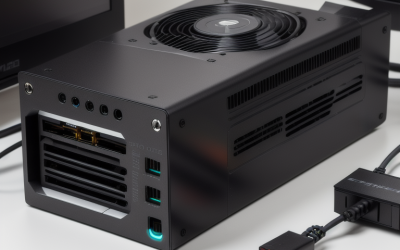
The RTX 4060 Ti 8GB pairs NVIDIA’s AD106-class Ada Lovelace silicon, listed by the maker with 4,352 CUDA cores and a boost clock near 2.54 GHz, with 8GB of GDDR6 on a 128-bit bus and a 160W total graphics power rating. It is a 1080p-first card that handles 1440p in many titles with sensible settings, and its single real limit is the 8GB memory pool, which is where it differs from the 16GB sibling.
Official Specifications
NVIDIA publishes one shared specification block for both RTX 4060 Ti memory versions, with only the power figure and the memory size changing. Here is the 8GB card laid out by category.
| Category | Maker-listed value |
|---|---|
| GPU architecture | Ada Lovelace |
| CUDA cores | 4,352 |
| Boost clock | About 2.54 GHz |
| Memory | 8GB GDDR6 |
| Memory interface | 128-bit |
| Total graphics power | 160W |
| Minimum recommended system PSU | 550W |
| Power input | One 8-pin PCIe cable (or a 300W PCIe Gen 5 cable through an adapter) |
| Bus interface | PCI Express Gen 4 |
| Peak shader throughput | 22 TFLOPS (maker figure) |
| Ray tracing and AI | Third-generation RT cores, fourth-generation Tensor cores, DLSS 3 support |
Partner brands such as ASUS, MSI, Gigabyte and others build their own boards around this chip. Some ship with a small factory overclock, a different cooler or a different power connector, so the sticker on a specific card can differ slightly from the reference figures above.
What 8GB Means in Practice
Video memory holds textures, geometry and frame buffers. When a game asks for more than the card has, data spills into system memory over the PCIe link, and that causes stutter or forces the game to lower texture quality. Reviewers who compared this card with its 16GB twin report that in games that fit within 8GB the two perform nearly the same, while a small group of recent, texture-heavy titles at higher presets show the 8GB version struggling.
A practical way to think about it:
- 1080p at medium to high settings: generally comfortable for the 8GB card.
- 1440p at high settings: fine in many games, but texture presets may need to come down in the most demanding new releases.
- 4K: not the target for this card.
- Ray tracing: the hardware is there, though ray tracing raises memory use, and the pool fills faster.
Publishers list their own requirements on Steam store pages or their sites. Some publish a recommended graphics card tier and a VRAM figure for high presets; others do not publish a number at all. When a figure is missing, there is no honest way to fill it in, so use reviewer coverage of that specific game.
Where It Sits in NVIDIA’s Lineup
| Model | CUDA cores | Memory | Bus | TGP | Positioning |
|---|---|---|---|---|---|
| RTX 4060 | 3,072 | 8GB GDDR6 | 128-bit | 115W | Entry 1080p |
| RTX 4060 Ti 8GB | 4,352 | 8GB GDDR6 | 128-bit | 160W | Upper 1080p, light 1440p |
| RTX 4060 Ti 16GB | 4,352 | 16GB GDDR6 | 128-bit | 165W | Same speed, more memory |
| RTX 4070 | 5,888 | 12GB | 192-bit | 200W | Comfortable 1440p |
Compared with the RTX 4060, the 4060 Ti has about 40 percent more CUDA cores by the maker’s numbers (4,352 against 3,072), which is why reviewers place it a clear step up. Compared with the RTX 4070, it has a smaller core count, less memory and a narrower bus, and reviewers generally class the 4070 as noticeably faster at 1440p.
Platform and Power Notes for Builders
Sockets and CPUs
A graphics card has no socket tied to a CPU brand. It uses a standard PCI Express x16 slot, and any current AMD AM5 or Intel LGA1700 or LGA1851 board will work. The GPU only uses eight lanes, so on a Gen 4 or Gen 5 board you will not feel the narrower link. On a Gen 3 board, such as an older B450 or Intel 8th or 9th generation system, the link runs at Gen 3 x8, and reviewers have flagged reduced results in some games.
Power
The 160W rating and a 550W minimum system supply suit a modest build. Use the correct PCIe power cable from your power supply rather than a daisy-chained or adapter-heavy setup, make sure the connector clicks in fully, and do not open the power supply itself. If your supply is older, check its rating label and age before adding a new card.
Physical size
Cooler designs range from short two-fan boards suited to small cases to long three-fan versions. Note the length, thickness and your case’s front clearance.
Is the 8GB Card the Right One for You?
| If you… | Then… |
|---|---|
| Play esports and older titles at 1080p | The 8GB model covers it and avoids paying for unused memory |
| Play new AAA games and want high textures at 1440p | Consider the 16GB version or the RTX 4070 |
| Use heavy texture mods | Leave headroom with more VRAM |
| Want the lowest power and a simple install | The 8GB card is easy to fit and cool |
| Want the longest lifespan | Weigh memory capacity, since requirements have trended up |
Mistakes to Avoid
- Treating all RTX 4060 Ti cards as the same. Memory size is the difference, and it affects some games.
- Buying on boost clock alone. Cooler quality and power limits change real clocks.
- Pairing it with a weak CPU and blaming the GPU for low frame rates.
- Skipping the case measurements.
- Expecting frame generation to fix everything. It helps in supported games but does not add memory.
The card also has previous-generation status in 2026, since NVIDIA’s RTX 50-series has launched with new cards in the same performance tier. That does not make the 4060 Ti obsolete, but compare it against current options before deciding.
Frequently Asked Questions
How many CUDA cores does the RTX 4060 Ti 8GB have?
NVIDIA lists 4,352 CUDA cores, the same number as the 16GB version. Both share the same GPU and clocks.
What is the power requirement?
The maker lists 160W total graphics power for the 8GB model and a minimum 550W system power supply. It uses one 8-pin PCIe connector on the reference design.
Is 8GB of VRAM enough in 2026?
For many 1080p games it is adequate, but a few recent titles at high texture presets exceed it. If you play those games or want longer-term headroom, a card with more memory is the safer choice.
Does it support DLSS 3 and ray tracing?
Yes. Ada Lovelace brings third-generation ray tracing cores and fourth-generation Tensor cores, and DLSS 3 with frame generation works in supported games.
Is it better than the RTX 4060?
By the maker’s specifications it has many more CUDA cores and a higher power limit, and reviewers rank it a step above the RTX 4060. Both have 8GB and a 128-bit bus.
Related guides
More from Amazon
Programs that pair well with the guide above. Offers and eligibility are set by Amazon and may change.
Free shipping on eligible items, Prime Video and more. Eligible new members can start with a free trial.
Start a Prime free trialAd-free music streaming. Eligible new subscribers can start with a free trial.
Try Music Unlimited freeA Prime membership for ages 18-24 with a trial period. Eligibility is set by Amazon.
See Prime for Young AdultsAudiobooks and podcasts to listen to on the go. Eligible new members can start with a free trial.
Try Audible freeAs an Amazon Associate we earn from qualifying purchases.