A ceiling of under 200 dollars changes the question you are really asking. You are no longer shopping for the fastest card; you are deciding which compromise you can live with. One path is a modern but trimmed-down design with a narrow memory bus. The other is an older or rebadged design that hands you more raw video memory and a wider bus. Both can run a 1080p library of popular games at sensible settings, and both can quietly disappoint if you pick the wrong one for your monitor, your power supply, or the way you play.
This guide is written for the builder with a fixed cap who wants to repair an aging desktop, finish a first build, or give a hand-me-down tower a second life in 2026. Five distinct listings are compared below, using only what each product title states: memory size, bus width, interface, outputs, and cooler layout. Some of these cards sit at the generous end of the cap and some at the cheap end of the market, so confirm the final cost of the exact listing against your limit before you commit. Where a title leaves something out, we say so instead of guessing.
Our Top Picks
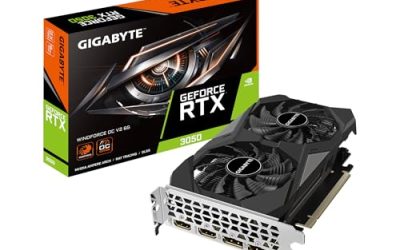
 GIGABYTE GeForce RTX 3050 WINDFORCE OC V2 6GStandard7.5 x 4.4 x 0.1 Inches0.88 PoundsCheck on Amazon
 ASUS Prime Radeon RX 9070 XT 16GB GDDR6RX9070XT|OC|16GB12.3 x 5.1 x 2 inches3.3 PoundsCheck on Amazon


Top 3 picks at a glance
Quick Picks
As an Amazon Associate we earn from qualifying purchases at no extra cost to you.


| Product | Best for | Key spec from the title |
|---|---|---|
| GIGABYTE RTX 3050 WINDFORCE OC V2 6G | Modern features on a short, simple card | 6GB GDDR6, 96-bit, 2X WINDFORCE fans |
| MOUGOL Radeon RX 580 8GB | Maximum memory for the smallest spend | 8GB GDDR5, 256-bit, HDMI/DP/DVI outputs |
| MSI GeForce RTX 3060 Ventus 2X 12G OC V1 | Large memory pool with a compact twin-fan cooler | 12GB, 192-bit, 15 Gbps GDDR6, boost clock 1807 MHz |
| AISURIX Radeon RX 5500 XT 8GB | PCIe 4.0 boards that need multi-monitor outputs | 8GB GDDR6, 128-bit, 3x DP plus HDMI, PCIe 4.0 x8 |
| GIGABYTE GeForce RTX 3060 Gaming OC 12G (REV2.0) | Buyers who want a triple-fan cooler | 12GB 192-bit GDDR6, 3X WINDFORCE fans |
The 5 Best Options
One listing in the source group, a Radeon RX 9070 XT with 16GB of memory from ASUS, was left out. It belongs to a far higher tier than this cap implies, and putting it next to entry cards would only distort the comparison. The five cards below run roughly from the most conservative design to the most spacious, and each review closes by pointing at its neighbor.
GIGABYTE RTX 3050 WINDFORCE OC V2 6G
This is the pick for someone who wants a current-generation architecture, not a bargain-bin relic, and who plays at 1080p with a modest library. The title lists 6GB of GDDR6 on a 96-bit bus, a pair of WINDFORCE fans, a factory overclock in the name, and the model number GV-N3050WF2OCV2-6GD. It does not list power connectors, card length, or output counts, so confirm those on the full listing before you buy. Think of it as the tidy, low-drama option: a familiar board partner, a two-fan layout that suits ordinary mid-size cases, and a memory type that is newer than what the cheapest Radeon here uses. It also suits a buyer who has never opened a driver control panel and simply wants a card that installs, boots, and stays out of the way. The listing shows a model code rather than a long feature list, which is typical of straightforward entry cards, so the value lies in reliability and fit instead of extras.
- Modern GeForce design with GDDR6 instead of older memory.
- Two-fan cooler is a sensible fit for ordinary mid-size cases and typical airflow.
- A factory overclock is part of the name, so you get a little extra speed without touching any software.
- The 96-bit bus and 6GB capacity are the limiting factors; texture-heavy new releases will push past them.
- Less memory than every other card in this list, which shortens its useful life if you raise settings later.
Skip it if you plan to raise texture quality in recent open-world titles or keep the card for several years. The 12GB cards further down give you far more headroom for that. Against the MOUGOL RX 580 that follows, the Gigabyte trades capacity for a newer feature set and a more efficient design philosophy, which matters if your power supply is modest or your case airflow is average.
MOUGOL Radeon RX 580 8GB
For a build where every spare coin counts, this listing offers the widest bus in the group. The title states 8GB of GDDR5, a 256-bit interface, a 2048SP configuration, PCIe x16 3.0, triple output with HDMI, DisplayPort and DVI, and a dual-fan cooler in white. The 2048SP label points to a reduced shader count compared with the 2304 on the original RX 580, so expect it to sit below a classic RX 580 in raw speed. That is not a flaw in itself, but it explains why this is a budget-tier purchase rather than a bargain on paper. Its natural audience is the tinkerer who already owns a roomy case, a sturdy power supply with spare leads, and an older monitor, and who wants maximum capacity from a small outlay. The triple output means a first monitor, a second display, and even an older DVI panel can all be connected without a single adapter.
- 8GB of memory on a wide 256-bit bus helps with textures at 1080p.
- Three video outputs, including DVI, suit older monitors without adapters.
- White shroud suits a light-colored build and looks tidy behind a glass panel.
- GDDR5 and an older architecture mean lower efficiency and fewer modern features than the GeForce picks.
- The title does not name a warranty path or driver support, so buyers should read the seller details before purchase.
Skip it if your power supply is small, if you want the latest upscaling and video-decode support, or if you need a clear manufacturer warranty. Compared with the RTX 3050 above, it is the blunter tool: more memory and more outputs, less polish. Compared with the next listing, which is built on newer memory, it is the choice for people who value capacity over refinement.
MSI GeForce RTX 3060 Ventus 2X 12G OC V1
This is the compact route to a large memory pool. The title gives 12GB, a 192-bit bus, 15 Gbps GDDR6, a boost clock of 1807 MHz, HDMI and DisplayPort outputs, PCIe 4, a Torx twin-fan cooler, and the Ampere label. Few cards in this tier combine that much video memory with a two-fan body that still fits many cases. For a buyer who intends to keep the card through a couple of monitor or game-library upgrades, the memory figure is the whole argument. The title also mentions a V1 designation, so match that exact label when comparing against other MSI listings, since similarly named boards can differ in small ways. If your cap has any flexibility at all, this is the listing that most rewards stretching it, because the extra memory is the part of a graphics card you cannot add later.
- 12GB handles high texture settings far better than the 6GB and 8GB cards here.
- 192-bit bus keeps memory bandwidth in a healthy range for 1080p and some 1440p play.
- Twin-fan Torx design is a familiar, quiet-leaning layout from a major board partner.
- It is the most expensive kind of card in this group, so the final cost may brush the top of your cap.
- Two fans on a card this capable can run louder under sustained load than the triple-fan model.
Skip it if the cap is truly hard and your listing lands above it, or if your case is very small. The Gigabyte Gaming OC covered later uses the same GPU family with a larger cooler, so the choice between them comes down to case space and noise tolerance. Before that, though, there is one more Radeon worth a look, aimed at a different kind of desk.
AISURIX Radeon RX 5500 XT 8GB
This one suits an owner who runs several monitors and still wants a budget gaming card. The title states 8GB of GDDR6, a 128-bit bus, three DisplayPort connectors plus HDMI, a PCI Express 4.0 x8 interface, an 8-pin power connector, and a fan-based cooling system. The x8 link is worth noticing: on an older PCIe 3.0 board it runs at reduced bandwidth, though many 1080p workloads shrug that off. It is also the only card in this list that spells out four separate outputs in its title. For a home office with a pair of side-by-side monitors and a television on the same desk, that connector count is genuinely practical. The cooling description is generic, so buyers should look for photos and dimensions in the full listing to judge how it will sit in a case.
- Four total outputs mean an easy multi-monitor desk without adapters.
- 8GB of GDDR6 is a comfortable amount for 1080p.
- Newer memory type than the RX 580 listing, with a PCIe 4.0 interface.
- Brand recognition is low, so warranty and support details matter more than usual.
- The 8-pin power connector rules out very small, older power supplies without a spare cable.
Skip it if your motherboard only offers PCIe 3.0 and you want the maximum from every slot, or if you prefer a major board partner. It is a step up in memory type from the MOUGOL card, but the GeForce options carry a stronger software ecosystem and clearer support. Next in line is the larger 12GB triple-fan card, which trades the extra outputs for much more memory.
GIGABYTE GeForce RTX 3060 Gaming OC 12G (REV2.0)
The Gaming OC is the roomy-cooler version of the same 12GB idea. The title lists three WINDFORCE fans, 12GB of GDDR6 on a 192-bit bus, and the revision tag REV2.0. Triple-fan layouts usually let each fan spin more slowly for the same airflow, which matters in a bedroom or living-room PC where noise is noticed. The revision tag is also a useful reminder to match the exact model name when you compare listings, because board partners revise designs over time. For a family PC that runs for hours at a stretch, or a desk where the tower sits close to your ears, the larger cooler is the main reason to choose this card over its twin-fan neighbor. It also leaves more thermal headroom if your case has only a single exhaust fan.
- 12GB and 192-bit give long-term texture headroom.
- Three fans give the cooler room to stay quiet under load.
- Established board partner with a recognizable support channel.
- A longer body can collide with drive cages or small cases, so measure first.
- The title does not mention outputs or power connectors; read the full specification.
Skip it if your case is compact or the cost climbs past your limit. It closes the list as the sensible endpoint: it is what you step up to when the narrower cards feel cramped. If you jumped straight here from the RTX 3050 at the top, expect a major jump in memory, and compare it directly with the MSI Ventus to decide between a longer quiet card and a shorter busy one.
Who Needs a Card in This Bracket
Not everyone with a small budget should buy the same thing. The right choice depends on what the card is replacing and what it is plugged into. Three situations cover most buyers who search for this keyword.
Rescuers of an old office tower
If you own a pre-built desktop with a stock power supply and an integrated or ancient graphics chip, a card with simple power needs makes the most sense. Check the supply’s label and spare cables before buying anything with an 8-pin plug, and measure the free space beside the drive bays. Many of these towers have a single x16 slot with little clearance, so a two-fan card is often the practical answer, and the case may also limit how much heat can be exhausted.
First-time builders
A first build usually has a blank slate and a fixed total. Spending toward the top of the cap on 12GB of memory will save you a mid-life upgrade, because texture demands grow faster than raw speed demands. If you can wait to get the cost within range, lean that direction. If the cap is firm, the 8GB cards still cover 1080p without embarrassment, and you can plan the next upgrade around the processor instead.
Esports and light-game players
Competitive titles care about frame rate more than texture size, so the cheaper cards can be entirely adequate. A 6GB or 8GB card paired with a 1080p panel is a sensible match for that style of play, and money saved here can go toward a faster monitor or a better keyboard. Buyers who mostly play older libraries should resist paying for memory they will not use. A useful rule is to list the three games you play most and look up their listed memory needs before you choose a tier; if none of them ask for more than six or eight gigabytes, the cheaper cards will serve you well.
How to Choose Under a Hard Cap
Memory capacity and bus width
Treat 6GB as the floor and 8GB as the comfortable middle for 1080p. A 12GB card gives room for high texture settings and light content work. Bus width matters alongside capacity: a 96-bit bus moves data more slowly than a 128-bit or 192-bit one, so a large pool on a narrow bus is not always better than a smaller pool on a wider bus. A 256-bit bus on older GDDR5 can still lose ground to a narrower bus on newer memory, so read both numbers together rather than either one alone. For a practical threshold, 1080p at high settings is comfortable on 8GB, 1440p with high textures is where 12GB earns its keep, and anything below 6GB should be reserved for older titles. Keep in mind that video memory cannot be upgraded later, so it deserves more weight than almost any other number on the box.
Power supply and connectors
Look at the wattage on your supply label and count its PCIe power leads. Many entry cards need a single 6-pin or 8-pin lead; a few draw only from the slot. A supply under 450 watts calls for care, and a supply of 550 watts from a known brand covers every card here with room to spare. Never use a splitter that turns one lead into two, and do not rely on an adapter that was bundled with a different product. If the supply is more than eight years old, consider replacing it when you add a card, because capacitors age and a unit that once delivered its rated output may no longer do so. A modern 550-watt supply from a reputable maker is inexpensive insurance for the whole system.
Interface and motherboard
A PCIe x16 slot is standard on nearly every desktop board, but an x8 card such as the Radeon 5500 XT runs at half width. On PCIe 4.0 boards that is a non-issue; on PCIe 3.0 boards it costs a little bandwidth. Make sure the slot is not blocked by a drive cage or a large CPU cooler, and confirm the BIOS is current if the board is more than a few years old.
Cooler size and case fit
Dual-fan cards are usually shorter, and triple-fan cards are longer and thicker. Measure the clear space from the back panel to the front of the case, and check how many slots the card will occupy. A card that fits on paper can still block an adjacent port or press against a front fan. Allow at least a finger’s width of air in front of the fans. In compact cases, check whether the side panel bulges or the power lead exits the card at a point where it will bend sharply, because a kinked lead is an avoidable source of instability.
Outputs and monitors
Count your monitor inputs before choosing. DVI is useful for older panels; DisplayPort handles higher refresh rates; HDMI covers TVs. A card with three DisplayPort connectors and one HDMI suits a multi-monitor desk better than a card with a single outlet of each kind, and adapters add cost and a possible point of failure.
What to ignore, and where budget models cut corners
Ignore boost-clock marketing numbers that differ by a few dozen megahertz, because real behavior depends on cooling. Be wary of unfamiliar brands that do not state warranty terms. Budget cards trim corners on cooler size, backplate material, and bundled documentation, and some lesser-known sellers skip software and driver support altogether. A recognized board partner with a clear return window is worth a modest premium, because a dead card with no support costs more than the savings. Read the listing for the warranty length, the return window, and whether the card ships with a driver disc or a download link, since some bargain sellers leave out installation guidance entirely. When two cards look equal on paper, the one with the clearer paperwork usually causes fewer problems later.
Old Design or New: A Direct Comparison
The buyers in this bracket face one comparison above all: a newer GeForce with less memory, or an older or rebadged Radeon with more. The table below lines up what the listed titles actually say.
| Factor | Newer GeForce (RTX 3050 / 3060) | Older or budget Radeon (RX 580 / 5500 XT) |
|---|---|---|
| Memory type | GDDR6 | GDDR5 (RX 580) or GDDR6 (5500 XT) |
| Capacity in this list | 6GB to 12GB | 8GB |
| Bus width in this list | 96-bit to 192-bit | 128-bit to 256-bit |
| Interface | PCIe 4 listed on the MSI | PCIe 3.0 x16 or PCIe 4.0 x8 |
| Brand and support | Established partners | Lesser-known sellers |
When the newer card is the better buy
If you care about warranty clarity, driver support, and a design built for current games, the GeForce cards are the safer pick. They also tend to suit smaller power supplies, which makes them friendlier to office-tower upgrades. The 12GB models in particular remove the memory argument that normally favors Radeon at this cost level. The two RTX 3060 listings differ mainly in cooler design, so the decision between them is about your case and your tolerance for fan noise, not about the silicon underneath.
When the older card is the better buy
If your only goal is a large memory pool at the lowest cost, and you accept a bit more heat and noise, the Radeon options deliver. Just be honest about warranty risk, and avoid them when your power supply is already near its limit. A buyer with a spare 8-pin lead and an older monitor with DVI is the ideal match. Treat these cards as an economical bridge: they will carry a 1080p setup comfortably today, and when your budget grows you can move to something newer without feeling you overpaid for the stopgap.
Setup, Compatibility and Upgrade Tips
What to verify before you order
Open your case and read three things: the power supply label, the free slot space, and the available power leads. Then confirm the motherboard slot type. Also look at your monitor inputs, since a card with only DisplayPort will need an adapter for an HDMI-only screen. Write the numbers down so you can compare them against the full listing instead of relying on memory.
What to upgrade first
If the card is going into a machine with a mechanical hard drive and four gigabytes of memory, fix those first. A fast graphics card cannot compensate for a slow storage drive and too little system memory. Eight gigabytes of RAM is a practical minimum for modern games, with sixteen being more comfortable, and a basic solid-state drive transforms load times for very little outlay. After storage and memory, look at the processor: a quad-core chip from several generations back can hold a modest card back in busy scenes, and a cheap cooler swap or a clean-out of dust can restore lost performance before you spend anything on parts.
Common compatibility traps
The classic mistakes are buying a card that needs an 8-pin lead when the supply has only a 6-pin, buying a triple-fan model that touches the drive bay, and forgetting that a very old processor can bottleneck a newer card. Uninstall the previous graphics driver before swapping brands, and run the manufacturer’s fresh installer afterward. If the monitor stays blank, reseat the power lead and try a different output before assuming the card is faulty. Also confirm that the monitor cable is plugged into the card and not the motherboard, a surprisingly common reason a new card seems to do nothing. Finally, install the latest chipset and graphics drivers from the vendor site, and keep the old card in its box until the new one has run stably for a week.
Which One Fits Your Situation
You game at 1080p and own a small power supply
Pick the GIGABYTE RTX 3050 WINDFORCE OC V2 6G. It is the most conservative design here and fits comfortably inside a modest build.
You want the most memory and do not mind older tech
Pick the MOUGOL Radeon RX 580 8GB. It gives you the widest bus and a classic triple-output layout for the smallest spend.
You run three monitors and keep it simple
Pick the AISURIX Radeon RX 5500 XT 8GB. Its three DisplayPort outputs plus HDMI make a multi-screen desk easy.
You want long-term headroom and have case space
Pick the GIGABYTE RTX 3060 Gaming OC 12G, or the MSI Ventus 2X 12G if the case is tight. Both give you 12GB for the years ahead.
Common Mistakes
- Buying on memory size alone while ignoring bus width and architecture.
- Forgetting to count the power leads on the supply before choosing a card.
- Assuming every x8 card will behave identically on an older PCIe 3.0 board.
- Choosing an unfamiliar brand without reading warranty and return terms.
- Ignoring the rest of the system, such as a slow drive or too little memory.
- Skipping a case measurement and finding the card will not fit.
Related guides
- Gaming Laptop Battery Draining While Plugged In Fix
- Graphics Cards For Low Wattage Power Supplies
- How To Stop Laptop Thermal Throttling In Software
Frequently Asked Questions
Is 6GB enough for gaming today?
For 1080p play at medium settings in a mix of older and esports titles, yes. Recent releases that lean on large textures will want 8GB or more, so treat 6GB as the floor rather than a long-term plan. Lowering texture quality one notch is usually the simplest way to stay inside the memory limit.
Does a wider memory bus always mean faster?
Not by itself. A wide bus on older memory can still lose to a narrower bus on faster memory, so look at the whole configuration. Use bus width and memory type together when comparing.
Can these cards go in an older motherboard?
Most will work in a PCIe x16 slot, even on older boards, though the x8 card may run with reduced bandwidth on a PCIe 3.0 board. Confirm the slot and your BIOS support before ordering.
What power supply is needed?
Match the card’s connector, then leave generous headroom. A supply of 500 to 550 watts from a reputable brand covers every card in this list, but the exact connector type matters more than the number on the label.
Are lesser-known brands safe to buy?
They can work well, but support is less predictable. Read the seller’s return window and warranty terms before purchase, and keep the packaging until you have confirmed the card is stable.
Should a buyer wait for a newer generation instead?
If your current card works, waiting is reasonable. If your PC cannot play what you want today, buying inside the cap now is more practical than waiting for a change in the market.
Final Words
The right answer inside a hard cap is rarely the biggest number on a spec sheet. If your case and supply are modest, the compact GeForce options fit most builds without drama. If memory is the priority, the Radeon cards and the 12GB RTX 3060 models offer the most room for the money. Measure your case, read your power supply label, confirm the final cost against your limit, and choose the card that fits the machine you actually own, not the one you wish you had. A card that installs cleanly, stays quiet, and handles your favorite games at sensible settings is worth more than any number on a box.