Case fans are the cheapest way to change how a PC looks and sounds, and RGB fans changed what people expect from them. A set of lit blades behind a glass panel can turn a plain tower into a showpiece, but the same purchase also decides how much air moves through the case, how loud it gets under load, and how many cables you end up fighting at the back of the motherboard tray. The keyword hides three questions: how bright and controllable the lighting is, how well the fan moves air, and how it all plugs in.
This guide compares six distinct 120mm multi-packs and sets, drawn only from what their titles state: pack size, bearing type, speed ceiling, LED count, connector type, and wiring method. Several listings in the source group were left out because they are the same Thermalright fan sold in different pack sizes or colors, plus a single-fan version of the Corsair set, and counting them again would only pad the list. Whatever you choose in 2026, treat the lighting as the finishing touch and the airflow as the job, and match the pack size to the number of fan positions your case actually has.
Our Top Picks
 DARKROCK Black F120 3in1 120mm Infinite Mirror Design120mm-Forward4.7 x 1 x 4.7 inchesCheck on Amazon

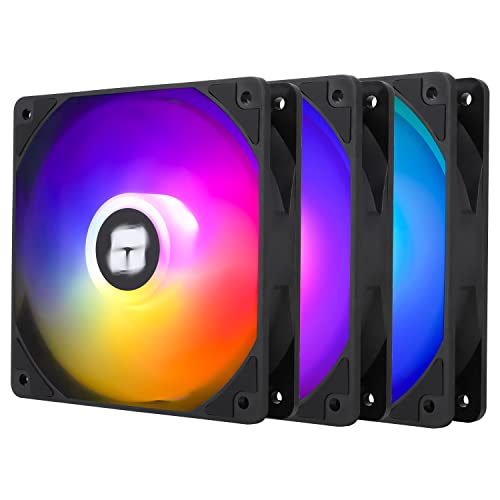


Top 3 picks at a glance
Quick Picks
As an Amazon Associate we earn from qualifying purchases at no extra cost to you.



| Product | Best for | Key spec from the title |
|---|---|---|
| Thermalright TL-C12C-S 5 Pack | Filling a whole case with matching fans | 120mm ARGB, 4-pin PWM, S-FDB bearing, up to 1550 RPM |
| UTLGAMENG 7 Pack 120mm ARGB | Large builds and radiator push-pull setups | 7 fans, 4 forward and 3 reverse, 28 ARGB LEDs, 1550 RPM |
| Cooler Master MF120 Lite ARGB 3-Pack | A brand-name trio focused on airflow | 120mm PWM, up to 1,750 RPM, ARGB lighting |
| DARKROCK Black F120 3in1 | Showpiece builds that want a mirror look | Infinite Mirror design, 24 LEDs, PWM, hydraulic HDB bearing |
| CORSAIR RS120 ARGB Triple Pack | Tidy wiring with a quiet profile | Daisy-chain connection, magnetic dome bearing, PWM |
| RGB 120mm 5 Pack with Hub | Simple control through an included hub | 5 ARGB PWM fans with fan hub and speed control |
The 6 Best Options
Thermalright TL-C12C-S 5 Pack
This listing is for the builder who wants every fan position filled with the same model. The title describes a 120mm ARGB fan with 4-pin PWM control, an S-FDB bearing, and a speed ceiling of 1550 RPM, sold as a five-pack. Five identical fans cover three front intakes, one rear exhaust, and one top exhaust in a typical mid-tower, which keeps both the look and the sound consistent. The same family also appears in a white version in the source group, which matters if your build follows a light theme, but the pack-size and color variants were not counted separately here. The shape of the offer is simple: a matched set at a sensible count, a bearing that the maker bothers to name, and PWM speed control. Builders who dislike a patchwork of mismatched fans will like that every blade, frame, and light ring comes from the same family, so the whole airflow path looks and sounds uniform. If your case has fewer mounts than five, consider a smaller pack from the same family instead.
- Five fans in one box cover a whole airflow layout without mixing models.
- 4-pin PWM lets the motherboard adjust speed to temperature.
- S-FDB bearing is named in the title, which points to a design aimed at quiet, long-lived operation.
- The title says nothing about daisy-chain wiring or an included hub, so confirm the cables in the full listing.
- Five fans may be more than a small case can use.
Skip it if your case has only two or three fan mounts, because you would pay for fans that never get installed. It differs from the UTLGAMENG seven-pack in that the Thermalright set keeps to a single blade direction, which is simpler to plan around. Next on the list is the larger kit that mixes blade directions.
UTLGAMENG 7 Pack 120mm ARGB PC Fans
This is the volume choice for a large case or a radiator setup. The title lists seven 120mm ARGB fans with PWM control, split into four forward and three reverse designs, 28 LEDs per fan, and a 1550 RPM limit. The reverse-blade fans are meant to sit where airflow is reversed, so the intake and exhaust faces of the case look uniform from the front. That solves a real cosmetic problem: with standard fans, the side that shows lights depends on the direction of airflow, and mixed orientations often look inconsistent. The kit is also a fit for a dual-radiator loop where fans sit on both sides of the radiator, or for an enthusiast who wants every opening in a large case covered. Because seven fans can draw a fair amount of power through their connectors, plan which headers or hub will feed them before you begin installing, and keep the extra leads tidy with cable ties.
- Seven fans cover a big case, a full-tower layout, or a push-pull radiator configuration.
- Reverse-blade fans keep the lit side facing outward on the exhaust side.
- 28 LEDs per fan promise dense lighting effects.
- Seven fans mean a lot of cables, so cable management takes planning.
- Lesser-known brand, so read the warranty terms before purchase.
Skip it if your case is small or you want a recognized name. Compared with the Thermalright pack, you gain two extra fans and reverse blades, and you take on more wiring. Compared with the Cooler Master trio that follows, this kit is the volume option where the other is the airflow-oriented brand option.
Cooler Master MF120 Lite ARGB 3-Pack
The Cooler Master set is the straightforward brand-name pick for a standard case. The title lists three 120mm PWM fans with ARGB lighting and a top speed of 1,750 RPM, described as high airflow. A three-pack matches the most common front-intake layout, so many mid-tower owners can fill the front of the case in a single purchase. The “Lite” label in the name means buyers should read the full description for details the title cuts off. This is the set for someone who wants to fill the front of a standard tower, trust a brand they already know, and move on to the rest of the build. The speed ceiling gives the system room to push air when a graphics card heats the case, while PWM control lets the fans slow down when the machine is idle. Anyone who plans to run a fan curve in the BIOS will find the wide speed range useful for balancing noise against temperatures.
- Highest listed top speed in the group at 1,750 RPM.
- Three fans suit a front intake without waste.
- A recognized cooling brand brings clearer support channels.
- Higher top speed can mean more noise at full tilt, so check how the fans behave under a fan curve.
- The title is cut off, so confirm cable and splitter details before relying on it.
Skip it if you need five or more fans or want a mirror-style look. It trades quantity for brand and speed headroom, and that trade is fair for a mid-tower. Next to the DARKROCK set, which targets looks, the Cooler Master targets airflow.
DARKROCK Black F120 3in1
This one is for the builder who cares about how the fans look when idle. The title mentions an Infinite Mirror design with 24 LED lights, PWM control, ARGB effects, and a hydraulic HDB bearing for low-noise operation. The mirror effect creates the illusion of lights receding into the fan, which looks striking behind a tempered glass panel. The 3in1 label suggests a three-fan set, but confirm contents in the full listing. Think of a desk setup with a glass side panel facing the user, where the interior is visible every day and the fans are the first thing a visitor sees. The black frame blends into most dark builds, and the hydraulic bearing named in the title fits the low-noise promise. The title gives no speed rating or airflow figure, so appearance is the case for this set, not performance claims.
- Infinite Mirror styling gives a depth effect that plain ring fans lack.
- Hydraulic HDB bearing is named alongside low-noise operation.
- PWM control and ARGB effects cover both speed and lighting.
- Mirror-style effects look best in a dim room and add little in a brightly lit one.
- Less brand recognition, so support terms matter.
Skip it if you want maximum airflow numbers, since the title does not state a top speed. This pick suits the person building for appearance first. Compared with the Corsair set that follows, it leans on visual drama, while the Corsair set leans on cable tidiness and quiet.
CORSAIR RS120 ARGB Triple Pack
The RS120 is the polished pick for a clean build. The title lists 120mm ARGB PWM fans, daisy-chain connection, low-noise operation, a magnetic dome bearing, and a triple-pack black finish. Daisy-chain wiring lets fans connect to each other in a line, so fewer cables reach the motherboard, which makes the back of the case tidier. Magnetic dome bearings are named in the title and relate to smooth, quiet operation. This set suits a minimalist build in a dark case where the goal is a calm interior with subtle lighting and no tangle of leads at the front of the tray. It also helps small-case owners, because every cable you remove is more room for airflow. Check the length of the daisy-chain leads against the distance between your fan mounts, since a short lead can force an awkward routing.
- Daisy-chain connection cuts the number of cables heading to the motherboard.
- Magnetic dome bearing is named alongside low-noise operation.
- Established brand with a consistent, understated black look.
- Three fans may not fill a larger case.
- Daisy-chained fans share one header, so check the header’s rating for the total load.
Skip it if you need to fill five or more positions on a tight budget. The single-pack version of this fan was left out of the list since it is the same product in a smaller quantity. Compared with the last listing, the Corsair set offers a tidier approach, while the hub-based kit offers broader control.
RGB 120mm 5 Pack with Hub
The last entry is the all-in-one kit with a controller hub. The title describes five 120mm ARGB PWM fans, a fan hub, speed control, PWM control, and forward-blade orientation in black, meant for computer cases. A hub gathers fan connections into one place and can simplify headers, especially in cases with several fans and only a few motherboard connectors. The listing lacks a recognizable brand name in the title, so buyers should check seller details and warranty. The kit is aimed at a person with an older case and a motherboard that has only one or two fan headers, since the hub gathers the fans into a single connection. It also appeals to a beginner who wants one purchase to cover every position and a single place to adjust speed. Because the title says the blades are forward-facing, the lit side will face the usual direction of airflow, which is fine for intake positions.
- Five fans and a hub in one kit make a complete package.
- Speed control and PWM control are both named in the title.
- Hub simplifies connecting many fans to few motherboard headers.
- No named brand, so support and quality are less predictable.
- The title does not state bearing type or top speed.
Skip it if you want a documented bearing type or a major brand. It is the budget-minded choice when you want many fans and one control point. Compared with the Thermalright five-pack at the top of the list, this kit adds a hub but gives up a named bearing and speed rating.
Why Buy RGB Case Fans
RGB lighting is optional, but case fans are not, so the real question is whether lit fans earn their place in your build. Three kinds of buyers tend to say yes.
People with a glass-panel case
If your case has a tempered glass side, bare fans look unfinished, and lit fans make the interior part of the design. A single color scheme across the fans can unify RAM lighting, the graphics card, and the cooler. That is a purely visual benefit, but for many builders it is the reason they open the case at all. Lighting also helps in practical ways: a lit interior makes it easier to see what you are doing when you add a drive late at night, and a quick glance at a still-spinning ring tells you a fan has not failed.
Upgraders replacing stock fans
Many cases ship with noisy or underperforming fans. Replacing them with PWM fans lets the system ramp up only when needed, which keeps idle noise down. Picking a pack that matches your fan count saves effort and ensures consistent behavior. Stock fans in prebuilt towers are often basic three-pin models that spin at one speed, so a PWM upgrade is one of the few changes that can make a PC both cooler and quieter at the same time.
Builders who want one place to control lighting
Addressable lighting can be driven from a motherboard header or a hub. If you want to change colors, speeds, and effects from one place, a kit with a hub or daisy-chain design reduces clutter and gives you a single control point.
How to Choose RGB Case Fans
Size and count
Most mid-tower cases take 120mm fans at the front, rear, and top, usually three at the front, one at the rear, and one or two on top. Count your mounting points first. A five-pack suits a standard tower, a three-pack a small one, and a seven-pack a large case or radiator setup. Check the frame thickness as well, because a thick fan can collide with a radiator or a tall memory heatsink, and confirm that the mounting holes follow the standard 120mm pattern.
Connector types: ARGB versus RGB
ARGB uses a three-pin 5-volt connector and allows each LED to change color separately. Standard RGB uses a four-pin 12-volt connector and sets one color at a time. Never plug a 12-volt RGB fan into a 5-volt ARGB header, because the mismatch can damage the LEDs. All six listings in this guide name ARGB lighting, and the fan motor itself uses a separate 4-pin PWM connector. That means every fan has two leads to place: one for motor control and one for lighting. Check the connector shape and the arrow marking on the lighting header before you push anything in, and if you are unsure, consult the motherboard manual. A typical addressable header supports a limited number of LEDs, so very long chains of lit fans can exceed it.
Speed range and PWM
PWM fans change speed in response to temperature, which is the best way to avoid constant noise. Look for a top speed between roughly 1,500 and 1,800 RPM in 120mm models; the group ranges from 1550 to 1,750 RPM where stated. A lower maximum usually means quieter operation, and a higher one means more airflow when you need it. The sensible habit is to set a curve that keeps the fans near the bottom of their range during web browsing and office work, then lets them climb only when the processor or graphics card gets hot. Fans that jump between speeds in short bursts are more annoying than fans at a steady moderate speed.
Bearing type
Bearings affect noise and lifespan. This group names S-FDB, hydraulic HDB, and magnetic dome designs. All three aim at quiet running, and buyers can compare warranty length as a rough indicator of the maker’s confidence. A bearing that is not named in the title is a question to answer before buying. Sleeve bearings, which budget fans often use, tend to lose smoothness sooner if a fan is mounted on its side, so a named, sealed design is a better sign for a case where fans hang vertically on the front panel. Remember that noise also depends on mounting, so rubber pads or soft screws can reduce vibration.
Airflow versus static pressure
Fans for open mesh fronts favor airflow, while fans for radiators and dense dust filters favor static pressure. Titles rarely state it, so use the product page. For a simple case with a mesh front, airflow-focused fans are the right choice. If your front panel is solid with narrow side vents, pressure-focused fans will do better, and you should pay attention to filters, since a clogged filter cuts airflow dramatically. Clean filters every few months and your fans will move more air at lower speeds. A practical threshold is to aim for slightly more intake than exhaust, which keeps dust from being pulled in through every gap in the case.
What to ignore and where cheap sets cut corners
Ignore LED counts as a quality signal; more LEDs do not mean better light. Cheap sets often skimp on cable length, hub quality, and warranty, and unnamed brands can have inconsistent color across a pack. Confirm the cable lengths will reach the headers in your case. Also look for a warranty period in the listing, a bag of spare screws or rubber mounts, and a clear statement of what is in the box, because multi-packs sometimes leave out the hub or the extension leads that the photos suggest.
Daisy-Chain, Hub or Direct Headers
The comparison most buyers of multi-packs face is how the fans connect, since it decides how tidy the build looks and how much control you have. Two sets of wires leave each fan, one for the motor and one for the lights, so the wiring method affects both airflow control and lighting control. The table compares the three approaches that appear in this group, using only what the titles describe.
| Factor | Daisy-chain (Corsair RS120) | Hub kit (5 Pack with Hub) | Direct to headers (most others) |
|---|---|---|---|
| Cables to the motherboard | Fewest | One or two from the hub | One set per fan |
| Control point | Single header | Hub with speed control | Per header |
| Best for | Neat builds | Many fans, few headers | Fine-grained tuning |
| Main risk | Header load limit | Unnamed brand quality | Cable clutter |
When daisy-chain wins
If you value a tidy interior and own a case with limited cable space, daisy-chain wiring is the cleanest approach. It reduces clutter, but the chain draws from one header, so you need to know how much load that header can handle. Daisy-chain sets also tend to move all fans together, so individual tuning is limited. For a three-fan front intake that you set once and forget, that limitation rarely matters, and the tidy result is worth it.
When a hub or direct headers win
A hub is the practical answer when you have many fans and few headers. Direct headers give the most control over each fan, and they suit buyers who want to build precise fan curves. Pick based on how much tinkering you plan to do. Builders who adjust their curves regularly and keep a close eye on temperatures will usually prefer direct headers, while people who set their fans once and forget them are happier with a hub or daisy-chain.
Setup, Compatibility and Upgrade Tips
What to check before you buy
Count the fan mounts in your case, check the number of ARGB and PWM headers on your motherboard, and look at the clearance around your CPU cooler and memory. Measure the distance from the fan to the nearest header, since short cables can force awkward routing. If your case has a fan controller or a built-in hub, find out whether it supports addressable lighting, because older cases only handle plain RGB. Finally, decide whether you want the lights to follow the motherboard software or a standalone remote, since that choice determines which cable goes where.
What to do first when installing
Plan the airflow before mounting anything: intake at the front, exhaust at the rear and top. Install the fans with the arrow on the frame pointing the right direction, route cables behind the tray, and connect PWM and ARGB leads to their matching headers. Then set a gentle fan curve in the BIOS. A good routine is to install the front fans first, connect everything, power the system on with the side panel off, and watch that each fan spins and lights up before you tidy the leads. Fixing a loose connector is far easier at that stage than after you have tied everything down.
Common compatibility traps
The usual problems are mixing 12-volt RGB with 5-volt ARGB, overloading a single header with a long chain, buying fans with cables too short, and installing fans with the airflow direction reversed. Test the lighting on the bench before closing the case, and keep the manuals for the lighting control. Another trap is a tall memory heatsink or a large air cooler that blocks the fan position next to the processor, so check the clearance on both sides before ordering a seven-pack for a compact case.
Which One Fits Your Situation
You have a standard mid-tower with five fan positions
Pick the Thermalright TL-C12C-S 5 Pack. It fills every position with a matching model, so you buy once, mount everything in an evening, and never worry about mismatched colors or noise levels between fans.
You have a big case or a radiator and want matching looks
Pick the UTLGAMENG 7 Pack, whose reverse-blade fans keep the lit side facing the right way.
You want a clean, quiet front intake from a known brand
Pick the CORSAIR RS120 ARGB Triple Pack for daisy-chain wiring, or the Cooler Master MF120 Lite for higher speed headroom.
You want the most dramatic look behind glass
Pick the DARKROCK Black F120 3in1. Its mirror-style design is the most visually distinct in the group, and a trio is enough to cover the front of the case where the glass panel shows the most.
Common Mistakes
- Plugging a 12-volt RGB fan into a 5-volt ARGB header.
- Buying more fans than the case has mounting points for.
- Installing fans with the airflow direction reversed.
- Chaining too many fans to a single motherboard header.
- Choosing by LED count and ignoring bearing type and speed.
- Counting the same fan in different pack sizes as different products.
Related guides
- Gaming Laptop Battery Draining While Plugged In Fix
- Graphics Cards For Low Wattage Power Supplies
- How To Stop Laptop Thermal Throttling In Software
Frequently Asked Questions
How many case fans does a typical PC need?
Most mid-tower builds work well with three intake fans at the front and one or two exhaust fans at the rear and top. Add more only if your case has mounts for them. Balanced intake and exhaust matter more than raw fan count, so two good intakes and one exhaust can beat a crowded layout with fans fighting each other.
What is the difference between ARGB and RGB?
ARGB is addressable, so each LED can show a different color and effect, and it uses a three-pin 5-volt connector. RGB shows one color at a time and uses a four-pin 12-volt connector.
Do PWM fans run quieter than non-PWM fans?
They can, because they adjust speed in response to temperature. Quiet idle and louder load behavior is the main advantage of PWM control.
Are reverse-blade fans necessary?
They are optional. They help when you want the lit side of the fans to face outward on the exhaust side. Without them, some exhaust fans show their plain back.
Will these fans fit a radiator?
The 120mm size matches common radiator fan mounts, but check static pressure and thickness. For a radiator, confirm the product page rather than relying on the title.
Is a fan hub worth having?
It is useful when you have more fans than motherboard headers, because it combines connections and gives one control point. If your motherboard has enough headers, you can go without it. Remember that a hub still needs power from the supply and a signal lead to the board, so read how the included cables connect before assuming it simplifies your layout.
Final Words
The best RGB case fans are the ones that fit your case, plug into the headers you have, and run quietly when the system is idle. Mid-tower owners will find the Thermalright five-pack and the Cooler Master or Corsair trios the most natural fits, while large builds benefit from the seven-pack and anyone chasing a visual statement should look at the DARKROCK set. Count your mounts, match the connector types, and decide how tidy you want the wiring before you choose a pack. Do that homework first and the lighting will take care of itself, because a quiet, well-ventilated case with matching fans looks good with almost any color scheme.