“Surveillance” implies more than a single camera on a shelf. People who search for the best home surveillance cameras usually want continuous coverage of several angles: the driveway, the back gate, the side yard, and a few key rooms. That changes the buying questions. You are choosing a system architecture as much as a camera, and the main fork is between a wired kit with a recorder and a set of wireless cameras that run on batteries or solar panels.
This roundup covers both approaches, plus a few indoor units that fill in gaps. A wired recorder with a hard drive gives continuous footage and no monthly fees but demands cable runs. Wireless and solar kits install in an afternoon but depend on Wi-Fi strength and sunlight. If you are planning a property upgrade in 2026, decide first how many angles you need and whether you are willing to drill and pull cable, because that choice narrows the field faster than any resolution figure.
Top 3 picks at a glance
Quick Picks
As an Amazon Associate we earn from qualifying purchases at no extra cost to you.


| Product | Best for | Key spec taken from the product title |
|---|---|---|
| GMK 4-Pack System | Wireless outdoor coverage of several angles | 2K, 4 cameras, IP65, color night vision |
| Blink Outdoor 4 | Low-maintenance battery cameras | 1080p, two-year battery life, Sync Module Core |
| aosu D1 Classic 4-Cam Kit | Solar-powered, no-subscription coverage | 2K, solar, 32GB built-in storage, 360-degree auto tracking |
| Anona 4K Indoor Camera | Detailed indoor monitoring | 4K UHD, 360-degree pan-tilt, Wi-Fi 6 |
| Tapo C100 1080P | A single basic indoor view | 1080P, wired, cloud and SD card storage |
| ANNKE 3K Lite Wired System | Continuous wired recording | 8 x 2MP cameras, 1TB HDD, AI human/vehicle detection |
| ELYSOO Solar System | Solar kits with included local storage | 2K/4MP, 64GB local storage, dual-band Wi-Fi |
| GNCC 5G 4-Pack | Indoor pet and room coverage | 4 cameras, dual-band Wi-Fi, 360 PTZ auto-tracking |
How to Choose
Wired recorder versus wireless cameras
A wired system with a DVR, such as the ANNKE kit, records continuously to a hard drive and does not depend on Wi-Fi for recording. That reliability is why professional installers favor it. Wireless cameras are easier to place and move, but they rely on your network and need charging or solar light. If your property has a few hard-to-reach spots or you rent, wireless is practical. If you own the home and want continuous recording, a wired system pays off over time.
Power: battery, solar, or cable
Battery cameras like the Blink list multi-year battery life, though real life varies with how often they trigger. Solar units extend runtime if the panel gets several hours of direct light daily, which a shaded wall may not provide. Wired power removes the question entirely. Check where outlets and sunlight actually are before you pick a camera type, and keep in mind that a camera on a north-facing wall may not charge well.
Storage and subscription costs
Look for local storage, whether it is a hard drive, built-in memory such as 32GB or 64GB, or a card slot. A listing that says no subscription is required is a meaningful signal. Built-in storage fills over time, so confirm whether older clips are overwritten. If you rely on a cloud plan, factor the recurring fee into the total cost of ownership across several years.
Detection, weatherproofing, and coverage
For outdoor use, look for IP65 or IP67 ratings, which indicate resistance to water and dust. Human and vehicle detection cuts false alerts from swaying branches. Resolution between 2K and 4K helps identify details, but field of view and night performance matter just as much. For indoor rooms, 360-degree pan-tilt units fill gaps, though they are not a substitute for fixed outdoor coverage.
Think in terms of zones rather than camera counts. Entry points come first: the front door, the back door, and any ground-floor window or garage door. Next come approach paths, such as the driveway and side gate. Cameras aimed at open lawns generate lots of motion alerts and little useful footage. A common approach is to start with two or three well-placed units, live with the alert volume for a few weeks, and then add cameras where blind spots show up.
Finally, think about who will watch the footage. A system that sends an alert to a phone every few minutes teaches the household to ignore it. Person and vehicle filters, activity zones, and scheduled quiet hours are worth more than a resolution upgrade if your alerts are already noisy.
The 8 Best Options
GMK 4-Pack Camera System
The GMK kit lists four wireless outdoor cameras with 2K video, VicoHome app support, motion detection, color night vision, two-way talk, and IP65 waterproofing. It is a sensible way to cover a front door, a driveway, and the sides of a house in one purchase. Pack size is the draw: four cameras means no gaps at the corners.
- Strength: four 2K outdoor cameras provide whole-property coverage
- Strength: IP65 spec and color night vision suit outdoor placement
- Trade-off: wireless units still need power and Wi-Fi, which the listing leaves vague
Skip it if you want a recorder-based system that records without Wi-Fi.
Blink Outdoor 4
Blink Outdoor 4 lists a wireless smart security camera with two-year battery life, 1080p HD day and infrared night live view, two-way talk, and a Sync Module Core included. It is a set-and-forget choice for people who dislike recharging and want a recognizable ecosystem. The listing positions it for easy installation.
- Strength: two-year battery life reduces maintenance
- Strength: the included Sync Module Core simplifies setup
- Trade-off: 1080p is a lower resolution than the 2K and 4K kits here
Skip it if you want sharper detail or continuous recording.
aosu D1 Classic 4-Cam Kit
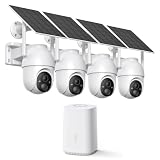
aosu lists a four-camera solar-powered kit with no subscription required, 32GB of built-in storage, 360-degree auto tracking, and 2K video. The solar approach and local storage together remove two common pain points: recharging and monthly fees. It suits a larger property with sunny walls.
- Strength: solar power plus built-in storage avoids cables and subscriptions
- Strength: 360-degree auto tracking follows movement across a wide area
- Trade-off: solar charging depends on sun exposure at each mounting spot
Skip it if your camera locations are shaded for most of the day.
Anona 4K UHD Indoor Camera
Anona lists 4K UHD resolution, a phone app, 360-degree pan-tilt, 5G and 2.4G dual-band Wi-Fi 6, auto-tracking, and person, pet, and baby crying detection. It is an indoor camera aimed at pets, babies, and general room monitoring. The 4K label is the highest resolution in the roundup.
- Strength: 4K resolution with auto-tracking offers detailed indoor coverage
- Strength: dual-band Wi-Fi 6 helps with connection stability
- Trade-off: it is an indoor unit and does not serve as outdoor surveillance
Skip it if you need exterior coverage.
Tapo C100 1080P Indoor Camera
The Tapo C100 lists 1080P video, a wired connection, motion detection, two-way audio, a siren, night vision, and both cloud and SD card storage. It is a simple single-room camera that doubles as a baby or dog monitor. Within a larger system it makes a low-key add-on.
- Strength: SD card storage plus a siren covers basic needs
- Strength: wired power avoids battery maintenance
- Trade-off: 1080P detail is modest next to the 2K and 4K options
Skip it if you need outdoor protection or multi-camera coverage from one box.
ANNKE 3K Lite Wired Security Camera System
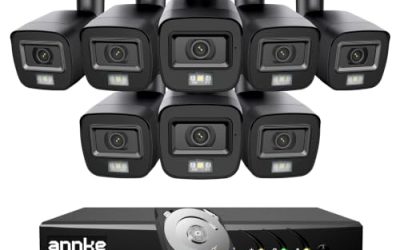
ANNKE lists a wired outdoor system with eight 2MP cameras, a 1TB hard drive, AI human and vehicle detection, an 8-channel H.265+ DVR, and IP67 weatherproofing. This is the true surveillance-system option here: continuous recording to a local drive with serious camera count.
- Strength: 1TB HDD and DVR record continuously without relying on Wi-Fi
- Strength: eight cameras and IP67 housings cover a large property
- Trade-off: wired installation means cable runs and more setup effort
Skip it if you rent or cannot drill and route cable.
ELYSOO 2K Solar Home Security System
ELYSOO lists a 2K 4MP system with 2.4G and 5GHz Wi-Fi, 64GB of local storage included, solar-powered wireless outdoor cameras, and IP65 weather resistance. It targets buyers who want wire-free outdoor cameras with local recording right out of the box.
- Strength: 64GB local storage is included, so recording starts without extra gear
- Strength: dual-band Wi-Fi support adds flexibility for connection
- Trade-off: solar charging needs adequate daily sunlight
Skip it if the mounting spots get little direct sun.
GNCC 5G 4-Pack Indoor Cameras
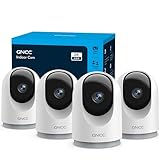
The GNCC four-pack lists dual-band 5G Wi-Fi, a phone app, 360-degree PTZ auto-tracking for pets, dogs, cats, and nannies, and motion alerts. It fits indoor needs: living rooms, nurseries, and play areas. Four cameras make it easy to cover many rooms.
- Strength: four 360-degree cameras provide wide indoor coverage
- Strength: dual-band Wi-Fi support suits modern routers
- Trade-off: indoor-only, so it cannot replace outdoor surveillance
Skip it if your priority is watching the exterior of the property.
Which One Fits Your Situation
You own a large property and want continuous recording
The ANNKE 3K Lite wired system is built for that job, with eight cameras and a 1TB drive. Plan the cable runs before ordering.
You rent and cannot drill
The aosu D1 solar kit or the ELYSOO solar system avoid wiring. If you prefer battery power, the Blink Outdoor 4 offers a long listed battery life.
You want four cameras for a mid-sized house
The GMK 4-Pack lists 2K video and IP65 protection for outdoor use, giving a balanced entry into multi-camera coverage.
You need to watch the inside as well
Combine an outdoor kit with the Anona 4K for detailed room coverage, or the GNCC four-pack for several rooms at once.
Common Mistakes
- Choosing solar cameras for walls that receive little direct sunlight.
- Assuming a wireless camera needs no Wi-Fi coverage at the mounting spot.
- Overlooking recurring subscription fees when comparing kits.
- Buying indoor cameras and mounting them outside without a weatherproof spec.
- Counting camera resolution but ignoring field of view and night performance.
Related guides
- Gaming Laptop Battery Draining While Plugged In Fix
- How To Stop Laptop Thermal Throttling In Software
- Gaming Laptop For High School Students
Frequently Asked Questions
Is a wired system better than wireless?
For continuous recording and reliability, wired systems usually win. Wireless is easier to install and move, which matters if you rent or want flexibility.
Do solar cameras work in winter?
They depend on daily sunlight, so short or cloudy days reduce charging. Mount panels where they get direct light and check the battery levels during darker months. Keep the panel surface clear of leaves, snow, and dust, since even partial shading can cut the charge noticeably.
What does IP65 or IP67 mean?
These ratings describe protection against dust and water. Higher numbers mean greater resistance, and IP65 or above is a reasonable baseline for outdoor placement.
How much storage do I need?
It depends on resolution and recording style. Continuous recording on a 1TB drive lasts longer than event-only clips on a small card, so match the storage to how you plan to record. Also check whether the system overwrites the oldest footage automatically, and how many days of history that gives you before important clips disappear.